


Page 111 - 9780077418427.pdf
P. 111
/Users/user-f465/Desktop
          tiL12214_ch04_085-114.indd Page 88  9/1/10  9:37 PM user-f465
          tiL12214_ch04_085-114.indd Page 88  9/1/10  9:37 PM user-f465                                                 /Users/user-f465/Desktop


                                                                          molecular theory, molecules of ammonia leave the bottle and
                    TABLE 4.1
                                                                          bounce around among the other molecules making up the air
                    The shape and volume characteristics of solids, liquids, and   until they are everywhere in the room, slowly becoming more
                    gases are reflections of their molecular arrangements*
                                                                          evenly distributed. The ammonia molecules diff use, or spread,


                                  Solids       Liquids        Gases       throughout the room. The ammonia odor diff uses throughout
                                                                          the room faster if the air temperature is higher and slower if
                    Shape         Fixed        Variable       Variable    the air temperature is lower. This would imply a relationship

                    Volume        Fixed        Fixed          Variable      between the temperature and the speed at which molecules
                                                                          move about.
                   *These characteristics are what would be expected under ordinary temperature and   The relationship between the temperature of a gas and
                   pressure conditions on the surface of Earth.
                                                                          the motion of molecules was formulated in 1857 by Rudolf
                                                                          Clausius. He showed that the temperature of a gas is pro-
                                                                          portional to the average kinetic energy of the gas molecules.

                   equilibrium position. The masses of these molecules and the   This means that ammonia molecules have a greater average
                   spacing between them determine the density of the solid. Th e   velocity at a higher temperature and a slower average veloc-
                   hardness of a solid is the resistance of a solid to forces that tend   ity at a lower temperature. This explains why gases diffuse at
                   to push its molecules farther apart.                   a greater rate at higher temperatures. Recall, however, that
                      Liquids have molecules that are not confined to an equilib-  kinetic energy involves the mass of the molecules as well as

                                                                                                 2

                   rium position as in a solid. The molecules of a liquid are close   their velocity (KE = 1/2 mv ). It is the average kinetic energy
                   together and bound by cohesive forces that are not as strong   that is proportional to the temperature, which involves the
                   as in a solid. This permits the molecules to move from place to   molecular mass as well as the molecular velocity. Whether

                   place within the liquid. The molecular forces are strong enough   the kinetic energy is jiggling, vibrating, rotating, or moving

                   to give the liquid a definite volume but not strong enough to   from place to place, the temperature of a substance is a mea-

                   give it a definite shape. Thus, a liter of water is always a liter of   sure of the average kinetic energy of the molecules making up


                   water (unless it is under tremendous pressure) and takes the   the substance (Figure 4.4).

                   shape of the container holding it. Because the forces between   The kinetic molecular theory explains why matter gener-
                   the molecules of a liquid are weaker than the forces between   ally expands with increased temperatures and contracts with
                   the molecules of a solid, a liquid cannot support the stress of   decreased temperatures. At higher temperatures, the molecules

                   a rock placed on it as a solid does. The liquid molecules fl ow,   of a substance move faster, with increased agitation; therefore,
                   rolling over one another as the rock pushes its way between   they move a little farther apart, thus expanding the substance.
                   the molecules. Yet, the molecular forces are strong enough to   As the substance cools, the motion slows, and the molecular
                   hold the liquid together, so it keeps the same volume.  forces are able to pull the molecules closer together, thus con-
                      Gases are composed of molecules with weak cohesive forces   tracting the substance.

                   acting between them. The gas molecules are relatively far apart
                   and move freely in a constant, random motion that is changed

                   often by collisions with other molecules. Gases therefore have
                   neither fixed shapes nor fi xed volumes.

                      Gases that are made up of positive ions and negative elec-
                   trons are called plasmas. Plasmas have the same properties as
                   gases but also conduct electricity and interact strongly with

                   magnetic fields. Plasmas are found in fluorescent and neon

                   lights on Earth, the Sun, and other stars. Nuclear fusion occurs
                   in plasmas of stars (see chapter 14), producing starlight as well   Increasing numbers
                   as sunlight. Plasma physics is studied by scientists in their
                     attempt to produce controlled nuclear fusion.
                      There are other distinctions between the phases of mat-

                   ter. Th e term vapor is sometimes used to describe a gas that
                   is  usually in the liquid phase. Water vapor, for example, is the
                   gaseous form of liquid water. Liquids and gases are collectively

                   called fl uids because of their ability to flow, a property that is
                   lacking in most solids.                                              250        500        750       1,000
                                                                                                Speed (m/s)

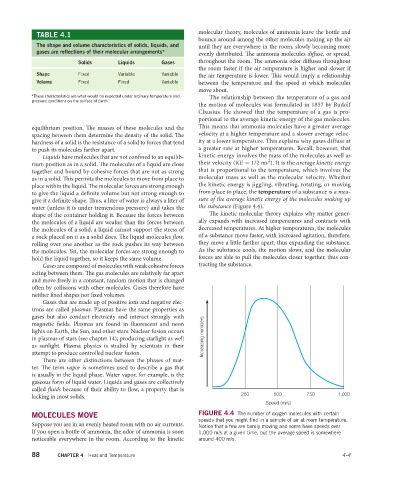
                   MOLECULES MOVE                                         FIGURE 4.4  The number of oxygen molecules with certain
                                                                          speeds that you might find in a sample of air at room temperature.
                   Suppose you are in an evenly heated room with no air currents.   Notice that a few are barely moving and some have speeds over
                   If you open a bottle of ammonia, the odor of ammonia is soon   1,000 m/s at a given time, but the average speed is somewhere
                     noticeable everywhere in the room. According to the kinetic   around 400 m/s.

                   88      CHAPTER 4  Heat and Temperature                                                                4-4

