


Page 113 - 9780077418427.pdf
P. 113
/Users/user-f465/Desktop
          tiL12214_ch04_085-114.indd Page 90  9/1/10  9:37 PM user-f465
          tiL12214_ch04_085-114.indd Page 90  9/1/10  9:37 PM user-f465                                                 /Users/user-f465/Desktop


                   so the liquid cannot normally return to the bulb. Th us, the             F        C        K
                                                                                  Boiling
                   thermometer shows the highest reading, even if the tempera-
                                                                                  point of   212°F     100°C    373 K
                   ture it measures has fluctuated up and down during the read-   water

                   ing. The liquid must be forced back into the bulb by a small

                   swinging motion, bulb end down, then sharply stopping the
                   swing with a snap of the wrist. The inertia of the mercury in

                   the bore forces it past the constriction and into the bulb. Th e   Freezing
                   fever thermometer is then ready to use again.                  point of   32°F      0°C      273 K
                                                                                  water
                      Today, scientists have developed a different type of ther-

                                                                                             0°F       –18°C    255 K
                   mometer and a way around the problems of using a glass
                   mercury fever thermometer. This new approach measures the

                                                                                  Absolute
                   internal core temperature by quickly reading infrared radia-   zero       –459°F    –273°C   0 K
                   tion from the eardrum. All bodies with a temperature above
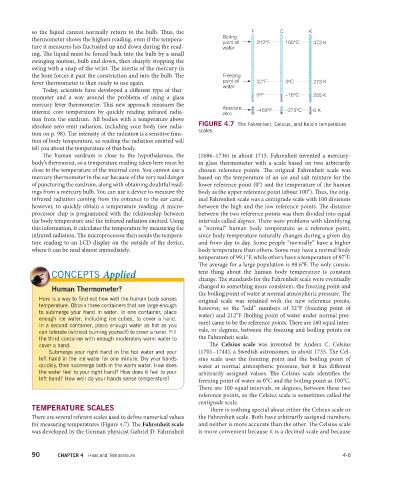
                   absolute zero emit radiation, including your body (see radia-  FIGURE 4.7  The Fahrenheit, Celsius, and Kelvin temperature
                                                                          scales.
                   tion on p. 98 ). The intensity of the radiation is a sensitive func-

                   tion of body temperature, so reading the radiation emitted will
                   tell you about the temperature of that body.

                      The human eardrum is close to the hypothalamus, the   (1686–1736) in about 1715. Fahrenheit invented a mercury-
                   body’s thermostat, so a temperature reading taken here must be   in-glass thermometer with a scale based on two arbitrarily

                   close to the temperature of the internal core. You cannot use a   chosen reference points. The original Fahrenheit scale was
                   mercury thermometer in the ear because of the very real danger   based on the temperature of an ice and salt mixture for the
                   of puncturing the eardrum, along with obtaining doubtful read-  lower reference point (0°) and the temperature of the human

                   ings from a mercury bulb. You can use a device to measure the   body as the upper reference point (about 100°). Thus, the orig-
                   infrared radiation coming from the entrance to the ear canal,   inal Fahrenheit scale was a  centigrade scale with  100 divisions
                   however, to quickly obtain a temperature reading. A micro-  between the high and the low reference points. Th e distance
                     processor chip is programmed with the relationship between   between the two reference points was then divided into equal

                   the body temperature and the infrared  radiation emitted. Using   intervals called degrees. There were problems with identifying
                   this information, it calculates the temperature by measuring the   a  “normal” human body temperature as a reference point,
                   infrared radiation. The microprocessor then sends the tempera-  since body temperature naturally changes during a given day

                   ture reading to an LCD display on the outside of the device,   and from day to day. Some people “normally” have a higher
                   where it can be read almost immediately.               body temperature than others. Some may have a normal body
                                                                          temperature of 99.1°F, while others have a temperature of 97°F.
                                                                          The average for a large population is 98.6°F. The only consis-


                         CONCEPTS Applied                                 tent thing about the human body temperature is constant
                                                                          change. The standards for the Fahrenheit scale were eventually

                                                                          changed to something more consistent, the freezing point and
                         Human Thermometer?
                                                                          the boiling point of water at normal atmospheric pressure. Th e
                     Here is a way to find out how well the human body senses   original scale was retained with the new reference points,
                       temperature. Obtain three containers that are large enough   however, so the “odd” numbers of 32°F (freezing point of
                     to submerge your hand in water. In one container, place   water) and 212°F (boiling point of water  under normal pres-
                     enough ice water, including ice cubes, to cover a hand.

                     In a second  container, place enough water as hot as you   sure) came to be the reference points. There are  180 equal inter-
                     can  tolerate  (without burning yourself) to cover a hand. Fill   vals, or degrees, between the freezing and boiling points on
                     the third container with enough moderately warm water to   the Fahrenheit scale.
                     cover a hand.                                           Th e  Celsius scale was invented by Anders C. Celsius
                        Submerge your right hand in the hot water and your   (1701–1744), a Swedish astronomer, in about 1735. Th e Cel-
                     left hand in the ice water for one minute. Dry your hands   sius scale uses the freezing point and the boiling point of
                     quickly, then submerge both in the warm water. How does   water at normal atmo spheric pressure, but it has diff erent
                     the water feel to your right hand? How does it feel to your   arbitrarily assigned values. The Celsius scale identifi es  the

                     left hand? How well do your hands sense temperature?  freezing point of water as 0°C and the boiling point as 100°C.

                                                                          There are 100 equal intervals, or degrees, between these two
                                                                          reference points, so the Celsius scale is sometimes called the
                                                                          centigrade scale.
                   TEMPERATURE SCALES                                        There is nothing special about either the Celsius scale or

                   There are several referent scales used to define numerical values   the Fahrenheit scale. Both have arbitrarily assigned numbers,


                   for measuring temperatures (Figure 4.7). Th e  Fahrenheit scale   and neither is more accurate than the other. The Celsius scale

                   was developed by the German physicist Gabriel D. Fahrenheit   is more convenient because it is a decimal scale and because

                   90      CHAPTER 4  Heat and Temperature                                                                4-6

