


Page 112 - 9780077418427.pdf
P. 112
/Users/user-f465/Desktop
          tiL12214_ch04_085-114.indd Page 89  9/1/10  9:37 PM user-f465
          tiL12214_ch04_085-114.indd Page 89  9/1/10  9:37 PM user-f465                                                 /Users/user-f465/Desktop


                              CONCEPTS Applied                                         Room temperature
                                                                                            Iron
                              Moving Molecules
                          Blow up a small balloon and make a knot in the neck so
                          it will not leak air. Note the size of the balloon. Place the
                          balloon in the freezer part of a refrigerator for an hour,           Brass
                          then again note the size of the balloon. Immediately place   A
                          the balloon in direct sunlight for an hour and again note the
                          size of the balloon. Explain your observations by using the   When heated
                          kinetic molecular theory.
                                                                                            Iron


                                                                                               Brass
                         4.2 TEMPERATURE

                       If you ask people about the temperature, they usually respond
                       with a referent (“hotter than the summer of ’89”) or a number
                       (“68°F or 20°C”). Your response, or feeling, about the referent   B
                       or number depends on a number of factors, including a rela-
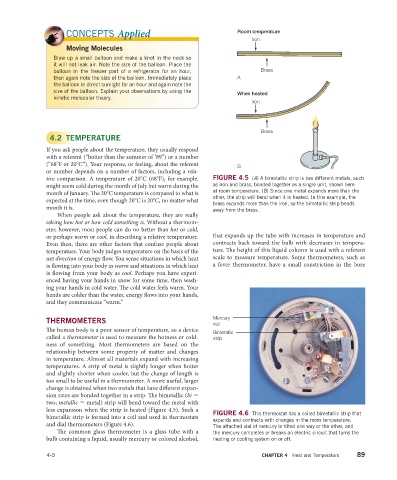
                       tive comparison. A temperature of 20°C (68°F), for example,   FIGURE 4.5  (A) A bimetallic strip is two different metals, such
                       might seem cold during the month of July but warm during the   as iron and brass, bonded together as a single unit, shown here
                       month of January. Th e 20°C temperature is compared to what is   at room temperature. (B) Since one metal expands more than the
                                                                               other, the strip will bend when it is heated. In this example, the
                       expected at the time, even though 20°C is 20°C, no matter what
                                                                               brass expands more than the iron, so the bimetallic strip bends
                       month it is.
                                                                               away from the brass.
                           When people ask about the temperature, they are really
                       asking how hot or how cold something is. Without a thermom-
                       eter, however, most people can do no better than hot or cold,
                       or perhaps warm or cool, in describing a relative temperature.   that  expands up the tube with increases in temperature and
                       Even then, there are other factors that confuse people about   contracts back toward the bulb with decreases in tempera-

                       temperature. Your body judges temperature on the basis of the   ture. The height of this liquid column is used with a referent

                       net direction of energy flow. You sense situations in which heat   scale to measure temperature. Some thermometers, such as

                       is flowing into your body as warm and situations in which heat   a fever thermometer, have a small constriction in the bore

                       is flowing from your body as cool. Perhaps you have experi-
                       enced having your hands in snow for some time, then wash-
                       ing your hands in cold water. The cold water feels warm. Your

                       hands are colder than the water, energy flows into your hands,

                       and they communicate “warm.”
                       THERMOMETERS                                            Mercury
                                                                               vial
                       The human body is a poor sensor of temperature, so a device

                                                                               Bimetallic
                       called a thermometer is used to measure the hotness or cold-  strip
                       ness of something. Most thermometers are based on the
                       relationship between some property of matter and changes
                       in temperature. Almost all materials expand with increasing
                       temperatures. A strip of metal is slightly longer when hotter
                       and slightly shorter when cooler, but the change of length is
                       too small to be useful in a thermometer. A more useful, larger
                       change is obtained when two metals that have diff erent expan-
                       sion rates are bonded together in a strip. The bimetallic (bi =

                       two; metallic = metal) strip will bend toward the metal with
                       less expansion when the strip is heated (Figure 4.5). Such a
                                                                               FIGURE 4.6  This thermostat has a coiled bimetallic strip that
                       bimetallic strip is formed into a coil and used in thermostats
                                                                               expands and contracts with changes in the room temperature.
                       and dial thermometers (Figure 4.6).                     The attached vial of mercury is tilted one way or the other, and

                           The common glass thermometer is a glass tube with a   the mercury completes or breaks an electric circuit that turns the
                       bulb containing a liquid, usually mercury or colored alcohol,   heating or cooling system on or off.
                       4-5                                                                     CHAPTER 4  Heat and Temperature   89

