


Page 115 - 9780077418427.pdf
P. 115
/Users/user-f465/Desktop
          tiL12214_ch04_085-114.indd Page 92  9/1/10  9:37 PM user-f465
          tiL12214_ch04_085-114.indd Page 92  9/1/10  9:37 PM user-f465                                                 /Users/user-f465/Desktop


                           A Closer Look


                           Goose Bumps and Shivering
                        or an average age and minimal level   Contraction of a tiny muscle attached to   core to be conducted through the skin, then
                     Fof activity, many people feel comfort-  the base of the hair shaft makes a tiny knot,   radiated away. It also causes some people to
                     able when the environmental temperature   or bump, on the skin. These are sometimes   have a red blush from the increased blood
                     is about 25°C (77°F). Comfort at this tem-  called “goose bumps” or “chill bumps.”   flow in the skin. This action increases con-
                     perature probably comes from the fact that   Although goose bumps do not significantly   duction through the skin, but radiation
                     the body does not have to make an effort to   increase insulation in humans, the equiva-  alone provides insufficient cooling at envi-
                     conserve or get rid of heat.       lent response in birds and many mammals   ronmental temperatures above about 29°C
                        Changes that conserve heat in the body   elevates feathers or hairs and greatly enhances   (84°F). At about this temperature, sweating
                     occur when the temperature of the air and   insulation.               begins and perspiration pours onto the skin
                     clothing directly next to a person becomes   Further cooling after the blood vessels   to provide cooling through evaporation. The
                     less than 20°C or if the body senses rapid   in the skin have been constricted results   warmer the environmental temperature,
                     heat loss. First, blood vessels in the skin are   in the body taking yet another action. The   the greater the rate of sweating and cooling
                     constricted. This slows the flow of blood   body now begins to produce  more heat,   through evaporation.
                     near the surface, which reduces heat loss   making up for heat loss through involun-  The actual responses to a cool, cold,
                     by conduction. Constriction of skin blood   tary muscle contractions called  shivering.   warm, or hot environment are influenced
                     vessels reduces body heat loss but may also   The greater the need for more body heat,   by a person’s activity level, age, and gender,
                     cause the skin and limbs to become signifi-  the greater the activity of shivering.  and environmental factors such as relative
                     cantly cooler than the body core tempera-  If the environmental temperatures rise   humidity, air movement, and combinations
                     ture (producing cold feet, for example).  above about 25°C (77°F), the body triggers   of these factors. Temperature is the single
                        Sudden heat loss, or a chill, often initi-  responses that cause it to  lose heat. One   most important comfort factor. But when
                     ates another heat-saving action by the body.   response is to make blood vessels in the   the temperature is high enough to require
                     Skin hair is pulled upright, erected to slow   skin larger, which increases blood flow in   perspiration for cooling, humidity becomes
                     heat loss to cold air moving across the skin.   the skin. This brings more heat from the   an important factor in human comfort.


                                                                          meteor enters Earth’s atmosphere and is heated so much from
                    4.3 HEAT
                                                                          the compression that it begins to glow, resulting in the fi reball
                   Suppose you have a bowl of hot soup or a cup of hot coff ee that   and smoke trail of a “falling star.”
                   is too hot. What can you do to cool it? You can blow across the   To distinguish between the energy of the object and the
                   surface, which speeds evaporation and therefore results in cool-    energy of its molecules, we use the terms external and internal
                   ing, but this is a slow process. If you were in a hurry, you would
                   probably add something cooler, such as ice. Adding a cooler
                   substance will cool the hot liquid.

                      You know what happens when you mix fluids or objects
                   with a higher temperature with fluids or objects with a lower

                   temperature. The warmer-temperature object becomes cooler,

                   and the cooler-temperature object becomes warmer. Eventually,   Molecule is pulled
                   both will have a temperature somewhere between the warmer   from home position,
                                                                           stretching bonds

                   and the cooler. This might suggest that something is moving
                   between the warmer and cooler objects, changing the tempera-
                   ture. What is doing the moving?

                          The relationship that exists between energy and tempera-
                                                                                                               Molecule is pulled
                   ture will help explain the concept of heat, so we will consider
                                                                                                               back, gaining
                   it first. If you rub your hands together a few times, they will                             vibrational kinetic

                   feel a little warmer. If you rub them together vigorously for a                             energy
                   while, they will feel a lot warmer, maybe hot. A temperature
                   increase takes place anytime mechanical energy causes one

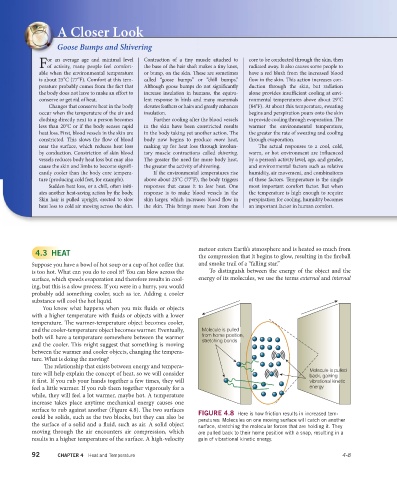
                   surface to rub against another (Figure 4.8). The two surfaces
                                                                          FIGURE 4.8  Here is how friction results in increased tem-
                   could be solids, such as the two blocks, but they can also be
                                                                          peratures: Molecules on one moving surface will catch on another

                   the surface of a solid and a fluid, such as air. A solid object   surface, stretching the molecular forces that are holding it. They
                   moving through the air encounters air compression, which   are pulled back to their home position with a snap, resulting in a
                   results in a higher temperature of the surface. A high-velocity   gain of vibrational kinetic energy.
                   92      CHAPTER 4  Heat and Temperature                                                                4-8

