


Page 127 - 9780077418427.pdf
P. 127
/Users/user-f465/Desktop
          tiL12214_ch04_085-114.indd Page 104  9/1/10  9:38 PM user-f465
          tiL12214_ch04_085-114.indd Page 104  9/1/10  9:38 PM user-f465                                                /Users/user-f465/Desktop


                         CONCEPTS Applied                                               A                         B
                                                                                                                Weight
                         Why Is It Called a “Pop” Can?
                                                                                                     Piston
                     Obtain two empty, clean pop cans, a container of ice water
                     with ice cubes, and a container of boiling water. You might
                     want to “dry run” this experiment to make sure of the
                     procedure before actually doing it.                              Weight
                        Place about 2 cm of water in a pop can and heat
                     it on a stove until the water boils and you see evidence   Piston
                     of steam  coming from the opening. Using tongs, quickly                                      Air
                     invert the can halfway into a container of ice water. Note
                     how much water runs from the can as you remove it from
                     the ice water.                                                     Air
                        Repeat this procedure, this time inverting the can
                     halfway into a container of boiling water. Note how much
                     water runs from the can as you remove it from the boiling
                     water.
                        Explain your observations in terms of the kinetic
                     molecular theory, evaporation, and condensation. It is also
                     important to  explain any differences observed between
                     what happened to the two pop cans.
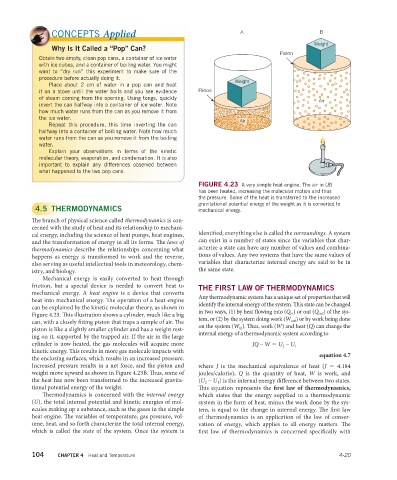
                                                                          FIGURE 4.23  A very simple heat engine. The air in (B)
                                                                          has been heated, increasing the molecular motion and thus
                                                                          the pressure. Some of the heat is transferred to the increased
                                                                          gravitational potential energy of the weight as it is converted to
                    4.5 THERMODYNAMICS                                    mechanical energy.


                   The branch of physical science called thermodynamics is con-
                   cerned with the study of heat and its relationship to mechani-

                   cal energy, including the science of heat pumps, heat engines,   identified, everything else is called the surroundings. A system
                   and the transformation of energy in all its forms. Th e laws of   can exist in a number of states since the variables that char-
                   thermo dynamics describe the relationships concerning what   acterize a state can have any number of values and combina-
                   happens as energy is transformed to work and the reverse,   tions of values. Any two systems that have the same values of
                   also serving as useful intellectual tools in meteorology, chem-  variables that characterize internal energy are said to be in
                   istry, and biology.                                    the same state.
                      Mechanical energy is easily converted to heat through
                   friction, but a special device is needed to convert heat to   THE FIRST LAW OF THERMODYNAMICS
                   mechanical energy. A  heat engine is a device that converts
                                                                          Any thermodynamic system has a unique set of properties that will
                   heat into mechanical energy. The operation of a heat engine


                                                                          identify the internal energy of the system. This state can be changed
                   can be explained by the kinetic molecular theory, as shown in

                                                                          in two ways, (1) by heat flowing into (Q in ) or out (Q out ) of the sys-

                   Figure 4.23. This illustration shows a cylinder, much like a big
                                                                          tem, or (2) by the system doing work (W out ) or by work being done

                   can, with a closely fitting piston that traps a sample of air. Th e
                                                                          on the system (W in ). Thus, work (W) and heat (Q) can change the

                   piston is like a slightly smaller cylinder and has a weight rest-
                                                                          internal energy of a thermodynamic system according to
                   ing on it, supported by the trapped air. If the air in the large
                   cylinder is now heated, the gas molecules will acquire more              JQ – W = U 2  – U 1
                   kinetic energy. This results in more gas molecule impacts with

                                                                                                                  equation 4.7
                   the enclosing surfaces, which results in an increased pressure.
                   Increased pressure results in a net force, and the piston and   where  J is the mechanical equivalence of heat (J  =  4.184
                   weight move upward as shown in Figure 4.23B. Thus, some of   joules/calorie),  Q is the quantity of heat,  W is work, and

                   the heat has now been transformed to the increased gravita-  (U 2  – U 1 ) is the internal energy difference between two states.

                   tional potential energy of the weight.                 This equation represents the  first law of thermodynamics,


                      Thermodynamics is concerned with the internal energy   which states that the energy supplied to a thermodynamic
                   (U), the total internal potential and kinetic energies of mol-  system in the form of heat, minus the work done by the sys-
                   ecules making up a substance, such as the gases in the simple   tem, is equal to the change in internal energy. Th e fi rst law
                   heat engine. The variables of temperature, gas pressure, vol-  of thermodynamics is an application of the law of conser-

                   ume, heat, and so forth characterize the total internal energy,   vation of energy, which applies to all energy matters. Th e
                   which is called the  state of the system. Once the system is   first law of thermodynamics is concerned specifi cally  with

                   104     CHAPTER 4  Heat and Temperature                                                              4-20

