


Page 124 - 9780077418427.pdf
P. 124
/Users/user-f465/Desktop
          tiL12214_ch04_085-114.indd Page 101  9/1/10  9:37 PM user-f465
          tiL12214_ch04_085-114.indd Page 101  9/1/10  9:37 PM user-f465                                                /Users/user-f465/Desktop


                                                                                            A Closer Look


                                                                                                  Passive Solar Design
                             assive solar application is an economi-  lator, so windows must have curtains or   can place carpets and furniture as they wish.
                          Pcally justifiable use of solar energy   movable insulation panels to slow energy   Controls to prevent energy loss at night are
                          today. Passive solar design uses a structure’s   loss at night. This requires the daily activ-  still necessary with this design.
                          construction to heat a living space with   ity of closing curtains or moving insulation   An  isolated solar gain home uses a
                          solar energy. There are few electric fans,   panels at night and then opening curtains   structure that is separated from the liv-
                          motors, or other  energy sources used. The   and moving panels in the morning. Passive   ing space to collect and store solar energy.
                          passive solar design takes advantage of free   solar homes, therefore, require a high level     Examples of an isolated gain design are
                          solar  energy; it stores and then distributes   of personal involvement by the occupants.  an attached greenhouse or sunporch (Box
                          this  energy through natural conduction,   There are three basic categories of   Figure 4.3). Energy flow between the
                          convection, and radiation.           passive solar design: (1) direct solar gain,     attached structure and the living space
                             In general, a passive solar home makes   (2)  indirect solar gain, and (3) isolated   can be by conduction, convection, and
                          use of the materials from which it is con-  solar gain.              radiation, which can be controlled by
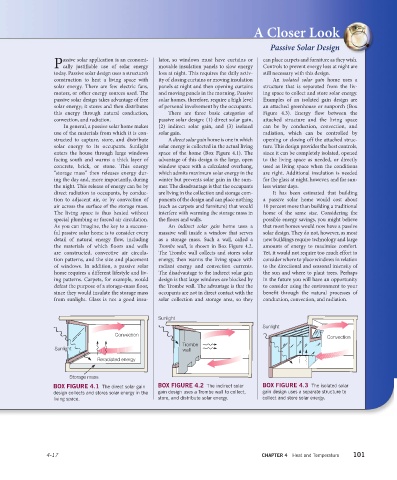
                          structed to capture, store, and distribute   A direct solar gain home is one in which   opening or closing off the attached struc-
                          solar energy to its occupants. Sunlight   solar energy is collected in the actual living   ture. This design provides the best controls,
                          enters the house through large windows   space of the home (Box Figure 4.1). The   since it can be completely isolated, opened
                          facing south and warms a thick layer of   advantage of this design is the large, open   to the living space as needed, or directly
                          concrete, brick, or stone. This energy   window space with a calculated overhang,   used as living space when the conditions
                          “storage mass” then releases energy dur-  which admits maximum solar energy in the   are right. Additional insulation is needed
                          ing the day and, more importantly, during   winter but prevents solar gain in the sum-  for the glass at night, however, and for sun-
                          the night. This release of energy can be by   mer. The disadvantage is that the occupants   less winter days.
                          direct radiation to occupants, by conduc-  are living in the collection and storage com-  It has been estimated that building
                          tion to adjacent air, or by convection of   ponents of the design and can place nothing   a passive solar home would cost about
                          air across the surface of the storage mass.   (such as carpets and furniture) that would   10 percent more than building a traditional
                          The living space is thus heated without   interfere with warming the storage mass in   home of the same size. Considering the
                          special plumbing or forced air circulation.   the floors and walls.  possible energy savings, you might believe
                          As you can imagine, the key to a success-  An  indirect solar gain home uses a   that most homes would now have a passive
                          ful passive solar home is to consider every   massive wall inside a window that serves   solar design. They do not, however, as most
                          detail of natural energy flow, including   as a storage mass. Such a wall, called a   new buildings require technology and large
                          the materials of which floors and walls   Trombe wall, is shown in Box Figure 4.2.   amounts of energy to maximize comfort.
                          are constructed, convective air circula-  The Trombe wall collects and stores solar   Yet, it would not require too much effort to
                          tion patterns, and the size and placement   energy, then warms the living space with   consider where to place windows in relation
                          of windows. In addition, a passive solar   radiant energy and convection currents.   to the directional and seasonal intensity of
                          home requires a different lifestyle and liv-  The disadvantage to the indirect solar gain   the sun and where to plant trees. Perhaps
                          ing patterns. Carpets, for example, would   design is that large windows are blocked by   in the future you will have an opportunity
                          defeat the purpose of a storage-mass floor,   the Trombe wall. The advantage is that the   to consider using the environment to your
                          since they would insulate the storage mass   occupants are not in direct contact with the   benefit through the natural processes of
                          from sunlight. Glass is not a good insu-  solar collection and storage area, so they   conduction, convection, and radiation.


                                                             Sunlight
                                                                                               Sunlight
                                              Convection
                                                                                                                    Convection
                                                                     Trombe
                          Sunlight                                   wall
                                        Reradiated energy


                               Storage mass
                          BOX FIGURE 4.1  The direct solar gain   BOX FIGURE 4.2  The indirect solar   BOX FIGURE 4.3  The isolated solar
                          design collects and stores solar energy in the   gain design uses a Trombe wall to collect,   gain design uses a separate structure to
                          living space.                      store, and distribute solar energy.  collect and store solar energy.


                       4-17                                                                    CHAPTER 4  Heat and Temperature   101

