


Page 128 - 9780077418427.pdf
P. 128
/Users/user-f465/Desktop
          tiL12214_ch04_085-114.indd Page 105  9/1/10  9:38 PM user-f465
          tiL12214_ch04_085-114.indd Page 105  9/1/10  9:38 PM user-f465                                                /Users/user-f465/Desktop


                                     High-temperature                                                High-temperature
                                         region                                                          region
                                         (Q )                                                             (Q )
                                                                                                           H
                                           H


                               Heat                                                                                 Heat
                                                     Work out (W)                   Work in (W)
                              engine                                                                               pump


                                     Low-temperature                                                 Low-temperature
                                         region                                                          region
                                         (Q )                                                             (Q )
                                           L
                                                                                                           L


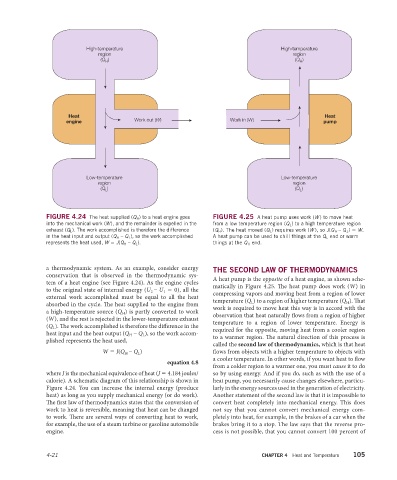
                       FIGURE 4.24  The heat supplied (Q H ) to a heat engine goes   FIGURE 4.25  A heat pump uses work (W ) to move heat
                       into the mechanical work (W), and the remainder is expelled in the   from a low temperature region (Q L ) to a high temperature region
                        exhaust (Q L ). The work accomplished is therefore the difference   (Q H ). The heat moved (Q L ) requires work (W ), so J(Q H  – Q L ) = W.
                       in the heat input and output (Q H  – Q L ), so the work accomplished   A heat pump can be used to chill things at the Q L  end or warm
                       represents the heat used, W = J(Q H  – Q L ).           things at the Q H  end.


                       a thermodynamic system. As an example, consider energy   THE SECOND LAW OF THERMODYNAMICS
                       conservation that is observed in the thermodynamic sys-
                                                                               A heat pump is the opposite of a heat engine, as shown sche-
                       tem of a heat engine (see Figure 4.24). As the engine cycles
                                                                               matically in Figure 4.25. The heat pump does work (W) in

                       to the original state of internal energy (U 2  – U 1  = 0), all the
                                                                               compressing vapors and moving heat from a region of lower
                       external work accomplished must be equal to all the heat
                                                                               temperature (Q L ) to a region of higher temperature (Q H ). Th at

                       absorbed in the cycle. The heat supplied to the engine from
                                                                               work is required to move heat this way is in accord with the
                       a high-temperature source (Q H ) is partly converted to work
                                                                               observation that heat naturally fl ows from a region of higher
                       (W), and the rest is rejected in the lower-temperature exhaust
                                                                               temperature to a region of lower temperature. Energy is

                       (Q L ). The work accomplished is therefore the difference in the

                                                                               required for the opposite, moving heat from a cooler region
                        heat input and the heat output (Q H  – Q L ), so the work accom-
                                                                               to a warmer region. The natural direction of this process is

                       plished represents the heat used,
                                                                               called the second law of thermodynamics, which is that heat
                                          W = J(Q H  – Q L )                   fl ows from objects with a higher temperature to objects with
                                                                               a cooler temperature. In other words, if you want heat to fl ow
                                                                equation 4.8
                                                                               from a colder region to a warmer one, you must cause it to do
                       where J is the mechanical equivalence of heat (J =  4.184 joules/  so by using energy. And if you do, such as with the use of a
                       calorie). A schematic diagram of this relationship is shown in   heat pump, you necessarily cause changes elsewhere, particu-
                       Figure 4.24. You can increase the internal energy (produce   larly in the energy sources used in the generation of  electricity.
                       heat) as long as you supply mechanical energy (or do work).   Another statement of the second law is that it is impossible to
                       Th e first law of thermodynamics states that the conversion of   convert heat completely into mechanical energy. This does

                       work to heat is reversible, meaning that heat can be changed   not say that you cannot convert  mechanical energy com-
                       to work. There are several ways of converting heat to work,   pletely into heat, for example, in the brakes of a car when the

                       for example, the use of a steam turbine or gasoline automobile   brakes bring it to a stop. The law says that the reverse pro-
                       engine.                                                 cess is not possible, that you cannot convert 100 percent of
                       4-21                                                                    CHAPTER 4  Heat and Temperature   105

