


Page 122 - 9780077418427.pdf
P. 122
/Users/user-f465/Desktop
          tiL12214_ch04_085-114.indd Page 99  9/1/10  9:37 PM user-f465
          tiL12214_ch04_085-114.indd Page 99  9/1/10  9:37 PM user-f465                                                 /Users/user-f465/Desktop


                              CONCEPTS Applied                                                    Energy released
                                                                                           Decreased molecular potential energy
                              Candle Wax, Bubbles, and a Lightbulb                       Freezing                Condensation
                          Here are three experiments you can do on heat flow:          releases energy          releases energy
                          Conduction: Use melted candle wax to stick thumbtack
                             heads to a long metal rod. Heat one end of the rod
                             with a flame. Record any evidence you observe that
                             heat moves across the rod by conduction.
                          Convection: Choose a calm, warm day with plenty
                             of strong sunlight. Make soap bubbles to study
                             convection  currents between a grass field and
                             an adjacent asphalt parking lot. Find other adjacent
                             areas where you think you might find convection
                             currents and study them with soap bubbles, too.
                             Record your experiments, findings, and  explanations
                             for what you observed.
                          Radiation: Hold your hand under an unlighted electric         Melting                  Evaporation
                             lightbulb and then turn on the bulb. Describe evidence   absorbs energy           absorbs energy
                             that what you feel traveled to you by radiation, not          Increased molecular potential energy
                             conduction or convection. Describe any experiments
                             you can think of to prove you felt radiant energy.                  Energy absorbed
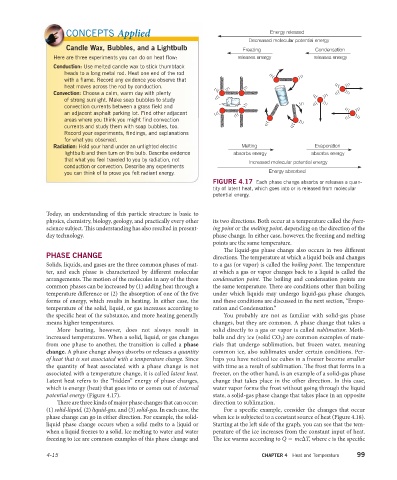
                                                                               FIGURE 4.17  Each phase change absorbs or releases a quan-
                                                                               tity of latent heat, which goes into or is released from molecular
                                                                               potential energy.


                        Today, an understanding of this particle structure is basic to
                        physics, chemistry, biology, geology, and practically every other   its two directions. Both occur at a temperature called the freez-

                        science subject. This understanding has also resulted in present-  ing point or the melting point, depending on the direction of the
                        day technology.                                        phase change. In either case, however, the freezing and melting
                                                                               points are the same temperature.
                                                                                  The liquid-gas phase change also occurs in two diff erent

                        PHASE CHANGE                                            directions. The temperature at which a liquid boils and changes

                        Solids, liquids, and gases are the three common phases of mat-  to a gas (or vapor) is called the boiling point. Th e temperature
                        ter, and each phase is characterized by diff erent  molecular   at which a gas or vapor changes back to a liquid is called the
                        arrangements. The motion of the molecules in any of the three   condensation point. The boiling and condensation points are


                        common phases can be increased by (1) adding heat through a   the same temperature. There are conditions other than boiling
                        temperature diff erence or (2) the absorption of one of the fi ve   under which liquids may undergo liquid-gas phase changes,
                        forms of energy, which results in heating. In either case, the   and these conditions are discussed in the next section, “Evapo-
                        temperature of the solid, liquid, or gas increases according to   ration and Condensation.”

                        the specific heat of the substance, and more heating generally   You probably are not as familiar with solid-gas phase
                        means higher temperatures.                             changes, but they are common. A phase change that takes a
                           More heating, however, does not always result in    solid directly to a gas or vapor is called sublimation. Moth-
                        increased temperatures. When a solid, liquid, or gas changes   balls and dry ice (solid CO 2 ) are common examples of mate-
                        from one phase to another, the transition is called a  phase   rials that undergo sublimation, but frozen water, meaning
                        change. A phase change always absorbs or releases a quantity   common ice, also sublimates under certain conditions. Per-
                        of heat that is not  associated with a temperature change. Since   haps you have noticed ice cubes in a freezer become smaller
                        the quantity of heat associated with a phase change is not   with time as a result of sublimation. The frost that forms in a

                          associated with a temperature change, it is called latent heat.   freezer, on the other hand, is an example of a solid-gas phase
                        Latent heat refers to the “hidden” energy of phase changes,   change that takes place in the other direction. In this case,
                        which is energy (heat) that goes into or comes out of internal   water vapor forms the frost without going through the liquid
                        potential energy (Figure 4.17).                        state, a solid-gas phase change that takes place in an opposite
                           There are three kinds of major phase changes that can occur:   direction to sublimation.


                        (1) solid-liquid, (2) liquid-gas, and (3) solid-gas. In each case, the   For a specific example, consider the changes that occur
                        phase change can go in either direction. For example, the solid-  when ice is subjected to a constant source of heat (Figure 4.18).

                        liquid phase change occurs when a solid melts to a liquid or   Starting at the left side of the graph, you can see that the tem-
                        when a liquid freezes to a solid. Ice melting to water and water   perature of the ice increases from the constant input of heat.

                        freezing to ice are common examples of this phase change and   The ice warms according to Q = mcΔT, where c is the specifi c
                       4-15                                                                    CHAPTER 4  Heat and Temperature   99

