


Page 149 - 9780077418427.pdf
P. 149
/Users/user-f465/Desktop
          tiL12214_ch05_115-138.indd Page 126  9/1/10  9:39 PM user-f465
          tiL12214_ch05_115-138.indd Page 126  9/1/10  9:39 PM user-f465                                                /Users/user-f465/Desktop


                                                                               The quack researchers speculated that the myth might have
                                                                             resulted because:
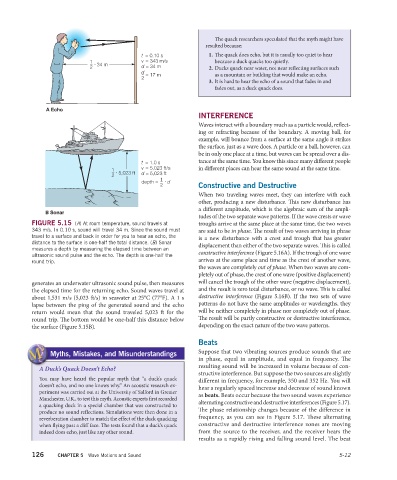
                                                       t  = 0.10 s           1. The quack does echo, but it is usually too quiet to hear
                                      1   34 m         v = 343 m/s             because a duck quacks too quietly.
                                      2  •             d = 34 m               2. Ducks quack near water, not near reflecting surfaces such
                                                       d                       as a mountain or building that would make an echo.
                                                          = 17 m
                                                       2
                                                                              3. It is hard to hear the echo of a sound that fades in and
                                                                               fades out, as a duck quack does.


                       A Echo
                                                                          INTERFERENCE
                                                                          Waves interact with a boundary much as a particle would, refl ect-
                                                                          ing or refracting because of the boundary. A moving ball, for
                                                                          example, will bounce from a surface at the same angle it strikes
                                                                          the surface, just as a wave does. A particle or a ball, however, can
                                                                          be in only one place at a time, but waves can be spread over a dis-
                                                       t  = 1.0 s         tance at the same time. You know this since many diff erent people

                                             1         v = 5,023 ft/s     in different places can hear the same sound at the same time.
                                             2  •  5,023 ft  d = 5,023 ft
                                                             1
                                                       depth =       d
                                                               •
                                                             2            Constructive and Destructive
                                                                          When two traveling waves meet, they can interfere with each
                                                                          other, producing a new disturbance. This new disturbance has

                                                                          a different amplitude, which is the algebraic sum of the ampli-

                       B Sonar
                                                                          tudes of the two separate wave patterns. If the wave crests or wave
                   FIGURE 5.15  (A) At room temperature, sound travels at   troughs arrive at the same place at the same time, the two waves
                   343 m/s. In 0.10 s, sound will travel 34 m. Since the sound must   are said to be in phase. The result of two waves arriving in phase

                   travel to a surface and back in order for you to hear an echo, the   is a new disturbance with a crest and trough that has greater
                   distance to the surface is one-half the total distance. (B) Sonar     displacement than either of the two separate waves. This is called

                   measures a depth by measuring the elapsed time between an
                   ultrasonic sound pulse and the echo. The depth is one-half the   constructive interference (Figure 5.16A). If the trough of one wave
                   round trip.                                            arrives at the same place and time as the crest of another wave,
                                                                          the waves are completely out of phase. When two waves are com-
                                                                          pletely out of phase, the crest of one wave (positive displacement)
                   generates an underwater ultrasonic sound pulse, then measures   will cancel the trough of the other wave (negative displacement),

                   the elapsed time for the returning echo. Sound waves travel at   and the result is zero total disturbance, or no wave. This is called

                   about 1,531 m/s (5,023 ft/s) in seawater at 25°C (77°F). A 1 s   destructive interference (Figure 5.16B). If the two sets of wave
                   lapse between the ping of the generated sound and the echo   patterns do not have the same amplitudes or wavelengths, they

                   return would mean that the sound traveled 5,023 ft for the   will be neither completely in phase nor completely out of phase.


                   round trip. The bottom would be one-half this distance below   The result will be partly constructive or destructive interference,
                   the surface (Figure 5.15B).                            depending on the exact nature of the two wave patterns.
                                                                          Beats
                         Myths, Mistakes, and Misunderstandings           Suppose that two vibrating sources produce sounds that are
                                                                          in phase, equal in amplitude, and equal in frequency. Th e
                                                                          resulting sound will be increased in volume because of con-
                     A Duck’s Quack Doesn’t Echo?
                                                                          structive interference. But suppose the two sources are slightly
                     You may have heard the popular myth that “a duck’s quack   different in frequency, for example, 350 and 352 Hz. You will

                     doesn’t echo, and no one knows why.” An acoustic research ex-  hear a regularly spaced increase and decrease of sound known
                     periment was carried out at the University of Salford in Greater   as beats. Beats occur because the two sound waves experience
                     Manchester, U.K., to test this myth. Acoustic experts first record ed
                     a quacking duck in a special chamber that was constructed to   alternating constructive and destructive interferences ( Figure 5.17).

                     produce no sound reflections. Simulations were then done in a   The phase relationship changes because of the diff erence in
                     reverberation chamber to match the effect of the duck quacking   frequency, as you can see in Figure 5.17. Th ese  alternating
                     when flying past a cliff face. The tests found that a duck’s quack   constructive and destructive interference zones are moving
                     indeed does echo, just like any other sound.         from the source to the receiver, and the receiver hears the
                                                                          results as a rapidly rising and falling sound level. The beat

                   126     CHAPTER 5  Wave Motions and Sound                                                            5-12

