


Page 175 - 9780077418427.pdf
P. 175
/Users/user-f465/Desktop
          tiL12214_ch06_139-176.indd Page 152  9/1/10  9:40 PM user-f465
          tiL12214_ch06_139-176.indd Page 152  9/1/10  9:40 PM user-f465                                                /Users/user-f465/Desktop


                   In units, you can see that multiplying the current A = C/s by the
                   potential (V = J/C) yields
                                           joules
                                                    joules
                              _ _ _
                               coulombs
                                                  =

                                       ×


                                second   coulombs   second
                   A joule/second is a unit of power called the watt (W). Th erefore,
                   electrical power is measured in units of watts, and
                                        W = A·V
                    power (in watts) = current (in amps) × potential (in volts)
                                   watts = amps × volts

                   This relationship is
                                         P = IV                           A
                                                           equation 6.6
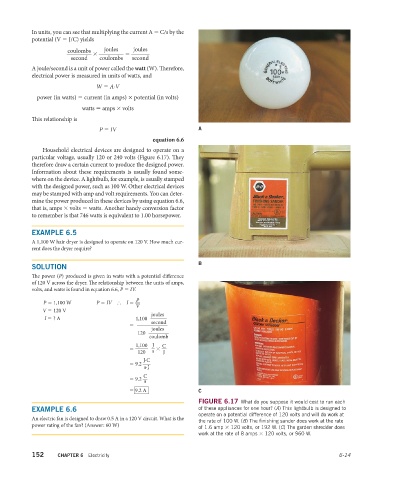
                      Household electrical devices are designed to operate on a
                   particular voltage, usually 120 or 240 volts (Figure 6.17). Th ey
                   therefore draw a certain current to produce the designed power.
                   Information about these requirements is usually found some-
                   where on the device. A lightbulb, for example, is usually stamped
                   with the designed power, such as 100 W. Other electrical devices
                   may be stamped with amp and volt requirements. You can deter-
                   mine the power produced in these devices by using equation 6.6,
                   that is, amps × volts = watts. Another handy conversion factor
                   to remember is that 746 watts is equivalent to 1.00 horsepower.

                   EXAMPLE 6.5
                   A 1,100 W hair dryer is designed to operate on 120 V. How much cur-
                   rent does the dryer require?

                                                                          B
                   SOLUTION
                   The power (P) produced is given in watts with a potential diff erence


                   of 120 V across the dryer. The relationship between the units of amps,
                   volts, and watts is found in equation 6.6, P = IV.
                                                     P _
                       P = 1,100 W      P = IV  ∴ I =
                                                     V
                      V = 120 V
                                                          joules
                                                          _
                            I = ? A                  1,100

                                                          second

                                                    =    __
                                                          joules
                                                         _

                                                      120
                                                          coulomb
                                                     1,100 J
                                                     _ _ _
                                                              C


                                                   =                  ×


                                                      120  s  J
                                                        J·C
                                                       _
                                                   = 9.2

                                                        s·J
                                                        C _

                                                   = 9.2
                                                        s
                                                   = 9.2 A                C
                                                                            FIGURE 6.17  What do you suppose it would cost to run each
                   EXAMPLE 6.6                                            of these appliances for one hour? (A) This lightbulb is designed to
                                                                          operate on a potential difference of 120 volts and will do work at
                   An electric fan is designed to draw 0.5 A in a 120 V circuit. What is the
                                                                          the rate of 100 W. (B) The finishing sander does work at the rate
                   power rating of the fan? (Answer: 60 W)
                                                                          of 1.6 amp × 120 volts, or 192 W. (C) The garden shredder does
                                                                          work at the rate of 8 amps × 120 volts, or 960 W.
                   152     CHAPTER 6 Electricity                                                                        6-14

