


Page 176 - 9780077418427.pdf
P. 176
/Users/user-f465/Desktop
          tiL12214_ch06_139-176.indd Page 153  9/1/10  9:40 PM user-f465
          tiL12214_ch06_139-176.indd Page 153  9/1/10  9:40 PM user-f465                                                /Users/user-f465/Desktop


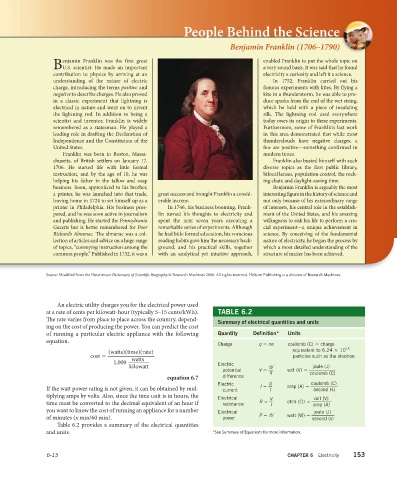
                                                                     People Behind the Science


                                                                                    Benjamin Franklin (1706–1790)

                             enjamin Franklin was the first great                              enabled Franklin to put the whole topic on
                          BU.S. scientist. He made an important                                a very sound basis. It was said that he found
                          contribution to physics by arriving at an                            electricity a curiosity and left it a science.
                          understanding of the nature of electric                                  In 1752, Franklin carried out his
                          charge, introducing the terms positive and                           famous experiments with kites. By flying a
                          negative to describe charges. He also proved                         kite in a thunderstorm, he was able to pro-
                          in a classic experiment that lightning is                            duce sparks from the end of the wet string,
                          electrical in nature and went on to invent                           which he held with a piece of insulating
                          the lightning rod. In addition to being a                            silk. The lightning rod used everywhere
                          scientist and inventor, Franklin is widely                           today owes its origin to these experiments.
                          remembered as a statesman. He played a                               Furthermore, some of Franklin’s last work
                          leading role in drafting the Declaration of                          in this area demonstrated that while most
                          Independence and the Constitution of the                             thunderclouds have negative charges, a
                          United States.                                                       few are positive—something confirmed in
                             Franklin was born in Boston, Massa-                               modern times.
                          chusetts, of British settlers on  January  17,                           Franklin also busied himself with such
                          1706. He started life with little formal                             diverse topics as the first public library,
                          instruction, and by the age of 10, he was                            bifocal lenses, population control, the rock-
                          helping his father in the tallow and soap                            ing chair, and daylight-saving time.
                          business. Soon, apprenticed to his brother,                              Benjamin Franklin is arguably the most
                          a printer, he was launched into that trade,   great success and brought Franklin a consid-  interesting figure in the history of science and
                          leaving home in 1724 to set himself up as a   erable income.         not only because of his extraordinary range
                          printer in Philadelphia. His business pros-  In 1746, his business booming, Frank-  of interests, his central role in the establish-
                          pered, and he was soon active in journalism   lin turned his thoughts to electricity and   ment of the United States, and his amazing
                          and publishing. He started the Pennsylvania   spent the next seven years executing a   willingness to risk his life to perform a cru-
                          Gazette but is better remembered for Poor   remarkable series of experiments. Although   cial experiment—a unique achievement in
                          Richard’s Almanac. The almanac was a col-  he had little formal education, his voracious   science. By conceiving of the fundamental
                          lection of articles and advice on a huge range   reading habits gave him the necessary back-  nature of electricity, he began the process by
                          of topics, “conveying instruction among the   ground, and his practical skills, together   which a most detailed understanding of the
                          common people.” Published in 1732, it was a   with an analytical yet intuitive approach,   structure of matter has been achieved.


                       Source: Modified from the Hutchinson Dictionary of Scientific Biography © Research Machines 2008. All rights reserved. Helicon Publishing is a division of Research Machines.


                               An electric utility charges you for the electrical power used
                       at a rate of cents per kilowatt-hour (typically 5–15 cents/kWh).   TABLE 6.2

                       The rate varies from place to place across the country, depend-
                                                                                Summary of electrical quantities and units
                       ing on the cost of producing the power. You can predict the cost
                       of running a particular electric appliance with the following   Quantity  Definition*  Units
                       equation.
                                                                                Charge        q = ne   coulomb (C) = charge
                                            (watts)(time)(rate)
                                            __                                                           equivalent to 6.24 × 10 18


                                      cost =       _                                                     particles such as the electron

                                              1,000    watts                    Electric
                                                   kilowatt                                      W _          __
                                                                                                                joule (J)


                                                                                 potential    V =           volt (V) =  coulomb (C)
                                                                                                 q
                                                                 equation 6.7    difference
                                                                                                               coulomb (C)
                                                                                                 _
                                                                                Electric         q     amp (A) =  __

                       If the watt power rating is not given, it can be obtained by mul-   current   I =            second (s)
                                                                                                 t
                       tiplying amps by volts. Also, since the time unit is in hours, the   Electrical   V _   _
                                                                                                                 volt (V)


                       time must be converted to the decimal equivalent of an hour if    resistance   R =             ohm (Ω) =      amp (A)
                                                                                                  I
                       you want to know the cost of running an appliance for a number     Electrical           __
                                                                                                                joule (J)
                       of minutes (x min/60 min).                                power        P = IV   watt (W) =  second (s)
                           Table 6.2 provides a summary of the electrical quantities
                       and units.                                              *See Summary of Equations for more information.
                       6-15                                                                            CHAPTER 6  Electricity   153

