


Page 179 - 9780077418427.pdf
P. 179
/Users/user-f465/Desktop
          tiL12214_ch06_139-176.indd Page 156  9/1/10  9:40 PM user-f465
          tiL12214_ch06_139-176.indd Page 156  9/1/10  9:40 PM user-f465                                                /Users/user-f465/Desktop


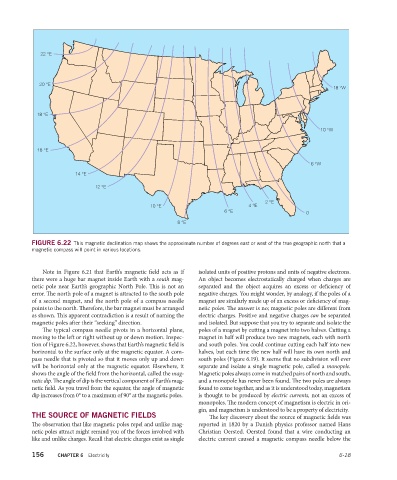
                   FIGURE 6.22  This magnetic declination map shows the approximate number of degrees east or west of the true geographic north that a
                   magnetic compass will point in various locations.


                      Note in Figure 6.21 that Earth’s magnetic field acts as if   isolated units of positive protons and units of negative electrons.
                   there were a huge bar magnet inside Earth with a south mag-  An object becomes electrostatically charged when charges are

                   netic pole near Earth’s geographic North Pole. This is not an   separated and the object acquires an excess or defi ciency  of
                   error. The north pole of a magnet is attracted to the south pole   negative charges. You might wonder, by analogy, if the poles of a

                   of a second magnet, and the north pole of a compass needle   magnet are similarly made up of an excess or deficiency of mag-


                   points to the north. Therefore, the bar magnet must be arranged   netic poles. The answer is no; magnetic poles are diff erent from
                   as shown. This apparent contradiction is a result of naming the   electric charges. Positive and negative charges can be separated

                   magnetic poles after their “seeking” direction.        and isolated. But suppose that you try to separate and isolate the

                      The typical compass needle pivots in a horizontal plane,   poles of a magnet by cutting a magnet into two halves. Cutting a

                   moving to the left or right without up or down motion. Inspec-  magnet in half will produce two new magnets, each with north

                   tion of Figure 6.22, however, shows that Earth’s magnetic fi eld is   and south poles. You could continue cutting each half into new
                   horizontal to the surface only at the magnetic equator. A com-  halves, but each time the new half will have its own north and
                   pass needle that is pivoted so that it moves only up and down   south poles (Figure 6.19). It seems that no subdivision will ever
                   will be horizontal only at the magnetic equator. Elsewhere, it   separate and isolate a single magnetic pole, called a monopole.
                   shows the angle of the field from the horizontal, called the mag-  Magnetic poles always come in matched pairs of north and south,


                   netic dip. The angle of dip is the vertical component of Earth’s mag-  and a monopole has never been found. The two poles are always


                   netic field. As you travel from the equator, the angle of magnetic   found to come together, and as it is understood today, magnetism
                   dip increases from 0° to a maximum of 90° at the magnetic poles.  is thought to be produced by electric currents, not an excess of
                                                                          monopoles. The modern concept of magnetism is electric in ori-

                                                                          gin, and magnetism is understood to be a property of electricity.
                   THE SOURCE OF MAGNETIC FIELDS                              The key discovery about the source of magnetic fi elds was

                   The observation that like magnetic poles repel and unlike mag-  reported in 1820 by a Danish physics professor named Hans

                   netic poles attract might remind you of the forces involved with   Christian Oersted. Oersted found that a wire conducting an
                   like and unlike charges. Recall that electric charges exist as single   electric current caused a magnetic compass needle below the
                   156     CHAPTER 6 Electricity                                                                        6-18

