


Page 171 - 9780077418427.pdf
P. 171
/Users/user-f465/Desktop
          tiL12214_ch06_139-176.indd Page 148  9/1/10  9:40 PM user-f465
          tiL12214_ch06_139-176.indd Page 148  9/1/10  9:40 PM user-f465                                                /Users/user-f465/Desktop


                   produced by a greater gravitational potential diff erence.  Th e   the following corrections: (1) in an electric current, electrons

                   rate of water flow is thus directly proportional to the diff erence   do not move through a wire just as water flows through a pipe;

                   in gravitational potential energy. In an electric circuit, the rate   (2) electrons are not pushed out one end of the wire as more
                   of current (coulombs/second, or amps) is directly proportional   electrons are pushed in the other end; and (3) electrons do not

                   to the difference of electrical potential (joules/coulombs, or   move through a wire at the speed of light since a power plant
                   volts) between two parts of the circuit, I ∝ V.        failure hundreds of miles away results in an instantaneous loss
                                                                          of power. Perhaps you have held one or more of these miscon-
                                                                          ceptions from fl uid analogies.
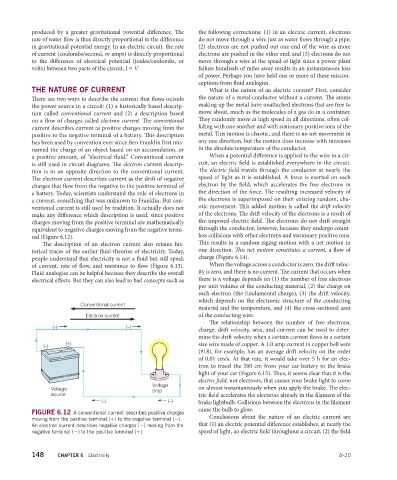
                   THE NATURE OF CURRENT                                     What is the nature of an electric current? First, consider
                   There are two ways to describe the current that fl ows outside   the nature of a metal conductor without a current. Th e atoms

                   the power source in a circuit: (1) a historically based descrip-  making up the metal have unattached electrons that are free to
                   tion called  conventional current and (2) a description based   move about, much as the molecules of a gas do in a container.

                   on a flow of charges called electron current. Th e conventional   They randomly move at high speed in all directions, oft en col-

                   current describes current as positive charges moving from the   liding with one another and with stationary positive ions of the

                   positive to the negative terminal of a battery. Th is description   metal. This motion is chaotic, and there is no net movement in
                   has been used by convention ever since Ben Franklin fi rst mis-  any one direction, but the motion does increase with increases
                   named the charge of an object based on an accumulation, or   in the absolute temperature of the conductor.

                   a positive amount, of “electrical fluid.” Conventional current   When a potential difference is applied to the wire in a cir-


                   is still used in circuit diagrams. Th e electron current descrip-  cuit, an electric field is established everywhere in the circuit.
                   tion is in an opposite direction to the conventional current.   Th e electric fi eld travels through the conductor at nearly the

                   The electron current describes current as the drift  of negative   speed of light as it is established. A force is exerted on each

                   charges that fl ow from the negative to the positive terminal of   electron by the field, which accelerates the free electrons in

                   a battery. Today, scientists understand the role of electrons in   the direction of the force. The resulting increased velocity of
                   a current, something that was unknown to Franklin. But con-  the electrons is superimposed on their existing random, cha-

                   ventional current is still used by tradition. It actually does not   otic movement. This added motion is called the drift  velocity

                   make any difference which description is used, since positive   of the electrons. Th e drift velocity of the electrons is a result of


                   charges moving from the positive terminal are mathematically   the imposed electric fi eld. The electrons do not drift  straight
                   equivalent to negative charges moving from the negative termi-  through the conductor, however, because they undergo count-
                   nal (Figure 6.12).                                     less collisions with other electrons and stationary positive ions.


                      The description of an electron current also retains his-  This results in a random zigzag motion with a net motion in


                   torical traces of the earlier fluid theories of electricity. Today,   one direction. This net motion constitutes a current, a fl ow of
                   people understand that electricity is not a fluid but still speak   charge (Figure 6.14).


                   of current, rate of flow, and resistance to flow (Figure 6.13).   When the voltage across a conductor is zero, the drift  veloc-

                   Fluid analogies can be helpful because they describe the overall   ity is zero, and there is no current. The current that occurs when
                   electrical effects. But they can also lead to bad concepts such as   there is a voltage depends on (1) the number of free electrons

                                                                          per unit volume of the conducting material, (2) the charge on
                                                                          each electron (the fundamental charge), (3) the drift  velocity,
                                                                          which depends on the electronic structure of the conducting
                                   Conventional current
                                                                          material and the temperature, and (4) the cross-sectional area
                                     Electron current                     of the conducting wire.
                                                                              The relationship between the number of free electrons,

                          (–)                     (–)

                                                                          charge, drift velocity, area, and current can be used to deter-
                                                                          mine the drift   velocity when a certain current fl ows in a certain
                       (–)    (+)                                         size wire made of copper. A 1.0 amp current in copper bell wire
                                                                          (#18), for example, has an average drift velocity on the order

                                                                          of 0.01 cm/s. At that rate, it would take over 5 h for an elec-
                                                                          tron to travel the 200 cm from your car battery to the brake
                                                                          light of your car (Figure 6.15). Thus, it seems clear that it is the

                                                                          electric fi eld, not electrons, that causes your brake light to come
                                                           Voltage
                         Voltage                           drop           on almost instantaneously when you apply the brake. Th e elec-
                         source                                           tric field accelerates the electrons already in the filament of the


                                           (–)                   (–)      brake lightbulb. Collisions between the electrons in the fi lament
                                                                          cause the bulb to glow.
                   FIGURE 6.12  A conventional current describes positive charges
                   moving from the positive terminal (+) to the negative terminal (−).   Conclusions about the nature of an electric current are

                   An electron current describes negative charges (−) moving from the   that (1) an electric potential difference establishes, at nearly the

                   negative terminal (−) to the positive terminal (+).    speed of light, an electric field throughout a circuit, (2) the fi eld
                   148     CHAPTER 6 Electricity                                                                        6-10

