


Page 173 - 9780077418427.pdf
P. 173
/Users/user-f465/Desktop
          tiL12214_ch06_139-176.indd Page 150  9/1/10  9:40 PM user-f465
          tiL12214_ch06_139-176.indd Page 150  9/1/10  9:40 PM user-f465                                                /Users/user-f465/Desktop


                   causes a net motion that constitutes a flow of charge, or current,   property of opposing or reducing a current, and this property is
                   and (3) the average velocity of the electrons moving as a cur-  called electrical resistance (R).
                   rent is very slow, even though the electric field that moves them   Recall that the current (I) through a conductor is directly

                   travels with a speed close to the speed of light.      proportional to the potential diff erence (V) between two points

                      Another aspect of the nature of an electric current is the   in a circuit. If a conductor offers a small resistance, less voltage

                   direction the charge is flowing. A circuit like the one described   would be required to push an amp of current through the circuit.

                   with your car battery has a current that always moves in one   If a conductor offers more resistance, then more voltage will be
                   direction, a direct current (dc). Chemical batteries, fuel cells,   required to push the same amp of current through the circuit.
                   and solar cells produce a direct current, and direct currents are   Resistance (R) is therefore a ratio between the potential diff erence
                   utilized in electronic devices. Electric utilities and most of the   (V) between two points and the resulting current (I). This ratio is

                   electrical industry, on the other hand, use an alternating cur-           electrical potential difference

                   rent (ac). An alternating current, as the name implies, moves   resistance =   ___


                                                                                                     current
                   the electrons alternately one way, then the other way. Since the
                                                                                             V _
                   electrons are simply moving back and forth, there is no elec-         R =


                   tron drift along a conductor in an alternating current. Since             I

                   household electric circuits use alternating current, there is no   In units, this ratio is

                   flow of electrons from the electrical outlets through the circuits.
                                                                                                     1.00 volt (V)

                   Instead, an electric field moves back and forth through the cir-    1.00 ohm (Ω) =     __

                   cuit at nearly the speed of light, causing electrons to jiggle back               1.00 amp (A)


                   and forth. This constitutes a current that flows one way, then the

                                                                          The ratio of volts/amps is the unit of resistance called an ohm

                   other with the changing fi eld. The current changes like this
                                                                          (Ω) after G. S. Ohm (1789–1854), a German physicist who dis-

                     120 times a second in a 60 hertz alternating current.
                                                                          covered the relationship. The resistance of a conductor is there-

                                                                          fore 1.00 ohm if 1.00 volt is required to maintain a 1.00 amp

                                                                          current. The ratio of volt/amp is defi ned as an ohm. Th erefore,
                                                                                                     volt
                         Myths, Mistakes, & Misunderstandings                                 ohm =   _


                                                                                                     amp
                     What Is Electricity?                                 Another way to show the relationship between the voltage, cur-
                                                                          rent, and resistance is
                     It is a misunderstanding that electricity is electrons moving
                     through wires at nearly the speed of light. First, if electrons were       V = IR
                     moving that fast, they would fly out of the wires at every little                            equation 6.5
                     turn. Electrons do move through wires in a dc circuit, but they

                     do so slowly. In an ac circuit, electrons do not flow forward at all   which is known as Ohm’s law. This is one of three ways to show
                     but rather jiggle back and forth in nearly the same place. Over-  the relationship, but this way (solved for V) is convenient for
                     all, electrons are neither gained nor lost in a circuit.  easily solving the equation for other unknowns.
                        There is something about electricity that moves through   The electrical resistance of a dc electrical conductor depends

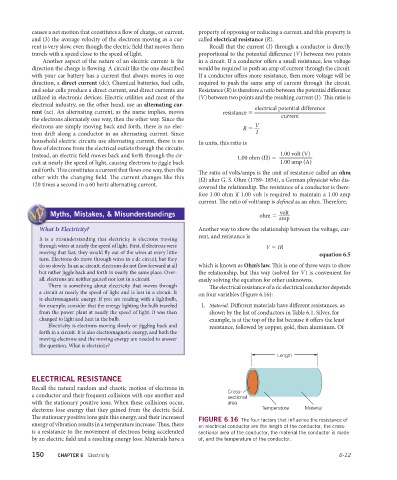
                     a circuit at nearly the speed of light and is lost in a circuit. It   on four variables (Figure 6.16):
                     is electromagnetic energy. If you are reading with a lightbulb,


                     for example, consider that the energy lighting the bulb traveled     1.  Material. Different materials have different resistances, as
                     from the power plant at nearly the speed of light. It was then   shown by the list of conductors in Table 6.1. Silver, for
                     changed to light and heat in the bulb.                  example, is at the top of the list because it offers the least

                        Electricity is electrons moving slowly or jiggling back and   resistance, followed by copper, gold, then aluminum. Of
                     forth in a circuit. It is also electromagnetic energy, and both the
                     moving electrons and the moving energy are needed to answer
                     the question, What is electricity?
                                                                                                    Length
                   ELECTRICAL RESISTANCE
                   Recall the natural random and chaotic motion of electrons in     Cross-
                   a conductor and their frequent collisions with one another and   sectional
                   with the stationary positive ions. When these collisions occur,   area
                   electrons lose energy that they gained from the electric fi eld.            Temperature   Material
                   The stationary positive ions gain this energy, and their increased

                                                                          FIGURE 6.16  The four factors that influence the resistance of
                   energy of vibration results in a temperature increase. Th us, there   an electrical conductor are the length of the conductor, the cross-
                   is a resistance to the movement of electrons being accelerated   sectional area of the conductor, the material the conductor is made

                   by an electric field and a resulting energy loss. Materials have a   of, and the temperature of the conductor.
                   150     CHAPTER 6 Electricity                                                                        6-12

