


Page 181 - 9780077418427.pdf
P. 181
/Users/user-f465/Desktop
          tiL12214_ch06_139-176.indd Page 158  9/1/10  9:40 PM user-f465
          tiL12214_ch06_139-176.indd Page 158  9/1/10  9:40 PM user-f465                                                /Users/user-f465/Desktop


                                                                                                               N
                      6.4  ELECTRIC CURRENTS AND                                                 e
                         MAGNETISM

                   As Oersted discovered, electric charges in motion produce a

                   magnetic fi eld.  The direction of the magnetic field around a

                   current-carrying wire can be determined by using a magnetic
                   compass. The north-seeking pole of the compass needle will

                   point in the direction of the magnetic field lines. If you move

                   the compass around the wire, the needle will always move to a   A         e         B
                   position that is tangent to a circle around the wire. Evidently, the
                   magnetic field lines are closed concentric circles that are at right

                   angles to the length of the wire (Figure 6.25).                                             S
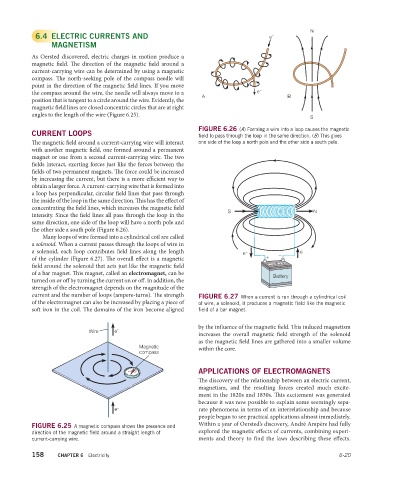
                                                                          FIGURE 6.26 (A) Forming a wire into a loop causes the magnetic
                   CURRENT LOOPS                                          field to pass through the loop in the same direction. (B) This gives

                   The magnetic field around a current-carrying wire will interact   one side of the loop a north pole and the other side a south pole.

                   with another magnetic field, one formed around a permanent

                   magnet or one from a second current-carrying wire. Th e two

                   fields interact, exerting forces just like the forces between the

                   fi elds of two permanent magnets. The force could be increased
                   by increasing the current, but there is a more effi  cient way to
                   obtain a larger force. A current-carrying wire that is formed into
                   a loop has perpendicular, circular field lines that pass through


                   the inside of the loop in the same direction. This has the eff ect of
                   concentrating the field lines, which increases the magnetic fi eld   S                       N

                   intensity. Since the field lines all pass through the loop in the

                   same direction, one side of the loop will have a north pole and
                   the other side a south pole (Figure 6.26).
                      Many loops of wire formed into a cylindrical coil are called
                   a solenoid. When a current passes through the loops of wire in
                   a solenoid, each loop contributes field lines along the length        e –         –      e –


                   of the cylinder (Figure 6.27). The overall effect is a magnetic              +

                   field around the solenoid that acts just like the magnetic fi eld

                   of a bar magnet. This magnet, called an electromagnet, can be                   Battery

                   turned on or off by turning the current on or off. In addition, the

                   strength of the electromagnet depends on the magnitude of the
                   current and the number of loops (ampere-turns). Th e strength   FIGURE 6.27  When a current is run through a cylindrical coil
                   of the electromagnet can also be increased by placing a piece of   of wire, a solenoid, it produces a magnetic field like the magnetic


                   soft iron in the coil. The domains of the iron become aligned   field of a bar magnet.

                                                                          by the influence of the magnetic fi eld. This induced magnetism

                                      Wire    e –
                                                                          increases the overall magnetic field strength of the solenoid

                                                                          as the magnetic field lines are gathered into a smaller volume

                                                      Magnetic            within the core.
                                                      compass
                                                                          APPLICATIONS OF ELECTROMAGNETS

                                                                          The discovery of the relationship between an electric current,
                                                                          magnetism, and the resulting forces created much excite-

                                                                          ment in the 1820s and 1830s. This excitement was generated
                                                                          because it was now possible to explain some seemingly sepa-
                                              e –                         rate phenomena in terms of an interrelationship and because
                                                                          people began to see practical applications almost immediately.
                                                                          Within a year of Oersted’s discovery, André Ampère had fully
                   FIGURE 6.25  A magnetic compass shows the presence and

                   direction of the magnetic field around a straight length of   explored the magnetic effects of currents, combining experi-

                   current-carrying wire.                                 ments and theory to find the laws describing these eff ects.
                   158     CHAPTER 6 Electricity                                                                        6-20

