


Page 184 - 9780077418427.pdf
P. 184
/Users/user-f465/Desktop
          tiL12214_ch06_139-176.indd Page 161  9/1/10  9:40 PM user-f465
          tiL12214_ch06_139-176.indd Page 161  9/1/10  9:40 PM user-f465                                                /Users/user-f465/Desktop


                                                 Commutator       Field
                                                                  magnet                  2 1 012                 2 1 012
                                                            N
                                         Brush

                                  S                      Armature  N
                                                                                        S                       S


                                          S

                                    e  –

                        e –                                                             N                       N


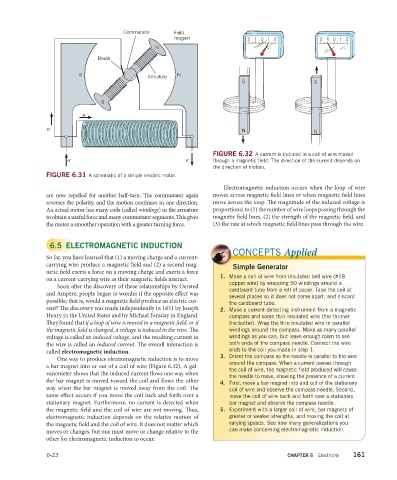
                                                                               FIGURE 6.32  A current is induced in a coil of wire moved
                               e –                                    e –      through a magnetic field. The direction of the current depends on
                                                                               the direction of motion.
                        FIGURE 6.31  A schematic of a simple electric motor.

                                                                                  Electromagnetic induction occurs when the loop of wire


                       are now repelled for another half-turn. The commutator again   moves across magnetic field lines or when magnetic fi eld lines
                       reverses the polarity, and the motion continues in one direction.   move across the loop. The magnitude of the induced voltage is

                       An actual motor has many coils (called windings) in the armature   proportional to (1) the number of wire loops passing through the

                       to obtain a useful force and many commutator segments. Th is gives   magnetic field lines, (2) the strength of the magnetic fi eld, and
                       the motor a smoother operation with a greater turning force.  (3) the rate at which magnetic field lines pass through the wire.

                         6.5 ELECTROMAGNETIC INDUCTION
                                                                                     CONCEPTS Applied
                       So far, you have learned that (1) a moving charge and a current-

                       carrying wire produce a magnetic field and (2) a second mag-  Simple Generator
                       netic fi eld exerts a force on a moving charge and exerts a force
                                                                                 1.  Make a coil of wire from insulated bell wire (#18
                       on a current-carrying wire as their magnetic fi elds interact.
                                                                                    copper wire) by wrapping 50 windings around a
                           Soon after the discovery of these relationships by Oersted

                                                                                    cardboard tube from a roll of paper. Tape the coil at
                       and Ampère, people began to wonder if the opposite eff ect was
                                                                                    several places so it does not come apart, and discard
                       possible; that is, would a magnetic field produce an electric cur-

                                                                                    the cardboard tube.

                       rent? The discovery was made independently in 1831 by Joseph   2.  Make a current-detecting instrument from a magnetic
                       Henry in the United States and by Michael Faraday in England.   compass and some thin insulated wire (the thinner
                       They found that if a loop of wire is moved in a magnetic fi eld, or if   the better). Wrap the thin insulated wire in parallel

                       the magnetic field is changed, a voltage is induced in the wire. Th e   windings around the compass. Make as many parallel

                       voltage is called an induced voltage, and the resulting current in   windings as you can, but leave enough room to see

                       the wire is called an induced current. The overall interaction is   both ends of the compass needle. Connect the wire
                       called electromagnetic induction.                            ends to the coil you made in step 1.
                                                                                 3.  Orient the compass so the needle is parallel to the wire
                           One way to produce electromagnetic induction is to move
                                                                                    around the compass. When a current passes through
                       a bar magnet into or out of a coil of wire (Figure 6.32). A gal-
                                                                                    the coil of wire, the magnetic field produced will cause
                       vanometer shows that the induced current flows one way when

                                                                                    the needle to move, showing the presence of a current.
                       the bar magnet is moved toward the coil and flows the other

                                                                                 4.  First, move a bar magnet into and out of the stationary
                       way when the bar magnet is moved away from the coil. Th e    coil of wire and observe the compass needle. Second,

                       same effect occurs if you move the coil back and forth over a   move the coil of wire back and forth over a stationary
                       stationary magnet. Furthermore, no current is detected when   bar magnet and observe the compass needle.

                       the magnetic field and the coil of wire are not moving. Th us,   5.  Experiment with a larger coil of wire, bar magnets of
                       electromagnetic induction depends on the relative motion of   greater or weaker strengths, and moving the coil at

                       the magnetic field and the coil of wire. It does not matter which   varying speeds. See how many generalizations you
                       moves or changes, but one must move or change relative to the   can make concerning electromagnetic induction.
                       other for electromagnetic induction to occur.
                        6-23                                                                           CHAPTER 6  Electricity   161

