


Page 182 - 9780077418427.pdf
P. 182
/Users/user-f465/Desktop
          tiL12214_ch06_139-176.indd Page 159  9/1/10  9:40 PM user-f465
          tiL12214_ch06_139-176.indd Page 159  9/1/10  9:40 PM user-f465                                                /Users/user-f465/Desktop


                       Soon after Ampère’s work, the possibility of doing mechanical   CONCEPTS Applied
                       work by sending currents through wires was explored. Th e elec-
                       tric motor, similar to motors in use today, was invented in 1834,   Lemon Battery

                       only 14 years after Oersted’s momentous discovery.
                                                                                 1.  You can make a simple compass galvanometer that

                           The magnetic fi eld produced by an electric current is used
                                                                                    will detect a small electric current (Box Figure 6.1).
                       in many practical applications, including electrical meters,
                                                                                    All you need is a magnetic compass and some thin
                       electromagnetic switches that make possible the remote or    insulated wire (the thinner the better).
                       programmed control of moving mechanical parts, and elec-  2.  Wrap the thin insulated wire in parallel windings
                       tric motors. In each of these applications, an electric current is   around the compass. Make as many parallel windings
                       applied to an electromagnet.                                 as you can, but leave enough room to see both ends
                                                                                    of the compass needle. Leave the wire ends free for
                                                                                    connections.
                       Electric Meters
                                                                                 3.  To use the galvanometer, first turn the compass so
                       Since you cannot measure electricity directly, it must be mea-  the needle is parallel to the wire windings. When a
                       sured indirectly through one of the effects that it produces. Th e   current passes through the coil of wire, the magnetic

                       strength of the magnetic field produced by an electromagnet   field produced will cause the needle to move from

                       is proportional to the electric current in the electromagnet.   its north-south position, showing the presence of a

                       Thus, one way to measure a current is to measure the magnetic   current. The needle will deflect one way or the other

                       field that it produces. A device that measures currents from   depending on the direction of the current.
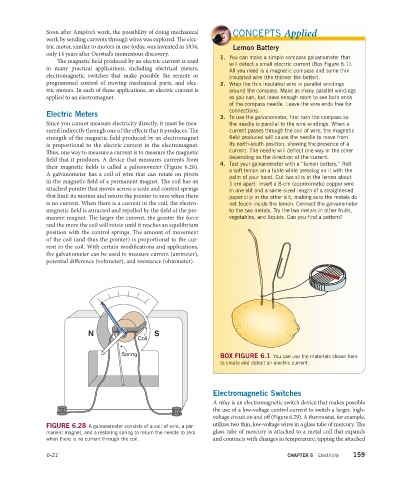
                       their magnetic fields is called a  galvanometer (Figure 6.28).   4.  Test your galvanometer with a “lemon battery.” Roll

                       A galvanometer has a coil of wire that can rotate on pivots   a soft lemon on a table while pressing on it with the
                                                                                    palm of your hand. Cut two slits in the lemon about


                       in the magnetic field of a permanent magnet. The coil has an   1 cm apart. Insert a 8-cm (approximate) copper wire
                       attached pointer that moves across a scale and control springs   in one slit and a same-sized length of a straightened
                       that limit its motion and return the pointer to zero when there   paper clip in the other slit, making sure the metals do
                       is no current. When there is a current in the coil, the electro-  not touch inside the lemon. Connect the galvanometer

                       magnetic field is attracted and repelled by the field of the per-  to the two metals. Try the two metals in other fruits,


                       manent magnet. The larger the current, the greater the force   vegetables, and liquids. Can you find a pattern?
                       and the more the coil will rotate until it reaches an equilibrium

                       position with the control springs. The amount of movement
                       of the coil (and thus the pointer) is proportional to the cur-

                       rent in the coil. With certain modifications and applications,
                       the galvanometer can be used to measure current (ammeter),
                       potential difference (voltmeter), and resistance (ohmmeter).


                                     N                     S
                                                      Coil

                                                Spring
                                                                                 BOX FIGURE 6.1  You can use the materials shown here
                                                                                 to create and detect an electric current.


                                                                               Electromagnetic Switches
                                                                               A relay is an electromagnetic switch device that makes possible
                                                                               the use of a low-voltage control current to switch a larger, high-
                                                                               voltage circuit on and off (Figure 6.29). A thermostat, for example,

                                                                               utilizes two thin, low-voltage wires in a glass tube of mercury. Th e
                       FIGURE 6.28  A galvanometer consists of a coil of wire, a per-
                       manent magnet, and a restoring spring to return the needle to zero   glass tube of mercury is attached to a metal coil that expands
                       when there is no current through the coil.              and contracts with changes in temperature, tipping the attached

                       6-21                                                                            CHAPTER 6  Electricity  159

