


Page 185 - 9780077418427.pdf
P. 185
/Users/user-f465/Desktop
          tiL12214_ch06_139-176.indd Page 162  9/1/10  9:40 PM user-f465
          tiL12214_ch06_139-176.indd Page 162  9/1/10  9:40 PM user-f465                                                /Users/user-f465/Desktop


                           A Closer Look


                           Current War
                        homas Edison (1847–1931) built the   lighting would soon be replacing all the gas-  Westinghouse’s promotion of ac led
                     Tfirst electric generator and electri-  lights. After studying the matter, he decided   to direct competition with Edison and his
                     cal distribution system to promote his   that Edison’s low-voltage system was not   dc electrical systems. A “war of currents”
                     new long-lasting lightbulbs. The dc gen-  efficient enough. In 1885, he began experi-  resulted, with Edison claiming that trans-
                     erator and distribution system was built in   menting with ac generators and transformers   mission of such high voltage was dangerous.
                     lower Manhattan, New York City, and was   in Pittsburgh.              He emphasized this point by recommend-
                     switched on September 4, 1882. It supplied   Nikola Tesla (1856–1943) was a  Croatian-   ing the use of high-voltage ac in an electric
                     110 V dc to 59 customers. Edison stud-  born U.S. physicist and electrical engineer   chair as the best way to execute prisoners.
                     ied both ac and dc systems and chose dc   who moved to the United States and worked   The advantages of ac were greater since
                     because of advantages it offered at the time.   for Thomas Edison in 1884. He then set up   you could increase the voltage, transmit
                     Direct current was used because batter-  his own laboratory and workshop in 1887.   for long distances at a lower cost, and then
                     ies are dc, and batteries were used as a   His work led to a complicated set of patents   decrease the voltage to a safe level. Even-
                     system backup. Also, dc worked fine with   covering the generation, transmission, and   tually, even Edison’s own General Electric
                     electric motors, and ac motors were not   use of ac electricity. From 1888 on, Tesla   company switched to producing ac equip-
                     yet available.                     was associated with George Westinghouse,   ment. Westinghouse turned his attention to
                        George Westinghouse (1846–1914)   who bought and successfully exploited Tesla’s   the production of large steam turbines for
                     was in the business of supplying gas for   ideas, leading to the introduction of ac for   producing ac power and was soon setting
                     gas lighting, and he could see that electric   power transmission.    up ac distribution systems across the nation.


                   GENERATORS
                   Soon after the discovery of electromagnetic induction the elec-

                   tric generator was developed. The generator is essentially an

                   axle with many wire loops that rotates in a magnetic fi eld. Th e                  Armature
                   axle is turned by some form of mechanical energy, such as a
                   water turbine or a steam turbine, which uses steam generated   Field coil      N           S
                   from fossil fuels or nuclear energy. As the coil rotates in a mag-
                   netic field, a current is induced in the coil (Figure 6.33).

                                                                                                             Magnetic
                                                                                  Connection                 field lines
                                                                                  for ac
                   TRANSFORMERS                                                                           Terminal brushes
                   Current from a power plant goes to a transformer to step up the
                   voltage. A transformer is a device that steps up or steps down   A
                   the ac voltage. It has two basic parts: (1) a primary or “input”
                   coil and (2) a secondary or “output” coil, which is close by. Both
                   coils are often wound on a single iron core but are always fully
                   insulated from each other. When there is an alternating current   +
                   through the primary coil, a magnetic field grows around the coil
                   to a maximum size, collapses to zero, then grows to a maximum
                   size with an opposite polarity. This happens 120 times a second   –
                   as the alternating current oscillates at 60 hertz. The magnetic
                   field is strengthened and directed by the iron core. The growing
                   and collapsing magnetic field moves across the wires in the   B
                   secondary coil, inducing a voltage in the secondary coil. The
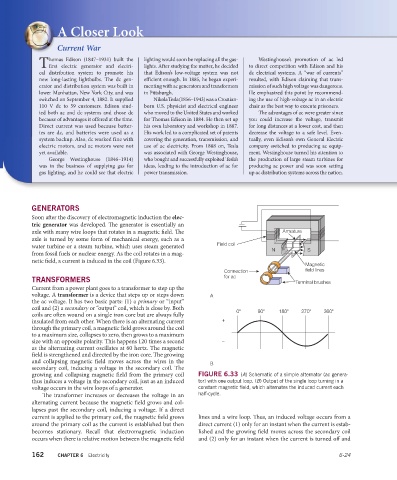
                   growing and collapsing magnetic field from the primary coil   FIGURE 6.33 (A) Schematic of a simple alternator (ac genera-
                   thus induces a voltage in the secondary coil, just as an induced   tor) with one output loop. (B) Output of the single loop turning in a
                   voltage occurs in the wire loops of a generator.       constant magnetic field, which alternates the induced current each

                      The transformer increases or decreases the voltage in an   half-cycle.

                   alternating current because the magnetic field grows and col-
                   lapses past the secondary coil, inducing a voltage. If a direct

                   current is applied to the primary coil, the magnetic fi eld grows   lines and a wire loop. Thus, an induced voltage occurs from a
                   around the primary coil as the current is established but then   direct current (1) only for an instant when the current is estab-

                   becomes stationary. Recall that electromagnetic induction   lished and the growing field moves across the secondary coil
                   occurs when there is relative motion between the magnetic fi eld   and (2) only for an instant when the current is turned off  and
                   162     CHAPTER 6 Electricity                                                                        6-24

