


Page 203 - 9780077418427.pdf
P. 203
/Users/user-f465/Desktop
          tiL12214_ch07_177-202.indd Page 180  9/1/10  9:43 PM user-f465
          tiL12214_ch07_177-202.indd Page 180  9/1/10  9:43 PM user-f465                                                /Users/user-f465/Desktop


                                  Visible light                                   Incident
                                                                                  light
                                                   Sensitivity of
                                                    human eye
                         Relative intensity  radiation    radiation                            Absorbed
                              Ultraviolet
                                                          Infrared


                                                                                               light
                                                                                                            Transmitted
                                                                                                            light
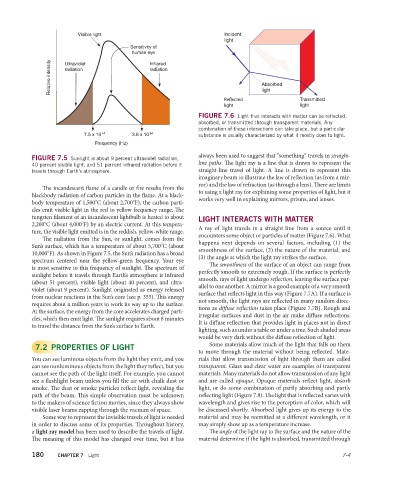
                                                                          FIGURE 7.6  Light that interacts with matter can be reflected,
                                                                          absorbed, or transmitted through transparent materials. Any
                                                                          combination of these interactions can take place, but a particular
                                    7.5 x 10 14     3.8 x 10 14           substance is usually characterized by what it mostly does to light.
                                        Frequency (Hz)
                                                                          always been used to suggest that “something” travels in straight-
                     FIGURE 7.5  Sunlight is about 9 percent ultraviolet radiation,
                                                                          line paths. The light ray is a line that is drawn to represent the

                   40 percent visible light, and 51 percent infrared radiation before it
                   travels through Earth’s atmosphere.                    straight-line travel of light. A line is drawn to represent this

                                                                          imaginary beam to illustrate the law of reflection (as from a mir-

                                                                          ror) and the law of refraction (as through a lens). There are limits
                      The incandescent flame of a candle or fire results from the


                   blackbody radiation of carbon particles in the flame. At a black-  to using a light ray for explaining some properties of light, but it
                   body temperature of 1,500°C (about 2,700°F), the carbon parti-  works very well in explaining mirrors, prisms, and lenses.
                   cles emit visible light in the red to yellow frequency range. Th e

                   tungsten filament of an incandescent lightbulb is heated to about   LIGHT INTERACTS WITH MATTER
                   2,200°C (about 4,000°F) by an electric current. At this tempera-
                   ture, the visible light emitted is in the reddish, yellow-white range.  A ray of light travels in a straight line from a source until it

                      The radiation from the Sun, or sunlight, comes from the   encounters some object or particles of matter (Figure 7.6). What
                   Sun’s surface, which has a temperature of about 5,700°C (about   happens next depends on several factors, including (1) the
                   10,000°F). As shown in Figure 7.5, the Sun’s radiation has a broad   smoothness of the surface, (2) the nature of the material, and
                   spectrum centered near the yellow-green frequency. Your eye   (3) the angle at which the light ray strikes the surface.

                   is most sensitive to this frequency of sunlight. The spectrum of   Th e smoothness of the surface of an object can range from
                   sunlight before it travels through Earth’s atmosphere is infrared   perfectly smooth to extremely rough. If the surface is perfectly
                   (about 51 percent), visible light (about 40 percent), and ultra-  smooth, rays of light undergo refl ection, leaving the surface par-
                   violet (about 9 percent). Sunlight originated as energy released   allel to one another. A mirror is a good example of a very smooth

                   from nuclear reactions in the Sun’s core (see p. 355).  Th is energy   surface that reflects light in this way (Figure 7.7A). If a surface is
                   requires about a million years to work its way up to the surface.   not smooth, the light rays are refl ected in many random direc-
                   At the surface, the energy from the core accelerates charged parti-  tions as diff use refl ection takes place (Figure 7.7B). Rough and
                   cles, which then emit light. The sunlight requires about 8 minutes   irregular surfaces and dust in the air make diff use refl ections.

                   to travel the distance from the Sun’s surface to Earth.  It is diff use refl ection that provides light in places not in direct
                                                                          lighting, such as under a table or under a tree. Such shaded areas

                                                                          would be very dark without the diff use reflection of light.
                                                                             Some materials allow much of the light that falls on them
                    7.2  PROPERTIES OF LIGHT
                                                                          to move through the material without being refl ected.  Mate-
                   You can see luminous objects from the light they emit, and you   rials that allow transmission of light through them are called
                   can see nonluminous objects from the light they reflect, but you   transparent. Glass and clear water are examples of transparent

                   cannot see the path of the light itself. For example, you cannot   materials. Many materials do not allow transmission of any light

                   see a flashlight beam unless you fill the air with chalk dust or   and are called  opaque. Opaque materials reflect light, absorb


                   smoke. The dust or smoke particles reflect light, revealing the   light, or do some combination of partly absorbing and partly


                   path of the beam. This simple observation must be unknown   reflecting light (Figure 7.8). The light that is refl ected varies with


                   to the makers of science fiction movies, since they always show   wavelength and gives rise to the perception of color, which will
                   visible laser beams zapping through the vacuum of space.  be discussed shortly. Absorbed light gives up its energy to the
                      Some way to represent the invisible travels of light is needed   material and may be reemitted at a different wavelength, or it

                   in order to discuss some of its properties. Th roughout history,   may simply show up as a temperature increase.
                   a light ray model has been used to describe the travels of light.   Th e angle of the light ray to the surface and the nature of the

                   The meaning of this model has changed over time, but it has   material determine if the light is absorbed, transmitted through
                   180     CHAPTER 7 Light                                                                                7-4

