


Page 205 - 9780077418427.pdf
P. 205
/Users/user-f465/Desktop
          tiL12214_ch07_177-202.indd Page 182  9/1/10  9:43 PM user-f465
          tiL12214_ch07_177-202.indd Page 182  9/1/10  9:43 PM user-f465                                                /Users/user-f465/Desktop


                         Myths, Mistakes, & Misunderstandings

                     The Light Saber

                     The Star Wars light saber is an impossible myth. Assuming that
                     the light saber is a laser beam, we know that one laser beam
                     will not stop another laser beam. Light beams simply pass
                     through each other. Furthermore, a laser with a fixed length is
                     not possible without a system of lenses that would also scatter
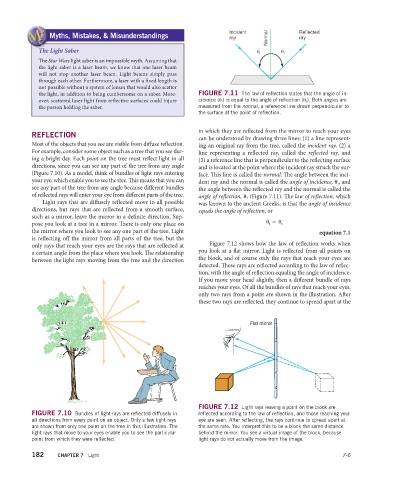
                     the light, in addition to being cumbersome on a saber. More-  FIGURE 7.11  The law of reflection states that the angle of in-
                     over, scattered laser light from reflective surfaces could injure   cidence (θ i ) is equal to the angle of reflection (θ r ). Both angles are
                     the person holding the saber.                        measured from the normal, a reference line drawn perpendicular to
                                                                          the surface at the point of reflection.

                                                                          in which they are reflected from the mirror to reach your eyes

                   REFLECTION
                                                                          can be understood by drawing three lines: (1) a line represent-
                   Most of the objects that you see are visible from diff use refl ection.   ing an original ray from the tree, called the incident ray, (2) a
                   For example, consider some object such as a tree that you see dur-  line representing a reflected ray, called the  refl ected  ray, and

                   ing a bright day. Each point on the tree must reflect light in all   (3) a reference line that is perpendicular to the refl ecting surface

                   directions, since you can see any part of the tree from any angle   and is located at the point where the incident ray struck the sur-
                   (Figure 7.10). As a model, think of bundles of light rays entering   face. This line is called the normal. The angle between the inci-


                   your eye, which enable you to see the tree. This means that you can   dent ray and the normal is called the angle of incidence, θ i , and
                   see any part of the tree from any angle because diff erent bundles   the angle between the reflected ray and the normal is called the


                   of reflected rays will enter your eye from different parts of the tree.  angle of refl ection, θ r  (Figure 7.11). Th e law of refl ection, which

                      Light rays that are diff usely reflected move in all possible   was known to the ancient Greeks, is that the angle of incidence

                   directions, but rays that are reflected from a smooth surface,   equals the angle of refl ection, or

                   such as a mirror, leave the mirror in a definite direction. Sup-

                   pose you look at a tree in a mirror. There is only one place on              θ i  = θ r
                   the mirror where you look to see any one part of the tree. Light                               equation 7.1

                   is refl ecting off the mirror from all parts of the tree, but the

                                                                             Figure 7.12 shows how the law of reflection works when
                   only rays that reach your eyes are the rays that are refl ected at


                                                                          you look at a flat mirror. Light is reflected from all points on
                   a certain angle from the place where you look. Th e relationship
                                                                          the block, and of course only the rays that reach your eyes are
                   between the light rays moving from the tree and the direction

                                                                          detected. These rays are refl ected according to the law of refl ec-

                                                                          tion, with the angle of reflection equaling the angle of incidence.
                                                                          If you move your head slightly, then a different bundle of rays

                                                                          reaches your eyes. Of all the bundles of rays that reach your eyes,
                                                                          only two rays from a point are shown in the illustration. Aft er
                                                                          these two rays are reflected, they continue to spread apart at the


                                                                          FIGURE 7.12  Light rays leaving a point on the block are
                   FIGURE 7.10  Bundles of light rays are reflected diffusely in   reflected according to the law of reflection, and those reaching your
                   all directions from every point on an object. Only a few light rays   eye are seen. After reflecting, the rays continue to spread apart at
                   are shown from only one point on the tree in this illustration. The   the same rate. You interpret this to be a block the same distance
                   light rays that move to your eyes enable you to see the particular   behind the mirror. You see a virtual image of the block, because
                   point from which they were reflected.                  light rays do not actually move from the image.

                   182     CHAPTER 7 Light                                                                                7-6

