


Page 208 - 9780077418427.pdf
P. 208
/Users/user-f465/Desktop
          tiL12214_ch07_177-202.indd Page 185  9/1/10  9:43 PM user-f465
          tiL12214_ch07_177-202.indd Page 185  9/1/10  9:43 PM user-f465                                                /Users/user-f465/Desktop


                         TABLE 7.1                                                                   Cooler air
                                                                                                          Hot air
                         Index of refraction
                         Substance               n = c/v
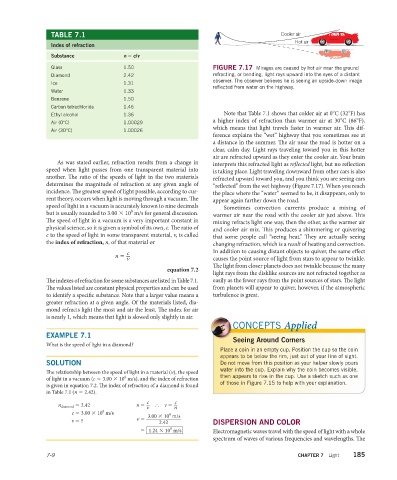
                         Glass                   1.50                          FIGURE 7.17  Mirages are caused by hot air near the ground
                         Diamond                 2.42                          refracting, or bending, light rays upward into the eyes of a distant
                                                                               observer. The observer believes he is seeing an upside-down image
                         Ice                     1.31
                                                                               reflected from water on the highway.
                         Water                   1.33
                         Benzene                 1.50
                         Carbon tetrachloride    1.46
                         Ethyl alcohol           1.36                             Note that Table 7.1 shows that colder air at 0°C (32°F) has
                                                                               a higher index of refraction than warmer air at 30°C (86°F),
                         Air (0°C)               1.00029
                                                                               which means that light travels faster in warmer air. Th is dif-
                         Air (30°C)              1.00026
                                                                               ference explains the “wet” highway that you sometimes see at
                                                                               a distance in the summer. The air near the road is hotter on a

                                                                               clear, calm day. Light rays traveling toward you in this hotter
                                                                               air are refracted upward as they enter the cooler air. Your brain
                           As was stated earlier, refraction results from a change in   interprets this refracted light as refl ected light, but no refl ection
                       speed when light passes from one transparent material into   is taking place. Light traveling downward from other cars is also

                       another. The ratio of the speeds of light in the two materials   refracted upward toward you, and you think you are seeing cars
                       determines the magnitude of refraction at any given angle of   “reflected” from the wet highway (Figure 7.17). When you reach


                       incidence. The greatest speed of light possible, according to cur-  the place where the “water” seemed to be, it disappears, only to
                       rent theory, occurs when light is moving through a vacuum. Th e   appear again farther down the road.
                       speed of light in a vacuum is accurately known to nine decimals   Sometimes convection currents produce a mixing of
                                                    8
                       but is usually rounded to 3.00 × 10  m/s for general discussion.   warmer air near the road with the cooler air just above. Th is
                       The speed of light in a vacuum is a very important constant in   mixing refracts light one way, then the other, as the warmer air

                       physical science, so it is given a symbol of its own, c. The ratio of   and cooler air mix. This produces a shimmering or quivering


                       c to the speed of light in some transparent material, v, is called   that some people call “seeing heat.” They are actually seeing

                       the index of refraction, n, of that material or         changing refraction, which is a result of heating and convection.
                                                  c _
                                              n =                              In addition to causing distant objects to quiver, the same eff ect

                                                  v                            causes the point source of light from stars to appear to twinkle.
                                                                               The light from closer planets does not twinkle because the many

                                                                equation 7.2
                                                                               light rays from the disklike sources are not refracted together as

                       The indexes of refraction for some substances are listed in  Table 7.1.   easily as the fewer rays from the point sources of stars. Th e light
                       The values listed are constant physical properties and can be used   from planets will appear to quiver, however, if the atmospheric

                       to identify a specifi c substance. Note that a larger value means a   turbulence is great.
                       greater refraction at a given angle. Of the materials listed, dia-

                       mond refracts light the most and air the least. The index for air
                       is nearly 1, which means that light is slowed only slightly in air.
                                                                                     CONCEPTS Applied
                       EXAMPLE 7.1
                                                                                     Seeing Around Corners
                       What is the speed of light in a diamond?
                                                                                 Place a coin in an empty cup. Position the cup so the coin
                                                                                   appears to be below the rim, just out of your line of sight.
                       SOLUTION                                                  Do not move from this position as your helper slowly pours
                                                                                 water into the cup. Explain why the coin becomes visible,

                       The relationship between the speed of light in a material (v), the speed
                                                 8
                       of light in a vacuum (c = 3.00 × 10  m/s), and the index of refraction   then appears to rise in the cup. Use a sketch such as one
                        is given in equation 7.2. The index of refraction of a diamond is found   of those in Figure 7.15 to help with your explanation.

                        in Table 7.1 (n = 2.42).
                                                                  c _
                                                         c _


                            n diamond  = 2.42        n =      ∴  v =


                                                         v        n
                                          8
                                c = 3.00 × 10  m/s              8
                                                         3.00 × 10  m/s

                                v = ?                v =     __                DISPERSION AND COLOR
                                                             2.42
                                                                 8
                                                       =   1.24 × 10  m/s      Electromagnetic waves travel with the speed of light with a whole
                                                                               spectrum of waves of various frequencies and wavelengths. Th e
                       7-9                                                                                 CHAPTER 7  Light   185

