


Page 206 - 9780077418427.pdf
P. 206
/Users/user-f465/Desktop
          tiL12214_ch07_177-202.indd Page 183  9/1/10  9:43 PM user-f465
          tiL12214_ch07_177-202.indd Page 183  9/1/10  9:43 PM user-f465                                                /Users/user-f465/Desktop


                       same rate that they were spreading before reflection. Your eyes   CONCEPTS Applied
                       and brain do not know that the rays have been refl ected, and
                       the diverging rays appear to come from behind the mirror, as   Good Reflections

                       the dashed lines show. The image, therefore, appears to be the
                                                                                 Do you need a full-length mirror to see your hair and your feet
                       same distance behind the mirror as the block is from the front
                                                                                 at the same time? Does how much you see in a mirror depend

                       of the mirror. Thus, a mirror image is formed where the rays of
                                                                                 on how far you stand from the mirror? If you wink your right
                       light appear to originate. This is called a virtual image. A virtual   eye, does the right or left eye of your image wink back?

                       image is the result of your eyes’ and brain’s interpretations of light   You can check your answers to the above questions
                       rays, not actual light rays originating from an image. Light rays   with a large mirror on a wall, masking tape, a meter stick,
                       that do originate from the other kind of image are called a real   and someone to help.
                       image. A real image is like the one displayed on a movie screen,   Stand facing the mirror and tell your helper exactly
                       with light originating from the image. A virtual image cannot   where to place a piece of masking tape on the mirror to
                       be displayed on a screen, since it results from an interpretation.  mark the top of your head. Place a second piece of tape on
                           Curved mirrors are either  concave, with the center part   the  mirror to mark the top of your belt or some other part
                                                                                 of your clothing.
                       curved inward, or  convex, with the center part bulging out-
                                                                                    Now we need some measurements on you and on the
                       ward. A concave mirror can be used to form an enlarged virtual
                                                                                   mirror. First, measure and record the actual distance from
                       image, such as a shaving or makeup mirror, or it can be used to
                                                                                 the top of your head to the top of your belt or the other
                       form a real image, as in a refl ecting telescope. Convex mirrors,   clothing marked. Second, measure and record the distance
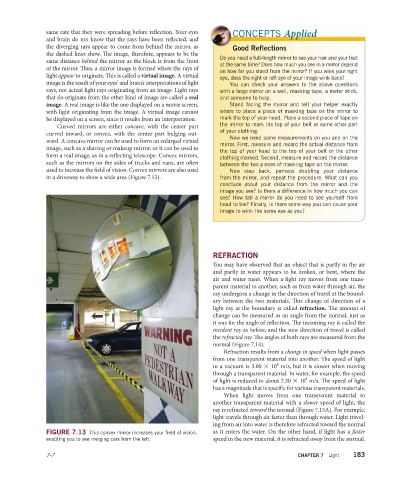
                       such as the mirrors on the sides of trucks and vans, are oft en   between the two pieces of masking tape on the mirror.

                       used to increase the field of vision. Convex mirrors are also used   Now step back, perhaps doubling your distance
                       in a driveway to show a wide area (Figure 7.13).          from the mirror, and repeat the procedure. What can you
                                                                                 conclude about your distance from the mirror and the
                                                                                 image you see? Is there a difference in how much you can
                                                                                 see? How tall a  mirror do you need to see yourself from
                                                                                 head to toe? Finally, is there some way you can cause your
                                                                                 image to wink the same eye as you?


                                                                               REFRACTION
                                                                               You may have observed that an object that is partly in the air
                                                                               and partly in water appears to be broken, or bent, where the
                                                                               air and water meet. When a light ray moves from one trans-
                                                                               parent material to another, such as from water through air, the
                                                                               ray undergoes a change in the direction of travel at the bound-

                                                                               ary between the two materials. This change of direction of a

                                                                               light ray at the boundary is called refraction. The amount of
                                                                               change can be measured as an angle from the normal, just as
                                                                               it was for the angle of refl ection. The incoming ray is called the

                                                                               incident ray as before, and the new direction of travel is called
                                                                               the refracted ray. The angles of both rays are measured from the

                                                                               normal (Figure 7.14).
                                                                                  Refraction results from a change in speed when light passes

                                                                               from one transparent material into another. The speed of light
                                                                                                    8
                                                                               in a vacuum is 3.00 × 10  m/s, but it is slower when moving
                                                                               through a transparent material. In water, for example, the speed
                                                                                                             8
                                                                               of light is reduced to about 2.30 × 10  m/s. The speed of light


                                                                               has a magnitude that is specific for various transparent materials.
                                                                                  When light moves from one transparent material to
                                                                               another transparent material with a slower speed of light, the
                                                                               ray is refracted toward the normal (Figure 7.15A). For example,
                                                                               light travels through air faster than through water. Light travel-
                                                                               ing from air into water is therefore refracted toward the normal
                       FIGURE 7.13  This convex mirror increases your field of vision,   as it enters the water. On the other hand, if light has a faster
                       enabling you to see merging cars from the left.         speed in the new material, it is refracted away from the normal.

                       7-7                                                                                 CHAPTER 7  Light   183

