


Page 207 - 9780077418427.pdf
P. 207
/Users/user-f465/Desktop
          tiL12214_ch07_177-202.indd Page 184  9/1/10  9:43 PM user-f465
          tiL12214_ch07_177-202.indd Page 184  9/1/10  9:43 PM user-f465                                                /Users/user-f465/Desktop


                                                                                                                 Air
                                                                                            90                   Water

                                                                                                 i  r
                                                                                                        Reflected ray
                                                                                            Critical
                                                                                            angle
                                                                                    Light source

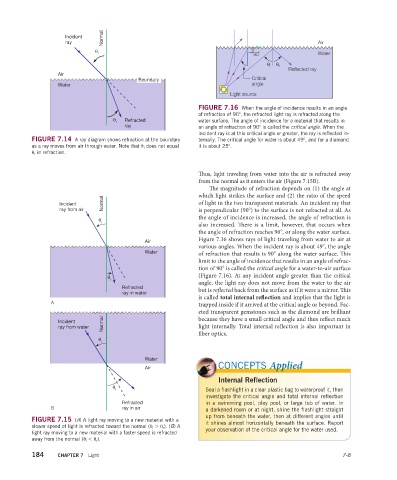
                                                                          FIGURE 7.16  When the angle of incidence results in an angle
                                                                          of refraction of 90°, the refracted light ray is refracted along the
                                                                          water surface. The angle of incidence for a material that results in
                                                                          an angle of refraction of 90° is called the critical angle. When the
                                                                          incident ray is at this critical angle or greater, the ray is reflected in-
                   FIGURE 7.14  A ray diagram shows refraction at the boundary   ternally. The critical angle for water is about 49°, and for a diamond
                   as a ray moves from air through water. Note that θ i  does not equal   it is about 25°.
                   θ r  in refraction.


                                                                          Thus, light traveling from water into the air is refracted away
                                                                          from the normal as it enters the air (Figure 7.15B).
                                                                             The magnitude of refraction depends on (1) the angle at

                                                                          which light strikes the surface and (2) the ratio of the speed
                                                                          of light in the two transparent materials. An incident ray that
                                                                          is perpendicular (90°) to the surface is not refracted at all. As
                                                                          the angle of incidence is increased, the angle of refraction is

                                                                          also increased. There is a limit, however, that occurs when
                                                                          the angle of refraction reaches 90°, or along the water surface.
                                                                          Figure 7.16 shows rays of light traveling from water to air at
                                                                          various angles. When the incident ray is about 49°, the angle
                                                                          of refraction that results is 90° along the water surface. Th is
                                                                          limit to the angle of incidence that results in an angle of refrac-
                                                                          tion of 90° is called the critical angle for a water-to-air surface
                                                                          (Figure 7.16). At any incident angle greater than the critical
                                                                          angle, the light ray does not move from the water to the air
                                                                          but is refl ected back from the surface as if it were a mirror. Th is
                                                                          is called total internal refl ection and implies that the light is
                         A
                                                                          trapped inside if it arrived at the critical angle or beyond. Fac-
                                                                          eted transparent gemstones such as the diamond are brilliant
                                                                          because they have a small critical angle and thus refl ect much

                                                                          light internally. Total internal reflection is also important in
                                                                          fi ber optics.


                                                                                CONCEPTS Applied

                                                                                Internal Reflection

                                                                            Seal a flashlight in a clear plastic bag to waterproof it, then
                                                                            investi gate the critical angle and total internal reflection
                                                                            in a swimming pool, play pool, or large tub of water. In
                         B
                                                                            a darkened room or at night, shine the flashlight straight
                                                                            up from beneath the water, then at diffe rent angles until
                   FIGURE 7.15  (A) A light ray moving to a new material with a   it shines almost horizontally beneath the surface. Report
                   slower speed of light is refracted toward the normal (θ i  > θ r ). (B) A
                                                                            your observation of the critical angle for the water used.
                   light ray moving to a new material with a faster speed is refracted
                   away from the normal (θ i  < θ r ).

                   184     CHAPTER 7 Light                                                                                7-8

