


Page 209 - 9780077418427.pdf
P. 209
/Users/user-f465/Desktop
          tiL12214_ch07_177-202.indd Page 186  9/1/10  9:43 PM user-f465
          tiL12214_ch07_177-202.indd Page 186  9/1/10  9:43 PM user-f465                                                /Users/user-f465/Desktop


                           A Closer Look


                           Optics
                         istorians tell us there are many
                     Hearly stories and legends about the
                     development of ancient optical devices.        Light rays
                     The first glass vessels were made about
                       1500 b.c., so it is possible that samples of
                     clear, transparent glass were available soon
                     after. One legend claimed that the ancient
                     Chinese invented eyeglasses as early as       A
                     500 b.c. A burning glass (lens) was men-
                     tioned in an ancient Greek play written
                     about 424 b.c. Several writers described
                     how Archimedes saved his hometown of
                     Syracuse with a burning glass in about
                     214 b.c. Syracuse was besieged by  Roman       Light rays
                     ships when Archimedes supposedly used
                     the burning glass to focus sunlight on the
                     ships, setting them on fire. It is not known
                     if this story is true, but it is known that the
                                                                   B
                     Romans indeed did have burning glasses.
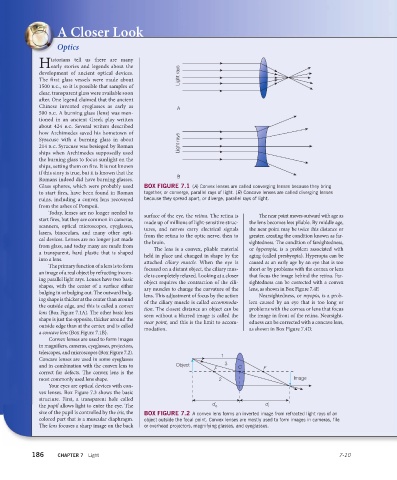
                     Glass spheres, which were probably used   BOX FIGURE 7.1 (A) Convex lenses are called converging lenses because they bring
                     to start fires, have been found in Roman   together, or converge, parallel rays of light. (B) Concave lenses are called diverging lenses
                     ruins, including a convex lens recovered   because they spread apart, or diverge, parallel rays of light.
                     from the ashes of Pompeii.
                        Today, lenses are no longer needed to
                                                        surface of the eye, the retina. The retina is   The near point moves outward with age as
                     start fires, but they are common in cameras,
                                                        made up of millions of light-sensitive struc-  the lens becomes less pliable. By middle age,
                     scanners, optical microscopes, eyeglasses,
                                                        tures, and nerves carry electrical signals   the near point may be twice this distance or
                     lasers, binoculars, and many other opti-
                                                        from the retina to the optic nerve, then to   greater, creating the condition known as far-
                     cal devices. Lenses are no longer just made
                                                        the brain.                         sightedness. The condition of farsightedness,
                     from glass, and today many are made from
                                                           The lens is a convex, pliable material   or  hyperopia, is a problem associated with
                     a transparent, hard plastic that is shaped
                                                        held in place and changed in shape by the   aging (called presbyopia).  Hyperopia can be
                     into a lens.
                                                        attached  ciliary muscle. When the eye is   caused at an early age by an eye that is too
                        The primary function of a lens is to form
                                                        focused on a distant object, the ciliary mus-  short or by problems with the cornea or lens
                     an image of a real object by refracting incom-
                                                        cle is completely relaxed. Looking at a closer   that focus the image behind the retina. Far-
                     ing parallel light rays. Lenses have two basic
                                                        object requires the contraction of the cili-  sightedness can be corrected with a convex
                     shapes, with the center of a surface either
                                                        ary muscles to change the curvature of the   lens, as shown in Box Figure 7.4F.
                     bulging in or bulging out. The outward bulg-
                                                        lens. This adjustment of focus by the action   Nearsightedness, or myopia, is a prob-
                     ing shape is thicker at the center than around
                                                        of the ciliary muscle is called accommoda-  lem caused by an eye that is too long or
                     the outside edge, and this is called a convex
                                                        tion. The closest distance an object can be   problems with the cornea or lens that focus
                     lens (Box Figure 7.1A). The other basic lens
                                                        seen without a blurred image is called the   the image in front of the retina. Nearsight-
                     shape is just the opposite, thicker around the
                                                        near point, and this is the limit to accom-  edness can be corrected with a concave lens,
                     outside edge than at the center, and is called
                                                        modation.                          as shown in Box Figure 7.4D.
                     a concave lens (Box Figure 7.1B).
                        Convex lenses are used to form images
                     in magnifiers, cameras, eyeglasses, projectors,
                     telescopes, and microscopes (Box  Figure 7.2).

                                                                                 1
                     Concave lenses are used in some eyeglasses
                     and in combination with the  convex lens to   Object          3   C
                                                                               F               F
                     correct for defects. The convex lens is the
                     most commonly used lens shape.                              2                       Image
                        Your eyes are optical devices with con-
                     vex lenses. Box Figure 7.3 shows the basic
                     structure. First, a transparent hole called
                     the pupil allows light to enter the eye. The              d o              d i
                     size of the pupil is controlled by the iris, the   BOX FIGURE 7.2  A convex lens forms an inverted image from refracted light rays of an
                     colored part that is a muscular diaphragm.   object outside the focal point. Convex lenses are mostly used to form images in cameras, file
                     The lens focuses a sharp image on the back   or overhead projectors, magnifying glasses, and eyeglasses.
                   186     CHAPTER 7 Light                                                                              7-10

