Page 235 - 9780077418427.pdf
P. 235

/Users/user-f465/Desktop
          tiL12214_ch08_203-228.indd Page 212  9/1/10  9:45 PM user-f465
          tiL12214_ch08_203-228.indd Page 212  9/1/10  9:45 PM user-f465                                                /Users/user-f465/Desktop


                                                                          matter, the existence of matter waves. According to  equation 8.5,
                    8.3 QUANTUM MECHANICS
                                                                          any moving object should exhibit wave properties. However, an
                   The Bohr model of the atom successfully accounted for the line   ordinary-sized object would have wavelengths so small that they
                   spectrum of hydrogen and provided an understandable mecha-  could not be observed. This is different for electrons because
                   nism for the emission of photons by atoms. However, the model   they have such a tiny mass.
                   did not predict the spectra of any atom larger than hydrogen,
                   and there were other limitations. A new, better theory was   EXAMPLE 8.5
                   needed. The roots of a new theory would again come from
                                                                          What is the wavelength associated with a 0.150 kg  baseball with a
                   experiments with light. Experiments with light had established
                                                                          velocity of 50.0 m/s?
                   that sometimes light behaves as a stream of particles, and at
                   other times it behaves as a wave (see chapter 7). Eventually, sci-
                   entists began to accept that light has both wave properties and   SOLUTION
                   particle properties, an idea now referred to as the wave-particle
                                                                                  m = 0.150 kg
                   duality of light. This dual nature of light was recognized in 1905,
                                                                                   v = 50.0 m/s
                   when Einstein applied Planck’s quantum concept to the energy              –34
                   of a photon with the relationship found in equation 8.1, E = hf,      h = 6.63 × 10  J⋅s
                   where E is the energy of a photon particle, f is the frequency      λ = ?
                   of the associated wave, and h is Planck’s constant.                              h _

                                                                                               λ =

                                                                                                   mv
                                                                                                            –34
                                                                                                     6.63 × 10  J⋅s
                                                                                                   __


                   MATTER WAVES                                                                  =             m _
                                                                                                   (0.150 kg)  (50.0          )
                                                                                                               s
                   In 1923, Louis de Broglie, a French physicist, reasoned that
                                                                                                               J⋅s
                                                                                                          –34
                                                                                                   6.63 × 10
                   symmetry is usually found in nature, so if a particle of light                =    __ _


                                                                                                                 m _

                   has a dual nature, then particles such as electrons should too.                 (0.150)(50.0)  kg ×
                                                                                                                  s
                   De Broglie reasoned further that if this is true, an electron in its                      _   2
                                                                                                             kg⋅ m

                   circular path around the nucleus would have to have a particu-                         –34      2   ⋅s

                                                                                                   6.63 × 10
                                                                                                                s


                   lar wavelength that would fit into the circumference of the orbit              =    __ _


                                                                                                      7.50    _
                                                                                                              kg⋅m
                   (Figure 8.13). De Broglie derived a relationship from equations                                s

                   concerning light and energy, which was
                                                                                                          –35
                                                                                                 = 8.84 × 10  m
                                             h _
                                         λ =                              What is the wavelength associated with an electron with a velocity of

                                             mv                                  6
                                                                          6.00 × 10 m/s?
                                                           equation 8.5
                   where λ is the wavelength, m is mass, v is velocity, and h is again   SOLUTION
                   Planck’s constant. This equation means that any moving particle
                                                                                             –31
                                                                                  m = 9.11 × 10  kg
                   has a wavelength that is associated with its mass and velocity. In
                                                                                             6
                                                                                   v = 6.00 × 10  m/s
                   other words, de Broglie was proposing a wave-particle duality of
                                                                                             –34
                                                                                   h = 6.63 × 10  J⋅s
                                           Orbit                                  λ = ?
                                                                                                    h _
                                                                                                λ =
                                                                                                   mv
                                                                                                                 –34
                                                                                                          6.63 × 10  J⋅s
                                                                                                   ___

                                                                                                 =                     6 m _
                                                                                                           –31
                                                                                                   (9.11 × 10  kg)  (6.00 × 10          )

                                                                                                                         s
                                                                                                          –34
                                                                                                               J⋅s
                                                                                                   ___
                                                                                                   6.63 × 10
                                                                                                 =


                                                                                                                 m _
                                                                                                   5.47 × 10 –24  kg ×

                                                                                                                 s
                                                                                                             kg⋅m
                                                                                                            _   2

                                                                                                                     ⋅  s
                                                                                                               2
                                                                                                          –10 _
                                                                                                              s

                                                                                                 = 1.21 × 10
                                                                                                             kg⋅m
                                                                                                             _


                             Standing                                                                          s
                       A     electron           B      Misfit                                    = 1.21 × 10  m
                                                                                                          –10
                             wave
                                                                                                      –35
                                                                          The baseball wavelength of 8.84  ×  10  m is much too small to be
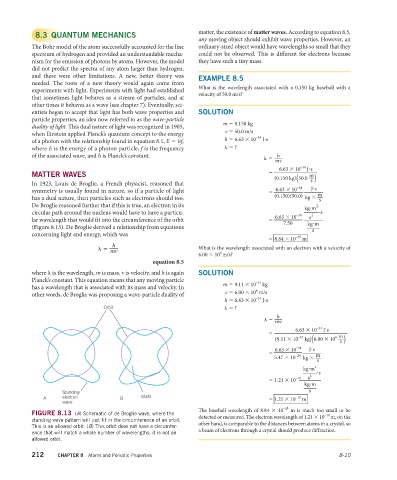
                   FIGURE 8.13  (A) Schematic of de Broglie wave, where the                                         –10
                                                                          detected or measured. The electron wavelength of 1.21 × 10  m, on the
                   standing wave pattern will just fit in the circumference of an orbit.
                   This is an allowed orbit. (B) This orbit does not have a circumfer-  other hand, is comparable to the distances between atoms in a crystal, so
                                                                          a beam of electrons through a crystal should produce diffraction.
                   ence that will match a whole number of wavelengths; it is not an
                   allowed orbit.
                   212     CHAPTER 8  Atoms and Periodic Properties                                                     8-10
   230   231   232   233   234   235   236   237   238   239   240