


Page 30 - 9780077418427.pdf
P. 30
/Users/user-f465/Desktop
          tiL12214_ch01_001-024.indd Page 7  9/1/10  9:51 PM user-f465
          tiL12214_ch01_001-024.indd Page 7  9/1/10  9:51 PM user-f465                                                  /Users/user-f465/Desktop


                         1.6  UNDERSTANDINGS FROM
                              MEASUREMENTS

                       One of the more basic uses of measurement is to  describe   1 centimeter
                         something in an exact way that everyone can understand. For
                       example, if a friend in another city tells you that the weather
                       has been “warm,” you might not understand what temperature         2 centimeters
                       is being described. A statement that the air temperature is 70°F
                       carries more exact information than a statement about “warm                           3 centimeters
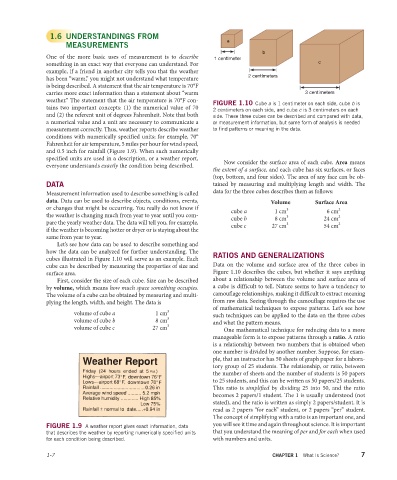
                       weather.” The statement that the air temperature is 70°F con-  FIGURE 1.10 Cube a is 1 centimeter on each side, cube b is
                       tains two important concepts: (1) the numerical value of 70   2 centimeters on each side, and cube c is 3 centimeters on each
                       and (2) the referent unit of degrees Fahrenheit. Note that both   side. These three cubes can be described and compared with data,
                       a  numerical value and a unit are necessary to communicate a   or measurement information, but some form of analysis is needed
                       measurement correctly. Thus, weather reports describe weather   to find patterns or meaning in the data.
                       conditions with numerically specified units; for example, 70°
                       Fahrenheit for air temperature, 5 miles per hour for wind speed,
                       and 0.5 inch for rainfall (Figure 1.9). When such numerically
                       specified units are used in a description, or a weather report,
                       everyone understands exactly the condition  being  described.  Now consider the surface area of each cube. Area means
                                                                               the extent of a surface, and each cube has six surfaces, or faces
                                                                               (top, bottom, and four sides). The area of any face can be ob-
                       DATA                                                    tained by measuring and multiplying length and width. The
                       Measurement information used to describe something is called   data for the three cubes describes them as follows:
                       data. Data can be used to describe objects, conditions, events,            Volume         Surface Area
                       or changes that might be occurring. You really do not know if   cube  a     1 cm 3           6 cm 2
                       the weather is changing much from year to year until you com-  cube  b      8 cm 3          24 cm 2
                       pare the yearly weather data. The data will tell you, for example,   cube  c  27 cm 3       54 cm 2
                       if the weather is becoming hotter or dryer or is staying about the
                       same from year to year.
                           Let’s see how data can be used to describe something and
                       how the data can be analyzed for further understanding. The   RATIOS AND GENERALIZATIONS
                       cubes illustrated in Figure 1.10 will serve as an example. Each
                       cube can be described by measuring the properties of size and   Data on the volume and surface area of the three cubes in
                       surface area.                                           Figure 1.10 describes the cubes, but whether it says anything
                           First, consider the size of each cube. Size can be described   about a relationship between the volume and surface area of
                       by volume, which means how much space something occupies.   a cube is difficult to tell. Nature seems to have a tendency to
                       The volume of a cube can be obtained by measuring and multi-  camouflage relationships, making it difficult to extract meaning
                       plying the length, width, and height. The data is       from raw data. Seeing through the camouflage requires the use
                                                                               of mathematical techniques to expose patterns. Let’s see how
                                 volume of cube a           1 cm 3             such techniques can be applied to the data on the three cubes
                                 volume of cube b           8 cm 3             and what the pattern means.
                                 volume of cube c          27 cm 3                One mathematical technique for reducing data to a more
                                                                               manageable form is to expose patterns through a ratio. A ratio
                                                                               is a relationship between two numbers that is obtained when
                                                                               one number is divided by another number. Suppose, for exam-
                                                                               ple, that an instructor has 50 sheets of graph paper for a labora-
                                                                               tory group of 25 students. The relationship, or ratio, between
                                                                               the number of sheets and the number of students is 50 papers
                                                                               to 25 students, and this can be written as 50 papers/25 students.
                                                                               This ratio is  simplifi ed by dividing 25 into 50, and the ratio
                                                                                 becomes 2 papers/1 student. The 1 is usually understood (not
                                                                               stated), and the ratio is written as simply 2 papers/student. It is
                                                                               read as 2 papers “for each” student, or 2 papers “per” student.
                                                                               The concept of simplifying with a ratio is an important one, and
                                                                               you will see it time and again throughout science. It is important
                       FIGURE 1.9  A weather report gives exact information, data
                        that describes the weather by reporting numerically specified units   that you understand the meaning of per and for each when used
                        for each condition being described.                    with numbers and units.

                       1-7                                                                        CHAPTER 1  What Is Science?   7

