


Page 261 - 9780077418427.pdf
P. 261
/Users/user-f465/Desktop
          tiL12214_ch09_229-250.indd Page 238  9/3/10  10:07 PM user-f465
          tiL12214_ch09_229-250.indd Page 238  9/3/10  10:07 PM user-f465                                               /Users/user-f465/Desktop


                    TABLE 9.4
                    Structures and compounds of nonmetallic elements
                      combined with hydrogen
                                          Element (E
                                          Represents Any
                    Nonmetallic Elements  Element of Family)  Compound
                                                                 H
                                                               ∙∙
                    Family IVA:           ∙                  H∶E∶  H
                     C, Si, Ge            ∙E∙                  ∙∙
                                          ∙
                                                                 H

                                                               ∙∙
                                          ∙  ∙
                    Family VA:            ∙E∙                H∶E∶  H
                                                               ∙∙
                                          ∙
                     N, P, As, Sb                                H


                                                               ∙∙
                                          ∙∙
                    Family VIA:           ∙E∙                H∶E∶  H
                     O, S, Se, Te         ∙∙                   ∙∙


                                                               ∙∙
                                          ∙∙
                    Family VIIA:          ∙E ∶               H∶E∶
                     F, Cl, Br, I         ∙∙                   ∙∙

                   Multiple Bonds
                   Two dots can represent a lone pair of valence electrons, or they
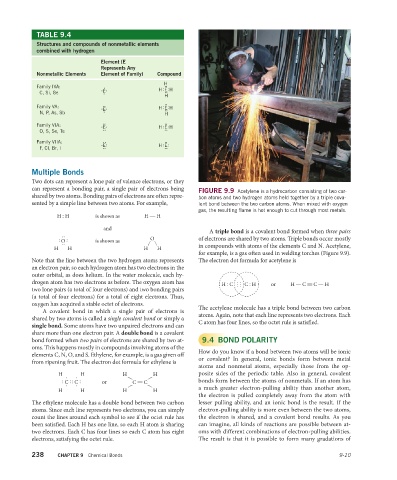
                   can represent a bonding pair, a single pair of electrons being   FIGURE 9.9  Acetylene is a hydrocarbon consisting of two car-
                   shared by two atoms. Bonding pairs of electrons are often repre-  bon atoms and two hydrogen atoms held together by a triple cova-
                   sented by a simple line between two atoms. For example,  lent bond between the two carbon atoms. When mixed with oxygen
                                                                          gas, the resulting flame is hot enough to cut through most metals.
                           H : H        is shown as     H — H
                                          and
                                                                             A triple bond is a covalent bond formed when three pairs
                           S O S        is shown as       O G             of electrons are shared by two atoms. Triple bonds occur mostly
                            O
                            Q
                                                          G
                          H    H                        H   H             in compounds with atoms of the elements C and N. Acetylene,
                                                                          for example, is a gas often used in welding torches (Figure 9.9).
                   Note that the line between the two hydrogen atoms represents   The electron dot formula for acetylene is
                   an electron pair, so each hydrogen atom has two electrons in the
                   outer orbital, as does helium. In the water molecule, each hy-
                   drogen atom has two electrons as before. The oxygen atom has   HSC YY  CSH     or    H O C q C O H
                   two lone pairs (a total of four electrons) and two bonding pairs
                   (a total of four electrons) for a total of eight electrons. Thus,
                   oxygen has acquired a stable octet of electrons.       The acetylene molecule has a triple bond between two carbon
                      A covalent bond in which a single pair of electrons is   atoms. Again, note that each line represents two electrons. Each
                   shared by two atoms is called a single covalent bond or simply a   C atom has four lines, so the octet rule is satisfied.
                   single bond. Some atoms have two unpaired electrons and can
                   share more than one electron pair. A double bond is a covalent
                   bond formed when two pairs of electrons are shared by two at-  9.4 BOND POLARITY
                   oms. This happens mostly in compounds involving atoms of the
                                                                          How do you know if a bond between two atoms will be ionic
                     elements C, N, O, and S. Ethylene, for example, is a gas given off
                                                                          or covalent? In general, ionic bonds form between metal
                   from ripening fruit. The electron dot formula for ethylene is
                                                                          atoms and nonmetal atoms, especially those from the op-
                           H       H             H         H              posite sides of the periodic table. Also in general, covalent
                              CS CS
                            S P  S P      or       G      G               bonds form  between the atoms of nonmetals. If an atom has
                              R
                                 R
                           H       H             H  G  C P C G  H         a much greater electron-pulling ability than another atom,
                                                                          the electron is pulled completely away from the atom with
                   The ethylene molecule has a double bond between two carbon   lesser pulling ability, and an ionic bond is the result. If the
                   atoms. Since each line represents two electrons, you can simply   electron-pulling ability is more even between the two atoms,
                   count the lines around each symbol to see if the octet rule has   the electron is shared, and a covalent bond results. As you
                   been satisfied. Each H has one line, so each H atom is sharing   can imagine, all kinds of reactions are possible between at-
                   two electrons. Each C has four lines so each C atom has eight   oms with different combinations of  electron-pulling abilities.
                   electrons, satisfying the octet rule.                  The result is that it is possible to form many gradations of

                   238     CHAPTER 9 Chemical Bonds                                                                     9-10

