


Page 330 - 9780077418427.pdf
P. 330
/Users/user-f465/Desktop
          tiL12214_ch12_299-322.indd Page 307  9/3/10  6:13 PM user-f465
          tiL12214_ch12_299-322.indd Page 307  9/3/10  6:13 PM user-f465                                                /Users/user-f465/Desktop


                         12.4 HYDROCARBON DERIVATIVES                                      H                  Cl
                       The hydrocarbons account for only about 5 percent of the known   Cl  C  Cl         Cl  C   Cl
                       organic compounds, but the other 95 percent can be considered
                                                                                           Cl                 Cl
                       hydrocarbon derivatives. Hydrocarbon derivatives are formed
                                                                                       Chloroform         Carbon tetrachloride
                       when one or more hydrogen atoms on a hydro carbon have been
                                                                                       (CHCl 3 )          (CCl 4 )
                       replaced by some element or group of elements other than hydro-
                       gen. For example, the halogens (F 2 , Cl 2 , Br 2 ) react with an alkane
                                                                                           Cl
                       in sunlight or when heated, replacing a hydrogen:                                   H        H
                                                                                       F   C  Cl              C   C
                                                                                                           H        Cl
                            H                              H                               F
                                              sunlight                                 Dichlorodifluoromethane  Vinyl chloride
                         H  C   H + Cl   Cl            H   C  Cl  +  H  Cl
                                                                                       (a Freon, CCl 2 F 2 )  (C 2 H 3 Cl)
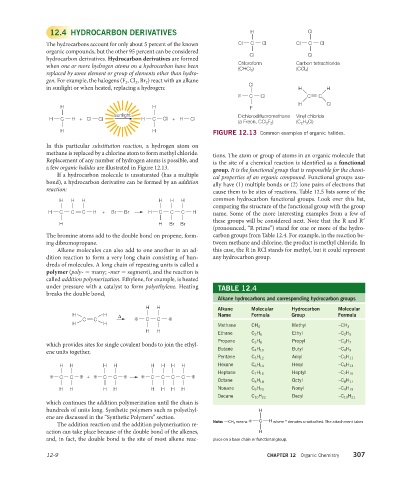
                            H                              H                   FIGURE 12.13  Common examples of organic halides.

                       In this particular  substitution reaction, a hydrogen atom on
                       methane is replaced by a chlorine atom to form methyl chloride.
                                                                               tions. The atom or group of atoms in an organic molecule that
                       Replacement of any number of hydrogen atoms is possible, and
                                                                               is the site of a chemical reaction is identified as a functional
                       a few organic halides are illustrated in Figure 12.13.
                                                                               group. It is the functional group that is responsible for the chemi-
                           If a hydrocarbon molecule is unsaturated (has a multiple
                                                                               cal  properties of an organic compound. Functional groups usu-
                       bond), a hydrocarbon derivative can be formed by an addition
                                                                               ally have (1) multiple bonds or (2) lone pairs of electrons that
                       reaction:
                                                                               cause them to be sites of reactions. Table 12.5 lists some of the
                            H   H  H                         H   H  H          common  hydrocarbon functional groups. Look over this list,
                                                                               comparing the structure of the functional group with the group
                        H   C   C  C    H  +  Br  Br     H   C   C  C   H      name. Some of the more interesting examples from a few of
                                                                               these groups will be considered next. Note that the R and R′
                            H                                H  Br  Br
                                                                                 (pronounced, “R prime”) stand for one or more of the hydro-
                       The bromine atoms add to the double bond on propene, form-  carbon groups from Table 12.4. For example, in the reaction be-
                       ing dibromopropane.                                     tween methane and chlorine, the product is methyl chloride. In
                           Alkene molecules can also add to one another in an ad-  this case, the R in RCl stands for methyl, but it could represent
                       dition reaction to form a very long chain consisting of hun-  any hydrocarbon group.
                       dreds of molecules. A long chain of repeating units is called a
                       polymer (poly- = many; -mer = segment), and the reaction is
                       called  addition polymerization. Ethylene, for example, is  heated
                       under pressure with a catalyst to form polyethylene. Heating   TABLE 12.4
                       breaks the double bond,
                                                                                Alkane hydrocarbons and corresponding hydrocarbon groups
                                                         H  H                   Alkane     Molecular     Hydrocarbon    Molecular
                                 H        H                                     Name       Formula       Group          Formula
                                    C  C                C   C
                                 H        H                                     Methane     CH 4         Methyl         –CH 3
                                                        H   H                   Ethane     C 2 H 6       Ethyl          –C 2 H 5
                                                                                Propane     C 3 H 8      Propyl         –C 3 H 7
                       which provides sites for single covalent bonds to join the ethyl-
                                                                                Butane     C 4 H 10      Butyl          –C 4 H 9
                       ene units together,
                                                                                Pentane     C 5 H 12     Amyl           –C 5 H 11
                            H  H          H   H           H   H  H  H           Hexane      C 6 H 14     Hexyl          –C 6 H 13
                                                                                Heptane     C 7 H 16     Heptyl         –C 7 H 15
                            C  C     +    C   C           C   C  C  C
                                                                                Octane     C 8 H 18      Octyl          –C 8 H 17
                            H  H          H   H           H   H  H  H           Nonane      C 9 H 20     Nonyl          –C 9 H 19
                                                                                Decane     C 10 H 22     Decyl          –C 10 H 21
                       which continues the addition polymerization until the chain is
                       hundreds of units long. Synthetic polymers such as polyethyl-          H
                       ene are discussed in the “Synthetic Polymers” section.
                                                                               Note: —CH 3  means   C  H  where * denotes unattached. The attachment takes
                           The addition reaction and the addition polymerization re-
                       action can take place because of the double bond of the alkenes,       H
                       and, in fact, the double bond is the site of most alkene reac-  place on a base chain or functional group.

                       12-9                                                                      CHAPTER 12  Organic Chemistry   307

