


Page 337 - 9780077418427.pdf
P. 337
/Users/user-f465/Desktop
          tiL12214_ch12_299-322.indd Page 314  9/3/10  6:13 PM user-f465
          tiL12214_ch12_299-322.indd Page 314  9/3/10  6:13 PM user-f465                                                /Users/user-f465/Desktop


                                        H                                 oil to the single bonds of a saturated one. As a result, the liquid
                                                                          oils are converted to solids at room temperature. For  example,
                                    H   C  O   C  R 1
                                                                          one brand of margarine lists ingredients as “liquid  soybean oil
                                               O                          (nonhydrogenated) and partially hydrogenated cottonseed oil
                                    H   C  O   C  R 2
                                                                          with water, salt, preservatives, and coloring.” Complete hydro-
                                               O                          genation would result in a hard solid, so the cottonseed oil is
                                    H   C  O   C  R 3                     partially hydrogenated and then mixed with liquid soybean oil.
                                                                          Coloring is added because oleo is white, not the color of butter.
                                        H      O
                                                                          Vegetable shortening is the very same product without added
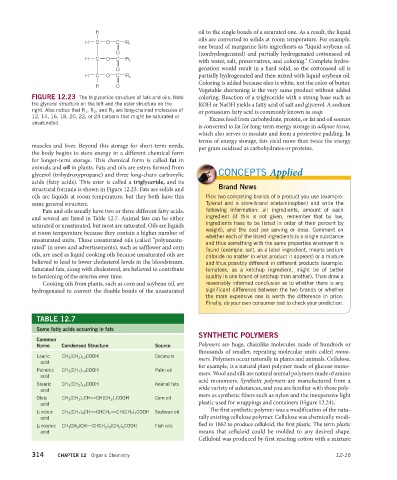
                   FIGURE 12.23  The triglyceride structure of fats and oils. Note   coloring. Reaction of a triglyceride with a strong base such as
                   the glycerol structure on the left and the ester structure on the   KOH or NaOH yields a fatty acid of salt and glycerol. A sodium
                   right. Also notice that R 1 , R 2 , and R 3  are long-chained molecules of   or potassium fatty acid is commonly known as soap.
                   12, 14, 16, 18, 20, 22, or 24 carbons that might be saturated or
                                                                             Excess food from carbohydrate, protein, or fat and oil sources
                   unsaturated.
                                                                          is converted to fat for long-term energy storage in adipose tissue,
                                                                          which also serves to insulate and form a protective padding. In
                                                                          terms of energy storage, fats yield more than twice the energy
                   muscles and liver. Beyond this storage for short-term needs,
                                                                          per gram oxidized as carbohydrates or proteins.
                   the body begins to store energy in a different chemical form
                   for longer-term storage. This chemical form is called  fat in
                   animals and oil in plants. Fats and oils are esters formed from
                   glycerol (trihydroxypropane) and three long-chain carboxylic   CONCEPTS Applied
                     acids (fatty acids). This ester is called a triglyceride, and its
                   structural formula is shown in Figure 12.23. Fats are solids and   Brand News
                   oils are liquids at room temperature, but they both have this   Pick two competing brands of a product you use (example:
                   same general structure.                                  Tylenol and a store-brand acetaminophen) and write the
                      Fats and oils usually have two or three different fatty acids,     follow ing information: all ingredients, amount of each
                   and several are listed in Table 12.7. Animal fats can be either   ingredient (if this is not given, remember that by law,
                                                                            ingredients have to be listed in order of their percent by
                     saturated or unsaturated, but most are saturated. Oils are liquids
                                                                            weight), and the cost per  serving or dose. Comment on
                   at room temperature because they contain a higher  number of
                                                                            whether each of the listed  ingredients is a single substance
                   unsaturated units. These unsaturated oils (called “polyunsatu-
                                                                            and thus something with the same properties wherever it is
                   rated” in news and advertisements), such as safflower and corn
                                                                            found (example: salt, as a label  ingredient, means sodium
                   oils, are used as liquid cooking oils because unsaturated oils are   chloride no matter in what product it appears) or a mixture
                   believed to lead to lower cholesterol levels in the bloodstream.   and thus possibly different in different products  (example:
                   Saturated fats, along with cholesterol, are believed to contribute   tomatoes, as a ketchup ingredient, might be of better
                   to hardening of the arteries over time.                  quality in one brand of ketchup than another). Then draw a
                      Cooking oils from plants, such as corn and soybean oil, are   reasonably informed conclusion as to whether there is any
                   hydrogenated to convert the double bonds of the unsaturated   significant difference between the two brands or whether
                                                                            the more expensive one is worth the difference in price.
                                                                            Finally, do your own consumer test to check your prediction.

                    TABLE 12.7
                    Some fatty acids occurring in fats
                                                                          SYNTHETIC POLYMERS
                    Common
                    Name     Condensed Structure            Source        Polymers are huge, chainlike molecules made of hundreds or
                                                                          thousands of smaller, repeating molecular units called mono-
                    Lauric   CH 3 (CH 2 ) 10 COOH          Coconuts       mers. Polymers occur naturally in plants and animals.  Cellulose,
                      acid
                                                                          for example, is a natural plant polymer made of glucose mono-
                    Palmitic  CH 3 (CH 2 ) 14 COOH         Palm oil
                      acid                                                mers. Wool and silk are natural animal polymers made of amino
                                                                          acid monomers.  Synthetic polymers are manufactured from a
                    Stearic  CH 3 (CH 2 ) 16 COOH          Animal fats
                      acid                                                wide variety of substances, and you are familiar with these poly-
                                                                          mers as synthetic fibers such as nylon and the  inexpensive light
                    Oleic    CH 3 (CH 2 ) 7 CH==CH(CH 2 ) 7 COOH  Corn oil
                      acid                                                plastic used for wrappings and containers (Figure 12.24).
                                                                             The first synthetic polymer was a modification of the natu-
                    Linoleic  CH 3 (CH 2 ) 4 CH==CHCH 2 ==CH(CH 2 ) 7 COOH Soybean oil
                      acid                                                rally existing cellulose polymer. Cellulose was chemically modi-
                    Linolenic CH 3 CH 2 (CH==CHCH 2 ) 3 (CH 2 ) 6 COOH  Fish oils  fied in 1862 to produce celluloid, the first plastic. The term plastic
                      acid                                                means that celluloid could be molded to any desired shape.
                                                                            Celluloid was produced by first reacting cotton with a mixture

                   314     CHAPTER 12 Organic Chemistry                                                                12-16

