


Page 335 - 9780077418427.pdf
P. 335
/Users/user-f465/Desktop
          tiL12214_ch12_299-322.indd Page 312  9/3/10  6:13 PM user-f465
          tiL12214_ch12_299-322.indd Page 312  9/3/10  6:13 PM user-f465                                                /Users/user-f465/Desktop


                   or sequence of these amino acid molecules determines the struc-    Glucose (an aldehyde sugar)
                   ture that gives the protein its unique set of biochemical proper-     H   H   H   H  OH H
                   ties. Insulin, for example, is a protein hormone that biochemically
                   regulates the blood sugar level.  Insulin contains 86 amino acid   H  C   C   C   C  C   C   O
                   molecules in the chain. Hemoglobin is the protein that carries
                                                                                         O   O   O   O  H
                   oxygen in the bloodstream, and its biochemical characteristics are    H   H   H   H
                   determined by its chain of 146 amino acid molecules.
                                                                                      Fructose (a ketone sugar)
                         CONCEPTS Applied                                                H   H   H  OH      H
                                                                                     H   C   C   C   C  C   C   H
                         Fats Foods
                                                                                         O   O   O   H  O   OH
                     Pick a food product and write the number of grams of fats,          H   H   H
                       proteins, and carbohydrates per serving according to the
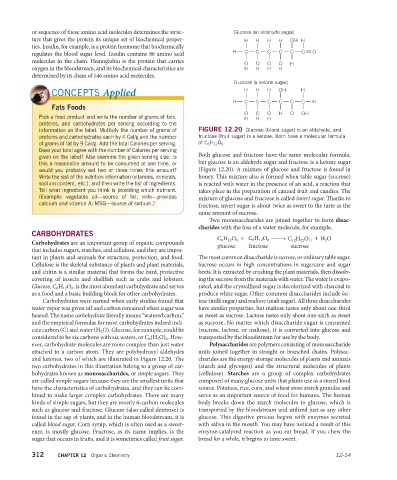
                       information on the label. Multiply the number of grams of   FIGURE 12.20  Glucose (blood sugar) is an aldehyde, and
                       proteins and carbohydrates each by 4 Cal/g and the number   fructose (fruit sugar) is a ketone. Both have a molecular formula
                     of grams of fat by 9 Cal/g. Add the total Calories per serving.   of C 6 H 12 O 6 .
                     Does your total agree with the number of Calories per serving
                     given on the label? Also examine the given serving size. Is   Both glucose and fructose have the same molecular  formula,
                     this a  reasonable amount to be consumed at one time, or   but glucose is an aldehyde sugar and fructose is a ketone sugar
                     would you probably eat two or three times this amount?   (Figure 12.20). A mixture of  glucose and fructose is found in
                     Write the rest of the nutrition information (vitamins, minerals,   honey. This mixture also is formed when table sugar (sucrose)
                     sodium content, etc.), and then write the list of ingredients.   is reacted with water in the presence of an acid, a reaction that
                     Tell what ingredient you think is providing which nutrient.   takes place in the preparation of canned fruit and candies. The
                     (Example: vegetable oil—source of fat; milk—provides   mixture of glucose and fructose is called invert sugar. Thanks to
                     calcium and vitamin A; MSG—source of sodium.)        fructose, invert sugar is about twice as sweet to the taste as the
                                                                          same amount of  sucrose.
                                                                             Two monosaccharides are joined together to form disac-
                                                                          charides with the loss of a water molecule, for example,
                   CARBOHYDRATES
                                                                                C 6 H 12 O 6    +  C 6 H 12 O 6   → C 12 H 22 O 11   + H 2 O


                   Carbohydrates are an important group of organic compounds
                                                                                 glucose   fructose      sucrose
                   that includes sugars, starches, and cellulose, and they are impor-
                   tant in plants and animals for structure, protection, and food.   The most common disaccharide is sucrose, or ordinary table  sugar.
                   Cellulose is the skeletal substance of plants and plant materials,   Sucrose occurs in high concentrations in sugarcane and sugar
                   and chitin is a similar material that forms the hard, protective   beets. It is extracted by crushing the plant materials, then dissolv-
                   covering of insects and shellfish such as crabs and lobsters.   ing the sucrose from the materials with water. The water is evapo-
                     Glucose, C 6 H 12 O 6 , is the most abundant carbohydrate and serves   rated, and the crystallized sugar is decolorized with charcoal to
                   as a food and a basic building block for other carbohydrates.  produce white sugar. Other common disaccharides include lac-
                      Carbohydrates were named when early studies found that   tose (milk sugar) and maltose (malt sugar). All three di saccharides
                   water vapor was given off and carbon remained when sugar was   have similar properties, but maltose tastes only about one-third
                   heated. The name carbohydrate literally means “watered carbon,”   as sweet as sucrose. Lactose tastes only about one-sixth as sweet
                   and the empirical formulas for most carbohydrates indeed indi-  as sucrose. No matter which di saccharide sugar is consumed
                   cate carbon (C) and water (H 2 O). Glucose, for  example, could be   (sucrose, lactose, or maltose), it is converted into glucose and
                   considered to be six carbons with six  waters, or C 6 (H 2 O) 6 . How-  transported by the bloodstream for use by the body.
                   ever, carbohydrate molecules are more complex than just water   Polysaccharides are polymers consisting of mono saccharide
                   attached to a carbon atom. They are polyhydroxyl aldehydes   units joined together in straight or branched chains. Polysac-
                   and ketones, two of which are  illustrated in Figure 12.20. The   charides are the energy-storage molecules of plants and animals
                   two carbohydrates in this il lus tration belong to a group of car-  (starch and glycogen) and the structural molecules of plants


                   bohydrates known as mono saccharides, or simple sugars. They   (cellulose).  Starches are a group of complex carbohydrates
                   are called simple sugars because they are the smallest units that   composed of many glucose units that plants use as a stored food
                   have the characteristics of carbohydrates, and they can be com-  source. Potatoes, rice, corn, and wheat store starch granules and
                   bined to make larger complex carbohydrates. There are many   serve as an important source of food for humans. The human
                   kinds of simple sugars, but they are mostly 6-carbon molecules   body breaks down the starch molecules to glucose, which is
                   such as glucose and fructose. Glucose (also called dextrose) is   transported by the bloodstream and utilized just as any other
                   found in the sap of plants, and in the human bloodstream, it is   glucose. This digestive process begins with enzymes secreted
                   called blood sugar. Corn syrup, which is often used as a sweet-  with saliva in the mouth. You may have noticed a result of this
                   ener, is mostly glucose. Fructose, as its name implies, is the   enzyme-catalyzed reaction as you eat bread. If you chew the
                   sugar that occurs in fruits, and it is sometimes called fruit sugar.   bread for a while, it begins to taste sweet.

                   312     CHAPTER 12 Organic Chemistry                                                                12-14

