


Page 334 - 9780077418427.pdf
P. 334
/Users/user-f465/Desktop
          tiL12214_ch12_299-322.indd Page 311  9/3/10  6:13 PM user-f465
          tiL12214_ch12_299-322.indd Page 311  9/3/10  6:13 PM user-f465                                                /Users/user-f465/Desktop


                       These liquid esters can be obtained from natural sources, or they   PROTEINS
                       can be chemically synthesized. Whatever the source, amyl  acetate,   Proteins are macromolecular polymers made up of smaller
                       for example, is the chemical responsible for what you identify as   molecules called amino acids. These very large macromolecules
                       the flavor of banana. Natural flavors, however, are complex mix-  have molecular weights that vary from about 6,000 to 50 mil-
                       tures of these esters along with other organic compounds. Lower   lion. Some proteins are simple straight-chain polymers of  amino
                                                                                                                    2+
                       molecular weight esters are  fragrant-smelling liquids, but higher   acids, but others contain metal ions such as Fe  or parts of or-
                       molecular weight esters are odorless oils and fats.     ganic molecules derived from vitamins. Proteins serve as major
                                                                               structural and functional materials in living things. Structurally,
                                                                               proteins are major components of muscles, connective tissue,
                              CONCEPTS Applied                                 and the skin, hair, and nails. Functionally, some proteins are
                                                                               enzymes, which catalyze metabolic reactions; hormones, which
                              Organic Products                                 regulate body activities; hemoglobin, which carries oxygen to

                          Pick a household product that has ingredients that sound   cells; and antibodies, which protect the body.
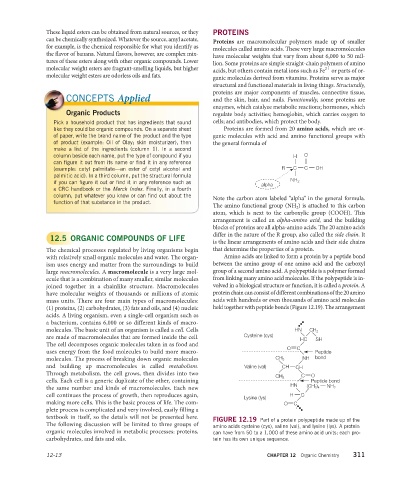
                          like they could be organic compounds. On a separate sheet   Proteins are formed from 20 amino acids, which are or-
                          of paper, write the brand name of the product and the type   ganic molecules with acid and amino functional groups with
                          of product (example: Oil of Olay; skin moisturizer), then   the general formula of
                          make a list of the  ingredients (column 1). In a second
                            column beside each name, put the type of compound if you                     H    O
                          can figure it out from its name or find it in any reference
                            (example: cetyl palmitate—an ester of cetyl alcohol and                  R   C   C   OH
                          palmitic acid). In a third column, put the structural formula
                          if you can figure it out or find it in any reference such as                  NH 2
                                                                                               alpha
                          a CRC handbook or the Merck Index. Finally, in a fourth
                          column, put whatever you know or can find out about the   Note the carbon atom labeled “alpha” in the general formula.
                          function of that substance in the product.
                                                                               The amino functional group (NH 2 ) is attached to this carbon
                                                                               atom, which is next to the carboxylic group (COOH). This
                                                                                 arrangement is called an  alpha-amino acid, and the building
                                                                               blocks of proteins are all alpha-amino acids. The 20 amino acids
                                                                               differ in the nature of the R group, also called the side chain. It
                         12.5  ORGANIC COMPOUNDS OF LIFE
                                                                               is the linear arrangements of amino acids and their side chains
                       The chemical processes regulated by living organisms begin   that determine the properties of a protein.
                       with relatively small organic molecules and water. The organ-  Amino acids are linked to form a protein by a peptide bond
                       ism uses energy and matter from the surroundings to build   between the amino group of one amino acid and the carboxyl
                       large macromolecules. A macromolecule is a very large mol-  group of a second amino acid. A polypeptide is a polymer formed
                       ecule that is a combination of many smaller, similar molecules   from linking many amino acid molecules. If the poly peptide is in-
                       joined together in a chainlike structure. Macro molecules   volved in a biological structure or function, it is called a protein. A
                       have molecular weights of thousands or millions of atomic   protein chain can consist of different combinations of the 20 amino
                       mass units. There are four main types of macromolecules:   acids with hundreds or even  thousands of amino acid molecules
                       (1) proteins, (2) carbohydrates, (3) fats and oils, and (4) nucleic   held together with peptide bonds (Figure 12.19). The  arrangement
                       acids. A living organism, even a single-cell organism such as
                       a bacterium, contains 6,000 or so different kinds of macro-
                       molecules. The basic unit of an organism is called a cell. Cells                   HN   CH 2
                       are made of macromolecules that are formed inside the cell.       Cysteine (cys)     HC   SH
                       The cell decomposes organic molecules taken in as food and
                                                                                                       O   C
                       uses energy from the food molecules to build more macro-                                  Peptide
                       molecules. The process of breaking down organic molecules                   CH 3     NH   bond
                       and building up macromolecules is called  metabolism.             Valine (val)  CH  CH
                       Through metabolism, the cell grows, then divides into two                            C  O
                                                                                                   CH 3
                       cells. Each cell is a generic duplicate of the other, containing                        Peptide bond
                                                                                                        HN
                       the same number and kinds of macromolecules. Each new                                  (CH 2 ) 4  NH 2
                       cell continues the process of growth, then reproduces again,                     H   C
                                                                                         Lysine (lys)
                       making more cells. This is the basic process of life. The com-                 O  C
                       plete process is complicated and very involved, easily filling a
                       textbook in itself, so the details will not be presented here.
                                                                               FIGURE 12.19  Part of a protein polypeptide made up of the
                       The following discussion will be limited to three groups of   amino acids cysteine (cys), valine (val), and lysine (lys). A protein
                       organic molecules involved in metabolic processes: proteins,   can have from 50 to a 1,000 of these amino acid units; each pro-
                       carbohydrates, and fats and oils.                       tein has its own unique sequence.

                       12-13                                                                     CHAPTER 12  Organic Chemistry   311

