


Page 333 - 9780077418427.pdf
P. 333
/Users/user-f465/Desktop
          tiL12214_ch12_299-322.indd Page 310  9/3/10  6:13 PM user-f465
          tiL12214_ch12_299-322.indd Page 310  9/3/10  6:13 PM user-f465                                                /Users/user-f465/Desktop


                           Science and Society


                           Aspirin, a Common Organic Compound
                         spirin went on the market as a pre-  chewed the bark for its medicinal effect. It
                                                                                          QUESTIONS TO DISCUSS
                     Ascription drug in 1897 after being   is estimated that more than 80 million tab-
                       discovered only two years earlier! How-  lets of aspirin are consumed in the United     1.  What structural parts of aspirin would
                     ever, even primitive humans were familiar   States daily. It is the most widely used drug   make it an organic acid?
                     with its value as a pain reliever. The bark   in the world. Just what does it do? Aspirin is     2.  Go to the Internet and find out just
                     of the willow tree was known for its “magi-    really acetylsalicylic acid, which inhibits the   how this organic compound acts as a
                     cal” pain relief power thousands of years   body’s production of compounds known as   pain  reliever.
                     ago. People in many cultures stripped and   prostaglandins, the cause of the pain.


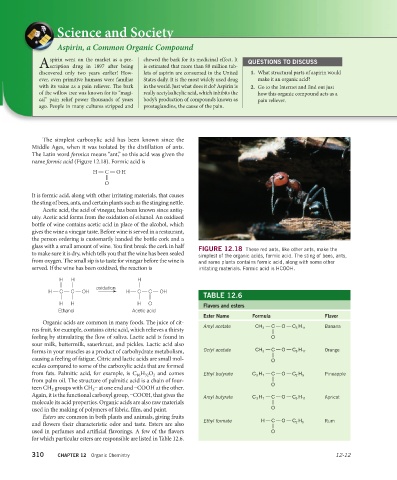
                      The simplest carboxylic acid has been known since the
                   Middle Ages, when it was isolated by the distillation of ants.
                   The Latin word formica means “ant,” so this acid was given the
                   name formic acid (Figure 12.18). Formic acid is
                                       H O C O OH
                                           B
                                           O
                   It is formic acid, along with other irritating materials, that causes
                   the sting of bees, ants, and certain plants such as the stinging nettle.
                      Acetic acid, the acid of vinegar, has been known since antiq-
                   uity. Acetic acid forms from the oxidation of ethanol. An oxidized
                   bottle of wine contains acetic acid in place of the alcohol, which
                   gives the wine a vinegar taste. Before wine is served in a restaurant,
                   the person ordering is customarily handed the bottle cork and a
                   glass with a small amount of wine. You first break the cork in half
                                                                          FIGURE 12.18  These red ants, like other ants, make the
                   to make sure it is dry, which tells you that the wine has been sealed     simplest of the organic acids, formic acid. The sting of bees, ants,
                   from oxygen. The small sip is to taste for vinegar before the wine is   and some plants contains formic acid, along with some other
                   served. If the wine has been oxidized, the reaction is    irritating materials. Formic acid is HCOOH.
                            H   H                     H
                                        oxidation
                        H   C   C  OH             H   C  C   OH
                                                                           TABLE 12.6
                            H   H                     H  O
                                                                           Flavors and esters
                            Ethanol                 Acetic acid
                                                                           Ester Name       Formula                 Flavor
                      Organic acids are common in many foods. The juice of cit-
                                                                           Amyl acetate      CH 3  C  O  C 5 H 11   Banana
                   rus fruit, for example, contains citric acid, which relieves a thirsty
                   feeling by stimulating the flow of saliva. Lactic acid is found in             O
                   sour milk, buttermilk, sauerkraut, and pickles. Lactic acid also
                   forms in your muscles as a product of carbohydrate metabolism,   Octyl acetate  CH 3  C  O  C 8 H 17  Orange
                   causing a feeling of fatigue. Citric and lactic acids are small mol-           O
                   ecules compared to some of the carboxylic acids that are formed
                   from fats. Palmitic acid, for example, is C 16 H 32 O 2  and comes   Ethyl butyrate  C 3 H 7  C  O  C 2 H 5  Pineapple
                   from palm oil. The structure of palmitic acid is a chain of four-
                                                                                                  O
                   teen CH 2  groups with CH 3 – at one end and –COOH at the other.
                   Again, it is the functional carboxyl group, –COOH, that gives the   Amyl butyrate  C 3 H 7  C  O  C 5 H 11  Apricot
                   molecule its acid properties. Organic acids are also raw materials
                                                                                                  O
                   used in the making of polymers of fabric, film, and paint.
                      Esters are common in both plants and animals, giving fruits
                                                                           Ethyl formate       H  C  O   C 2 H 5    Rum
                   and flowers their characteristic odor and taste. Esters are also
                   used in perfumes and artificial flavorings. A few of the flavors               O
                   for which particular esters are responsible are listed in Table 12.6.

                   310     CHAPTER 12 Organic Chemistry                                                                12-12

