


Page 382 - 9780077418427.pdf
P. 382
/Users/user-f465/Desktop
          tiL12214_ch14_351-376.indd Page 359  9/3/10  6:16 PM user-f465
          tiL12214_ch14_351-376.indd Page 359  9/3/10  6:16 PM user-f465                                                /Users/user-f465/Desktop


                       happens to it when it uses up the hydrogen in the core depend   slower rate. The overall life span on the main sequence ranges
                       on the mass of the star. Of course, no one has observed a star’s   from millions of years for O-type stars to trillions of years for
                       life cycle over billions of years. The life cycle of a star is a theo-    M-type stars. An  average one-solar-mass star will last about
                       retical outcome based on what is known about nuclear reac-    10 billion years.
                       tions. The predicted outcomes seem to agree with observations
                       of stars  today, with different groups of stars that can be plotted   Red Giant Stage
                       on the H-R diagram. Thus, the groups of stars on the diagram—
                                                                               The next stage in the theoretical life of a star begins when the
                       main sequence, red giants, and white dwarfs, for  example—are
                                                                               hydrogen in the core has been fused into helium. With fewer hy-
                       understood to be stars in various stages of their lives.
                                                                               drogen fusion reactions, less energy is released and less  outward
                                                                               balancing pressure is produced, so the star begins to  collapse.
                       Protostar Stage                                         The collapse heats the core, which now is composed primarily
                       The first stage in the theoretical model of the life cycle of a star is   of helium, and the surrounding shell where hydrogen still ex-
                       the formation of the protostar. As gravity pulls the gas of a pro-  ists. The increased temperature causes the hydrogen in the shell
                       tostar together, the density, pressure, and temperature increase   to undergo fusion, and the increased release of energy causes
                       from the surface down to the center. Eventually, the conditions   the outer layers of the star to expand. With an increased surface
                       are right for nuclear fusion reactions to begin in the core, which   area, the amount of radiation emitted per unit area is less, and
                       requires a temperature of 10 million kelvins. The initial fusion   the star acquires the properties of a brilliant red giant. Its po-
                       reaction essentially combines four hydrogen nuclei to form a   sition on the H-R diagram changes since it now has different
                       helium nucleus with the release of much energy. This energy     luminosity and temperature properties. (The star has not physi-
                       heats the core beyond the temperature reached by gravitational   cally  moved. The changing properties move its temperature-
                       contraction, eventually to 16 million kelvins. Since the star is a   luminosity data point, not the star, to a new  position.)
                       gas, the increased temperature expands the volume of the star.
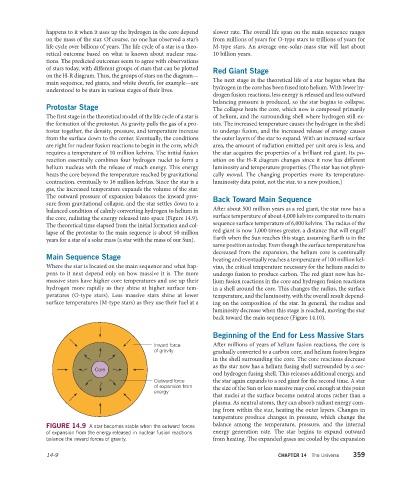
                       The outward pressure of expansion balances the inward pres-  Back Toward Main Sequence
                       sure from gravitational collapse, and the star settles down to a
                       balanced condition of calmly converting hydrogen to helium in   After about 500 million years as a red giant, the star now has a
                       the core, radiating the energy released into space  (Figure 14.9).   surface temperature of about 4,000 kelvins compared to its main
                       The theoretical time elapsed from the initial  formation and col-  sequence surface temperature of 6,000 kelvins. The radius of the
                       lapse of the protostar to the main sequence is about 50 million   red giant is now 1,000 times greater, a distance that will engulf
                       years for a star of a solar mass (a star with the mass of our Sun).  Earth when the Sun reaches this stage, assuming Earth is in the
                                                                               same position as today. Even though the surface temperature has
                                                                               decreased from the expansion, the helium core is  continually
                       Main Sequence Stage                                     heating and eventually reaches a temperature of 100 million kel-
                       Where the star is located on the main sequence and what hap-  vins, the critical temperature necessary for the helium nuclei to
                       pens to it next depend only on how massive it is. The more   undergo fusion to produce carbon. The red  giant now has he-
                         massive stars have higher core temperatures and use up their   lium fusion reactions in the core and hydrogen fusion reactions
                         hydrogen more rapidly as they shine at higher surface tem-  in a shell around the core. This changes the radius, the surface
                       peratures (O-type stars). Less massive stars shine at lower   temperature, and the luminosity, with the overall result depend-
                       surface temperatures (M-type stars) as they use their fuel at a   ing on the composition of the star. In  general, the radius and
                                                                               luminosity decrease when this stage is reached, moving the star
                                                                               back toward the main sequence  (Figure 14.10).

                                                                               Beginning of the End for Less Massive Stars
                                                           Inward force        After millions of years of helium fusion reactions, the core is
                                                           of gravity          gradually converted to a carbon core, and helium fusion begins
                                                                               in the shell surrounding the core. The core reactions decrease
                                                                               as the star now has a helium fusing shell surrounded by a sec-
                                        Core
                                                                               ond hydrogen fusing shell. This releases additional energy, and
                                                           Outward force       the star again expands to a red giant for the second time. A star
                                                           of expansion from   the size of the Sun or less massive may cool enough at this point
                                                           energy
                                                                               that nuclei at the surface become neutral atoms rather than a
                                                                               plasma. As neutral atoms, they can absorb radiant energy com-
                                                                               ing from within the star, heating the outer layers. Changes in
                                                                               temperature produce changes in pressure, which change the
                                                                               balance among the temperature, pressure, and the internal
                       FIGURE 14.9  A star becomes stable when the outward forces
                       of expansion from the energy released in nuclear fusion reactions   energy generation rate. The star  begins to expand outward
                       balance the inward forces of gravity.                   from heating. The  expanded gases are cooled by the expansion

                       14-9                                                                         CHAPTER 14  The Universe   359

