


Page 381 - 9780077418427.pdf
P. 381
/Users/user-f465/Desktop
          tiL12214_ch14_351-376.indd Page 358  9/3/10  6:16 PM user-f465
          tiL12214_ch14_351-376.indd Page 358  9/3/10  6:16 PM user-f465                                                /Users/user-f465/Desktop


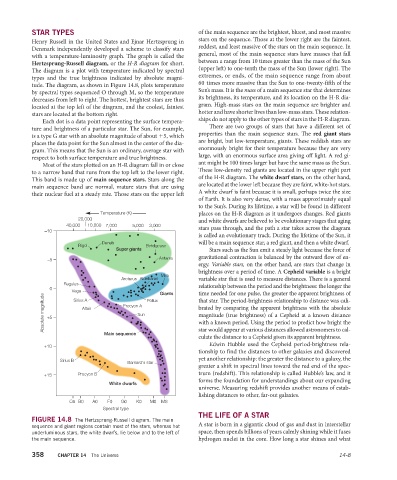
                   STAR TYPES                                             of the main sequence are the brightest, bluest, and most massive
                   Henry Russell in the United States and Ejnar Hertzsprung in   stars on the sequence. Those at the lower right are the faintest,
                   Denmark independently developed a scheme to classify stars   reddest, and least massive of the stars on the main sequence. In
                   with a temperature-luminosity graph. The graph is called the   general, most of the main sequence stars have masses that fall
                   Hertzsprung-Russell diagram, or the H-R diagram for short.   between a range from 10 times greater than the mass of the Sun
                   The diagram is a plot with temperature indicated by spectral   (upper left) to one-tenth the mass of the Sun (lower right). The
                   types and the true brightness indicated by absolute magni-  extremes, or ends, of the main sequence range from about
                   tude. The diagram, as shown in Figure 14.8, plots temperature     60 times more massive than the Sun to one-twenty-fifth of the
                   by spectral types sequenced O through M, so the temperature   Sun’s mass. It is the mass of a main sequence star that determines
                     decreases from left to right. The hottest, brightest stars are thus   its brightness, its temperature, and its location on the H-R dia-
                     located at the top left of the diagram, and the coolest, faintest   gram. High-mass stars on the main sequence are brighter and
                   stars are located at the bottom right.                 hotter and have shorter lives than low-mass stars. These relation-
                      Each dot is a data point representing the surface tempera-  ships do not apply to the other types of stars in the H-R diagram.
                   ture and brightness of a particular star. The Sun, for example,   There are two groups of stars that have a different set of
                   is a type G star with an absolute magnitude of about +5, which   properties than the main sequence stars. The  red giant stars
                   places the data point for the Sun almost in the center of the dia-  are bright, but low-temperature, giants. These reddish stars are
                   gram. This means that the Sun is an ordinary, average star with     enormously bright for their temperature because they are very
                   respect to both surface temperature and true brightness.  large, with an enormous surface area  giving off light. A red gi-
                      Most of the stars plotted on an H-R diagram fall in or close   ant might be 100 times larger but have the same mass as the Sun.
                   to a narrow band that runs from the top left to the lower right.   These low-density red giants are located in the upper right part
                   This band is made up of main sequence stars. Stars along the   of the H-R diagram. The white dwarf stars, on the other hand,
                   main sequence band are normal, mature stars that are using   are located at the lower left because they are faint, white-hot stars.
                   their nuclear fuel at a steady rate. Those stars on the upper left   A white dwarf is faint because it is small, perhaps twice the size
                                                                          of Earth. It is also very dense, with a mass approximately equal
                                                                          to the Sun’s. During its lifetime, a star will be found in different
                                         Temperature (K)                  places on the H-R diagram as it undergoes changes. Red giants
                                  20,000                                  and white dwarfs are believed to be evolutionary stages that aging
                              40,000  10,000 7,000  5,000  3,000
                       –10                                                stars pass through, and the path a star takes across the diagram
                                                                          is called an evolutionary track. During the lifetime of the Sun, it
                                          Deneb                           will be a main sequence star, a red giant, and then a white dwarf.
                                  Rigel                  Betelgeuse
                                               Super giants                  Stars such as the Sun emit a steady light because the force of
                        –5                                   Antares      gravitational contraction is balanced by the outward flow of en-
                                                                          ergy. Variable stars, on the other hand, are stars that change in
                                                                          brightness over a period of time. A Cepheid variable is a bright
                                                             Mira
                                                Arcturus Aldebaran        variable star that is used to measure distances. There is a general
                             Regulus
                         0                                                relationship between the period and the brightness: the longer  the
                                Vega                     Pollux  Giants   time needed for one pulse, the greater the apparent brightness of
                       Absolute magnitude  +5  Altair  Procyon A          brated by comparing the apparent brightness with the absolute
                                 Sirius A
                                                                          that star. The  period-brightness relationship to distance was cali-
                                                      Sun
                                                                          magnitude (true brightness) of a Cepheid at a known distance
                                                                          with a known period. Using the period to predict how bright the
                                           Main sequence                  star would appear at various distances allowed astronomers to cal-
                                                                          culate the distance to a Cepheid given its  apparent brightness.
                       +10                                                   Edwin Hubble used the Cepheid period-brightness rela-
                                                                          tionship to find the distances to other galaxies and discovered
                            Sirius B              Barnard’s star          yet another relationship: the greater the distance to a galaxy, the
                                                                          greater a shift in spectral lines toward the red end of the spec-
                       +15        Procyon B                               trum (redshift). This relationship is called Hubble’s law, and it
                                                                          forms the foundation for understandings about our  expanding
                                            White dwarfs
                                                                          universe. Measuring redshift provides another means of estab-
                                                                          lishing distances to other, far-out galaxies.
                               O5 B0   A0   F0  G0   K0   M0  M8
                                          Spectral type
                                                                          THE LIFE OF A STAR
                   FIGURE 14.8  The Hertzsprung-Russell diagram. The main
                   sequence and giant regions contain most of the stars, whereas hot   A star is born in a gigantic cloud of gas and dust in interstellar
                   underluminous stars, the white dwarfs, lie below and to the left of   space, then spends billions of years calmly shining while it fuses
                   the main sequence.                                     hydrogen nuclei in the core. How long a star shines and what

                   358     CHAPTER 14 The Universe                                                                      14-8

