


Page 380 - 9780077418427.pdf
P. 380
/Users/user-f465/Desktop
          tiL12214_ch14_351-376.indd Page 357  9/3/10  6:16 PM user-f465
          tiL12214_ch14_351-376.indd Page 357  9/3/10  6:16 PM user-f465                                                /Users/user-f465/Desktop


                    Ultraviolet    Visible              Infrared                TABLE 14.2

                                                                                Major stellar spectral types and temperatures
                                                                                Type Color    Temperature (K)  Comment
               Intensity of radiation  6,000 K                                                                helium and hydrogen but
                                           10,000 K
                                                                                O
                                                                                     Bluish
                                                                                              30,000–80,000  Spectrum with ionized
                                                                                                              little else; short-lived and
                                                                                                              rare stars


                                                                                                              helium, none ionized

                                             3,000 K                            B    Bluish   10,000–30,000  Spectrum with neutral
                                                                                A    Bluish   7,500–10,000   Spectrum with no helium,
                                                                                                              strongest hydrogen, some
                                                                                                              magnesium and calcium
                                                                                F    White    6,000–7,500   Spectrum with ionized
                       2,000  4,000     7,000     10,000  12,000  14,000                                      calcium, magnesium,
                                                                                                              neutral atoms of iron
                                     Wavelength (angstroms)
                                                                                G    Yellow   5,000–6,000   The spectral type of the
                                                                                                              sun. Spectrum shows
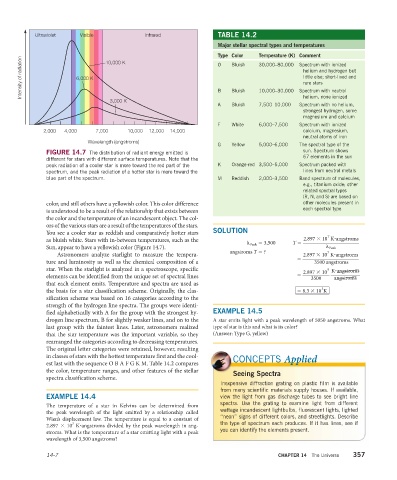
                       FIGURE 14.7  The distribution of radiant energy emitted is
                                                                                                              67 elements in the sun
                       different for stars with different surface temperatures. Note that the
                       peak radiation of a cooler star is more toward the red part of the   K   Orange-red  3,500–5,000   Spectrum packed with
                       spectrum, and the peak radiation of a hotter star is more toward the                   lines from neutral metals
                       blue part of the spectrum.                               M    Reddish  2,000–3,500  Band spectrum of molecules,
                                                                                                              e.g., titanium oxide; other
                                                                                                             related spectral types
                                                                                                              (R, N, and S) are based on
                       color, and still others have a yellowish color. This color difference                 other molecules present in
                       is understood to be a result of the relationship that exists between                   each spectral type
                       the color and the temperature of an incandescent object. The col-
                       ors of the various stars are a result of the temperatures of the stars.
                       You see a cooler star as reddish and comparatively hotter stars   SOLUTION                    7
                                                                                                             ___
                       as bluish white. Stars with in-between temperatures, such as the   λ    Peak   = 3,500  T =   2.897 × 1 0    K∙angstroms


                       Sun, appear to have a yellowish color (Figure 14.7).                                           λ    Peak
                                                                                                                     7
                           Astronomers analyze starlight to measure the tempera-    angstroms T = ?         ___
                                                                                                             2.897 × 1 0    K∙angstroms


                       ture and luminosity as well as the chemical composition of a                       =      3500 angstroms
                       star. When the starlight is analyzed in a spectroscope, specific                     _        7  K∙angstroms
                                                                                                             2.897 × 1 0   __


                         elements can be identified from the unique set of spectral lines                 =      3500
                                                                                                                       angstroms
                       that each element emits. Temperature and spectra are used as
                                                                                                                   3
                       the basis for a star classification scheme. Originally, the clas-                  = 8.3 × 1 0   K
                       sification scheme was based on 16 categories according to the
                       strength of the hydrogen line spectra. The groups were identi-
                       fied alphabetically with A for the group with the strongest hy-  EXAMPLE 14.5
                       drogen line spectrum, B for slightly weaker lines, and on to the   A star emits light with a peak wavelength of 5050 angstroms. What
                       last group with the faintest lines. Later, astronomers realized   type of star is this and what is its color?
                       that the star temperature was the important variable, so they   (Answer: Type G, yellow)
                       rearranged the categories according to  decreasing temperatures.
                       The original letter categories were retained, however, resulting
                       in classes of stars with the  hottest temperature first and the cool-  CONCEPTS Applied
                       est last with the sequence O B A F G K M. Table 14.2 compares
                       the color, temperature ranges, and other features of the stellar   Seeing Spectra
                       spectra classification scheme.
                                                                                 Inexpensive diffraction grating on plastic film is available
                                                                                 from many scientific materials supply houses. If available,
                       EXAMPLE 14.4                                              view the light from gas discharge tubes to see bright line
                                                                                 spectra. Use the  grating to  examine light from different
                       The temperature of a star in Kelvins can be determined from
                                                                                 wattage incandescent lightbulbs, fluorescent lights, lighted
                       the  peak wavelength of the light emitted by a relationship called
                                                                                 “neon” signs of different colors, and streetlights. Describe
                       Wien’s displacement law. The temperature is equal to a constant of
                                7
                       2.897 × 10  K∙angstroms  divided by the peak wavelength in ang-  the type of spectrum each produces. If it has lines, see if
                                                                                 you can identify the elements present.
                       stroms. What is the temperature of a star emitting light with a peak
                       wavelength of  3,500 angstroms?
                       14-7                                                                         CHAPTER 14  The Universe   357

