


Page 405 - 9780077418427.pdf
P. 405
/Users/user-f465/Desktop
          tiL12214_ch15_377-404.indd Page 382  9/3/10  6:17 PM user-f465
          tiL12214_ch15_377-404.indd Page 382  9/3/10  6:17 PM user-f465                                                /Users/user-f465/Desktop


                    TABLE 15.2

                    Spacecraft missions to Venus
                    Date         Name           Owner  Remark
                    Feb 12, 1961   Venera 1    U.S.S.R. Flyby
                    Aug 27, 1962   Mariner 2   U.S.    Flyby
                    Apr 2, 1964   Zond 1       U.S.S.R. Flyby
                    Nov 12, 1965   Venera 2    U.S.S.R. Flyby
                    Nov 16, 1965   Venera 3    U.S.S.R.  Crashed on Venus
                    Jun 12, 1967   Venera 4    U.S.S.R. Impacted Venus
                    Jun 14, 1967   Mariner 5   U.S.    Flyby
                    Jan 5, 1969   Venera 5     U.S.S.R. Impacted Venus
                    Jan 10, 1969   Venera 6    U.S.S.R. Impacted Venus
                    Aug 17, 1970   Venera 7    U.S.S.R. Venus landing
                    Mar 27, 1972   Venera 8    U.S.S.R. Venus landing
                    Nov 3, 1973   Mariner 10    U.S.   Venus, Mercury
                                                          flyby photos
                    Jun 8, 1975   Venera 9     U.S.S.R. Lander/orbiter
                    Jun 14, 1975   Venera 10   U.S.S.R. Lander/orbiter
                    May 20, 1978   Pioneer 12  U.S.    Orbital
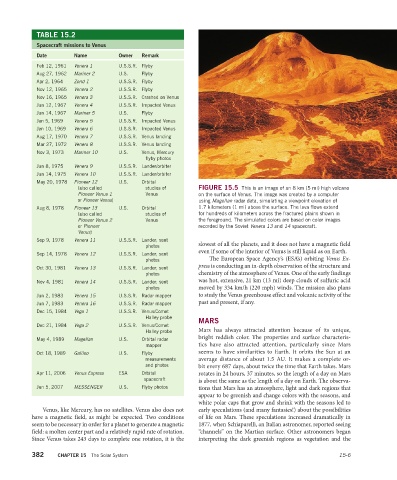
                                    (also called          studies of      FIGURE 15.5  This is an image of an 8 km (5 mi) high volcano
                                  Pioneer Venus 1       Venus             on the surface of Venus. The image was created by a computer
                                  or Pioneer Venus)                       using Magellan radar data, simulating a viewpoint elevation of
                    Aug 8, 1978   Pioneer 13   U.S.    Orbital            1.7 kilometers (1 mi) above the surface. The lava flows extend
                                    (also called          studies of      for hundreds of kilometers across the fractured plains shown in
                                  Pioneer Venus 2       Venus             the foreground. The simulated colors are based on color images
                                  or Pioneer                              recorded by the Soviet Venera 13 and 14 spacecraft.
                                  Venus)
                    Sep 9, 1978   Venera 11    U.S.S.R. Lander; sent
                                                        photos            slowest of all the planets, and it does not have a magnetic field
                                                                          even if some of the interior of Venus is still liquid as on Earth.
                    Sep 14, 1978   Venera 12   U.S.S.R. Lander; sent
                                                        photos               The European Space Agency’s (ESA’s) orbiting Venus Ex-
                                                                          press is conducting an in-depth observation of the structure and
                    Oct 30, 1981   Venera 13   U.S.S.R. Lander; sent
                                                        photos            chemistry of the atmosphere of Venus. One of the early findings
                    Nov 4, 1981   Venera 14    U.S.S.R. Lander; sent      was hot, extensive, 21 km (13 mi) deep clouds of sulfuric acid
                                                        photos            moved by 334 km/h (220 mph) winds. The mission also plans
                    Jun 2, 1983   Venera 15    U.S.S.R. Radar mapper      to study the Venus greenhouse effect and volcanic activity of the
                    Jun 7, 1983   Venera 16    U.S.S.R. Radar mapper      past and present, if any.
                    Dec 15, 1984   Vega 1      U.S.S.R. Venus/Comet
                                                          Halley probe
                                                                          MARS
                    Dec 21, 1984   Vega 2      U.S.S.R. Venus/Comet
                                                          Halley probe    Mars has always attracted attention because of its unique,
                                                                          bright reddish color. The properties and surface characteris-
                    May 4, 1989   Magellan     U.S.    Orbital radar
                                                        mapper            tics  have also attracted attention, particularly since Mars
                    Oct 18, 1989   Galileo     U.S.    Flyby              seems to have similarities to Earth. It orbits the Sun at an
                                                        measurements      average distance of about 1.5 AU. It makes a complete or-
                                                          and photos      bit every 687 days, about twice the time that Earth takes. Mars
                    Apr 11, 2006   Venus Express  ESA  Orbital            rotates in 24 hours, 37 minutes, so the length of a day on Mars
                                                        spacecraft        is about the same as the length of a day on Earth. The observa-
                    Jun 5, 2007   MESSENGER    U.S.    Flyby photos       tions that Mars has an atmosphere, light and dark regions that
                                                                          appear to be greenish and change colors with the seasons, and
                                                                          white polar caps that grow and shrink with the seasons led to
                      Venus, like Mercury, has no satellites. Venus also does not   early  speculations (and many fantasies!) about the possibilities
                   have a magnetic field, as might be expected. Two conditions   of life on Mars. These speculations increased dramatically in
                   seem to be necessary in order for a planet to generate a magnetic   1877, when Schiaparelli, an Italian astronomer, reported seeing
                   field: a molten center part and a relatively rapid rate of rotation.     “channels” on the Martian surface. Other astronomers  began
                   Since Venus takes 243 days to complete one rotation, it is the   interpreting the dark greenish regions as vegetation and the

                   382     CHAPTER 15  The Solar System                                                                 15-6

