


Page 403 - 9780077418427.pdf
P. 403
/Users/user-f465/Desktop
          tiL12214_ch15_377-404.indd Page 380  9/3/10  6:17 PM user-f465
          tiL12214_ch15_377-404.indd Page 380  9/3/10  6:17 PM user-f465                                                /Users/user-f465/Desktop


                    TABLE 15.1

                    Properties of the planets
                                              Mercury  Venus       Earth    Mars    Jupiter   Saturn    Uranus     Neptune
                    Average distance from the Sun:
                         6
                     in 10  km                58       108         150      228     778       1,400     3,000      4,497
                      in AU                   0.38     0.72        1.0      1.5     5.2       9.5       19.2       30.1
                    Inclination to ecliptic   7°       3.4°        0°       1.9°    1.3°      2.5°      0.8°       1.8°
                    Revolution period         0.24     0.62        1.00     1.88    11.86     29.46     84.01      164.8
                      (Earth years)
                    Rotation period           59 days   –243 days*   23 h   24 h    9 h       10 h      –17 h*     16 h
                      (Earth days, h,                              56 min   37 min   50 min   39 min    14 min     6.7 min
                      min, and s)                                  4 s      23 s    30 s
                    Mass (Earth = 1)         0.05      0.82        1.00     0.11    317.9     95.2      14.6       17.2
                    Equatorial dimensions:
                     diameter in km           4,880    12,104      12,756   6,787   142,984   120,536   57,118     49,528
                     in Earth radius = 1     0.38      0.95        1.00     0.53    11        9         4          4
                              3
                    Density (g/cm )          5.43      5.25        5.52     3.95    1.33      0.69      1.29       1.64
                    Atmosphere                None     CO 2        N 2 , O 2  CO 2  H 2 , He   H 2 , He   H 2 , He, CH 4  H 2 , He, CH 4
                      (major compounds)
                    Solar energy received     13.4     3.8         2.0      0.86    0.08      0.02      0.006      0.002
                           2
                      (cal/cm /s)
                   *Negative means spin is opposite to motion in orbit.


                   gases for an atmosphere. The lack of an atmosphere to even   by lava in the past, some time  after most of the  impact craters
                   the heat gains from the long days and heat losses from the long   were formed (Figure 15.4).
                   nights results in some very large temperature differences. The   A spacecraft named  MESSENGER is now on its way to
                   temperature of the surface of Mercury ranges from above the     investigate the planet Mercury. Its name is an acronym for
                   melting point of lead on the sunny side to below the tempera-  mercury surface, space environment, geochemistry, and rang-
                   ture of liquid oxygen on the dark side.                ing. It was launched August 3, 2004, on a 7.9 billion km (about
                      Mercury has been visited by  Mariner 10, which flew by   4.9 billion mi) trip designed to slow the spacecraft as it falls toward
                   three times in 1973 and 1974. The photographs transmitted by   the Sun. Overall, it looped by Earth in August 2005, then twice
                   Mariner 10 revealed that the surface of Mercury is covered with   by Venus in October 2006 and June 2007, and then three times
                   craters and very much resembles the surface of Earth’s Moon.   by Mercury in January 2008, October 2008, and September 2009.
                   There are large craters, small craters, super imposed craters, and   Eventually, it will be slow enough to be captured by the planet
                   craters with lighter colored rays coming from them just like the   Mercury as it flies by in March 2011. It will then become the first
                   craters on the Moon. Also as on Earth’s Moon, there are hills   spacecraft to orbit Mercury.  Mercury has a high surface tem-
                   and smooth areas with light and dark  colors that were covered   perature, and the spacecraft  instruments will be protected from
                                                                          high radiant energy from Mercury and the Sun by a sunshade of
                                                                          heat-resistant ceramic fabric. There is a NASA mission page at
                                                                          www.nasa.gov/mission_pages/messenger/main/index.html.
                                                                             Mercury has no natural satellites, or moons, it has a weak
                              Mercury (showing phases)
                                                                          magnetic field, and it has an average density more similar to
                                                                          that of Venus or Earth than to that of the Moon. The presence
                                                     Sun
                                                                          of the magnetic field and the relatively high density for such a
                                                                          small body must mean that Mercury probably has a relatively
                                                                          large core of iron with at least part of the core molten. Because
                                                      Earth               of its high density, it is thought that Mercury lost much of its less
                                                                          dense, outer layer of rock materials during its formation.

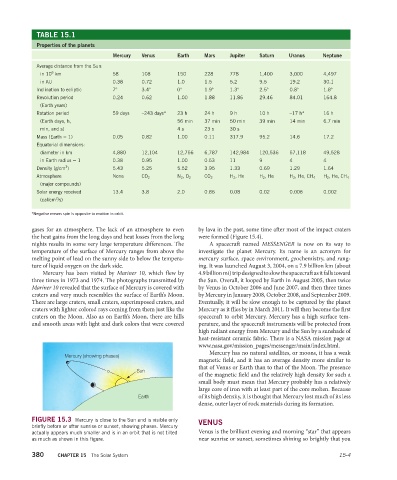
                   FIGURE 15.3  Mercury is close to the Sun and is visible only   VENUS
                   briefly before or after sunrise or sunset, showing phases. Mercury
                   actually appears much smaller and is in an orbit that is not tilted   Venus is the brilliant evening and morning “star” that appears
                   as much as shown in this figure.                       near sunrise or sunset, sometimes shining so brightly that you

                   380     CHAPTER 15  The Solar System                                                                 15-4

