


Page 404 - 9780077418427.pdf
P. 404
/Users/user-f465/Desktop
          tiL12214_ch15_377-404.indd Page 381  9/3/10  6:17 PM user-f465
          tiL12214_ch15_377-404.indd Page 381  9/3/10  6:17 PM user-f465                                                /Users/user-f465/Desktop


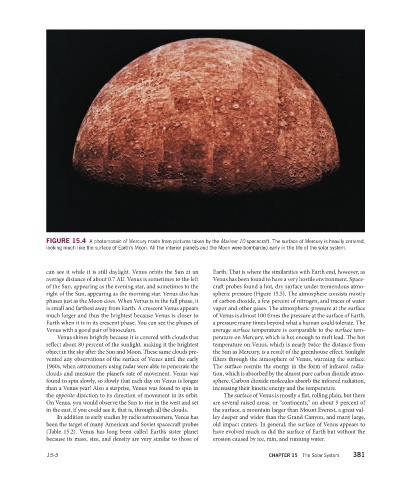
                       FIGURE 15.4  A photomosaic of Mercury made from pictures taken by the Mariner 10 spacecraft. The surface of Mercury is heavily cratered,
                       looking much like the surface of Earth’s Moon. All the interior planets and the Moon were bombarded early in the life of the solar system.


                       can see it while it is still daylight. Venus orbits the Sun at an   Earth. That is where the similarities with Earth end, however, as
                         average distance of about 0.7 AU. Venus is sometimes to the left   Venus has been found to have a very hostile environment. Space-
                       of the Sun, appearing as the evening star, and sometimes to the   craft probes found a hot, dry surface under tremendous atmo-
                       right of the Sun, appearing as the morning star. Venus also has   spheric pressure (Figure 15.5). The atmosphere consists mostly
                       phases just as the Moon does. When Venus is in the full phase, it   of carbon dioxide, a few percent of nitrogen, and traces of water
                       is small and farthest away from Earth. A crescent Venus appears   vapor and other gases. The atmospheric pressure at the surface
                       much larger and thus the brightest because Venus is closer to   of Venus is almost 100 times the pressure at the surface of Earth,
                       Earth when it is in its crescent phase. You can see the phases of   a pressure many times beyond what a human could  tolerate. The
                       Venus with a good pair of binoculars.                   average surface temperature is comparable to the surface tem-
                           Venus shines brightly because it is covered with clouds that   perature on Mercury, which is hot enough to melt lead. The hot
                       reflect about 80 percent of the sunlight, making it the brightest   temperature on Venus, which is nearly twice the distance from
                       object in the sky after the Sun and Moon. These same clouds pre-  the Sun as Mercury, is a result of the greenhouse effect. Sunlight
                       vented any observations of the surface of Venus  until the early   filters through the atmosphere of Venus, warming the surface.
                       1960s, when astronomers using radar were able to  penetrate the   The surface reemits the energy in the form of infrared radia-
                       clouds and measure the planet’s rate of movement. Venus was   tion, which is absorbed by the almost pure carbon dioxide atmo-
                       found to spin slowly, so slowly that  each day on Venus is longer   sphere. Carbon dioxide molecules absorb the  infrared radiation,
                       than a Venus year! Also a surprise, Venus was found to spin in   increasing their kinetic energy and the  temperature.
                       the opposite direction to its direction of movement in its orbit.   The surface of Venus is mostly a flat, rolling plain, but there
                       On Venus, you would observe the Sun to rise in the west and set   are several raised areas, or “continents,” on about 5 percent of
                       in the east, if you could see it, that is, through all the clouds.  the surface, a mountain larger than Mount Everest, a great val-
                           In addition to early studies by radio astronomers, Venus has   ley deeper and wider than the Grand Canyon, and many large,
                       been the target of many American and Soviet spacecraft probes   old impact craters. In general, the surface of Venus appears to
                       (Table 15.2). Venus has long been called Earth’s sister planet   have evolved much as did the surface of Earth but without the
                        because its mass, size, and density are very similar to those of   erosion caused by ice, rain, and running water.

                       15-5                                                                      CHAPTER 15  The Solar System   381

