


Page 407 - 9780077418427.pdf
P. 407
/Users/user-f465/Desktop
          tiL12214_ch15_377-404.indd Page 384  9/3/10  6:17 PM user-f465
          tiL12214_ch15_377-404.indd Page 384  9/3/10  6:17 PM user-f465                                                /Users/user-f465/Desktop


                           Science and Society


                           Worth the Cost?
                        eople are fascinated with ideas of   here on Earth, such as growing energy and
                                                                                          saved thanks to storm warnings provided
                     Pspace travel as well as new discoveries   water needs, pollution problems, and on-
                                                                                          by weather satellites. There are many other
                     about the universe and how it formed. Un-  going health problems. They say that the
                                                                                          spin-offs from the space program, including
                     manned space probes, new kinds of instru-  money spent on exploring space could be
                                                                                          improvements in communication  systems.
                     ments, and new kinds of telescopes have   better used for helping resolve problems
                     resulted in new information. We are learn-  on Earth.
                     ing about what is happening in outer space   In addition to new information and   QUESTIONS TO DISCUSS
                     away from Earth, as well as the existence of   understanding, supporters of the space pro-
                     other planets.                     gram point to new technology that helps     1. Have the gain of knowledge and the
                        Few would deny that the space pro-  people living on Earth. Satellites now pro-  spin-offs merited the expense?
                     gram has provided valuable information.   vide valuable information for agriculture,     2.  Alternatively, would the funds
                     Some people wonder, however, if it is worth   including land use and weather monitor-  be better spent on solving other
                     the cost. They point to many problems   ing. Untold numbers of lives have been   problems?


                   provided data about the early  environments and conditions that
                   have existed on Mars. After the Pathfinder lander completed its
                   primary 30 day mission and fell silent, it was renamed the Carl
                   Sagan Memorial  Station.
                      The Mars Exploration Rovers, named  Spirit and  Oppor-
                   tunity, landed on Mars on January 4 and January 25, 2004, to
                     answer questions about the history of water on Mars. The space-
                   craft were sent to sites on opposite sides of Mars that appear to
                   have been affected by liquid water in the past. After parachute
                   and airbag landings, the 185 kg (408 lb) rovers charged their
                   solar-powered batteries. They then began driving to different
                   locations to perform on-site scientific investigations over the
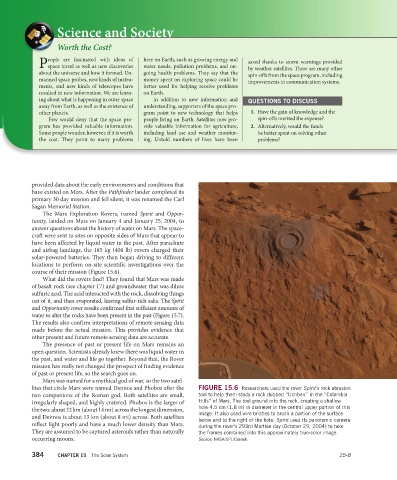
                   course of their mission (Figure 15.6).
                      What did the rovers find? They found that Mars was made
                   of basalt rock (see chapter 17) and groundwater that was dilute
                   sulfuric acid. The acid interacted with the rock, dissolving things
                   out of it, and then evaporated, leaving sulfur-rich salts. The Spirit
                   and Opportunity rover results confirmed that sufficient amounts of
                   water to alter the rocks have been present in the past ( Figure 15.7).
                   The results also confirm  interpretations of remote sensing data
                   made before the actual mission. This provides evidence that
                   other present and future remote sensing data are accurate.
                      The presence of past or present life on Mars remains an
                   open question. Scientists already knew there was liquid water in
                   the past, and water and life go together. Beyond that, the Rover
                   mission has really not changed the prospect of finding evidence
                   of past or present life, so the search goes on.
                      Mars was named for a mythical god of war, so the two satel-
                   lites that circle Mars were named Deimos and Phobos after the   FIGURE 15.6  Researchers used the rover Spirit’s rock abrasion
                   two companions of the Roman god. Both satellites are small,   tool to help them study a rock dubbed “Uchben” in the “Colombia
                   irregularly shaped, and highly cratered. Phobos is the larger of   Hills” of Mars. The tool ground into the rock, creating a shallow
                   the two, about 22 km (about 14 mi) across the longest  dimension,   hole 4.5 cm (1.8 in) in diameter in the central upper portion of this
                                                                          image. It also used wire bristles to brush a portion of the surface
                   and Deimos is about 13 km (about 8 mi) across. Both satellites
                                                                          below and to the right of the hole. Spirit used its panoramic camera
                   reflect light poorly and have a much lower density than Mars.   during the rover’s 293rd Martian day (October 29, 2004) to take
                   They are assumed to be captured asteroids rather than naturally   the frames combined into this approximately true-color image.
                   occurring moons.                                       Source: NASA/1PL/Cornell.

                   384     CHAPTER 15  The Solar System                                                                 15-8

