


Page 406 - 9780077418427.pdf
P. 406
/Users/user-f465/Desktop
          tiL12214_ch15_377-404.indd Page 383  9/3/10  6:17 PM user-f465
          tiL12214_ch15_377-404.indd Page 383  9/3/10  6:17 PM user-f465                                                /Users/user-f465/Desktop


                       white polar caps as ice caps as Earth has. In the early part of   tensive measurements of the Martian atmosphere, temperature
                       the  twentieth century, the American astronomer who founded   ranges, and chemistry. For about a year, Mariner 9 sent a flood
                       the Lowell Observatory in Arizona, Percival Lowell, published a   of new and surprising information about Mars back to Earth.
                       series of popular books showing a network of hundreds of canals   Mariner 9 found the surface of Mars not to be a crater- pitted
                       on Mars. Lowell and other respected astronomers  interpreted   surface as is found on the Moon. Mars has had a geologically ac-
                       what they believed to be canals as evidence of intelligent life on   tive past and has four provinces, or regions, of related surface
                       Mars. Still other astronomers, however, interpreted the green-    features. There are (1) volcanic regions with inactive volcanoes,
                       ish colors and the canals to be illusions, imagined features of   one larger than any found on Earth, (2) regions with systems of
                       astronomers working with the limited telescopes of that time.   canyons, some larger than any found on Earth, (3) regions of
                       Since canals never appeared in photographs, said the skeptics,   terraced plateaus near the poles, and (4) flat regions pitted with
                       the canals were the result of the human tendency to see patterns   impact craters. Surprisingly, dry channels suggesting former wa-
                       in random markings where no patterns actually exist.    ter erosion were discovered near the cratered  regions. These are
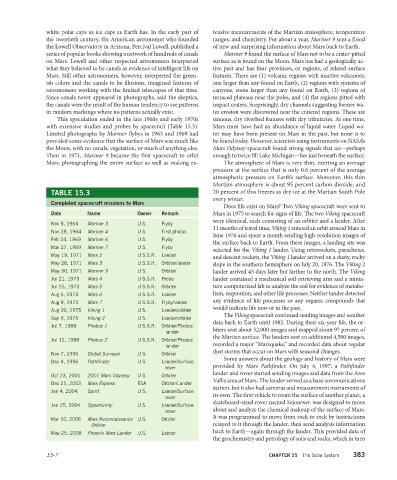
                           This speculation ended in the late 1960s and early 1970s   sinuous, dry riverbed features with dry  tributaries. At one time,
                       with extensive studies and probes by spacecraft (Table 15.3).   Mars must have had an abundance of liquid water. Liquid wa-
                       Limited photographs by Mariner flybys in 1965 and 1969 had   ter may have been present on Mars in the past, but none is to
                       provided some evidence that the surface of Mars was much like   be found  today. However, scientists using instruments on NASA’s
                       the Moon, with no canals, vegetation, or much of anything else.   Mars Odyssey spacecraft found strong signals that ice—perhaps
                       Then in 1971, Mariner 9 became the first spacecraft to orbit   enough to twice fill Lake Michigan—lies just beneath the surface.
                       Mars, photographing the entire surface as well as making ex-  The atmosphere of Mars is very thin, exerting an average
                                                                               pressure at the surface that is only 0.6 percent of the average
                                                                                 atmospheric pressure on Earth’s surface. Moreover, this thin
                                                                               Martian atmosphere is about 95 percent carbon dioxide, and
                         TABLE 15.3                                            20 percent of this freezes as dry ice at the Martian South Pole
                                                                               every winter.
                         Completed spacecraft missions to Mars
                                                                                  Does life exist on Mars? Two Viking spacecraft were sent to
                         Date        Name             Owner   Remark           Mars in 1975 to search for signs of life. The two Viking spacecraft
                                                                               were identical, each consisting of an orbiter and a lander. After
                         Nov 5, 1964   Mariner 3      U.S.    Flyby
                                                                               11 months of travel time, Viking 1 entered an orbit around Mars in
                         Nov 28, 1964  Mariner 4      U.S.    First photos
                                                                               June 1976 and spent a month sending high- resolution images of
                         Feb 24, 1969   Mariner 6     U.S.    Flyby
                                                                               the surface back to Earth. From these images, a landing site was
                         Mar 27, 1969  Mariner 7      U.S.    Flyby
                                                                               selected for the Viking 1 lander.  Using retrorockets, parachutes,
                         May 19, 1971  Mars 2         U.S.S.R.  Lander
                                                                               and descent rockets, the Viking 1 lander arrived on a dusty, rocky
                         May 28, 1971  Mars 3         U.S.S.R.  Orbiter/lander  slope in the southern hemisphere on July 20, 1976. The Viking 2
                         May 30, 1971  Mariner 9      U.S.    Orbiter          lander arrived 45 days later but farther to the north. The Viking
                         Jul 21, 1973   Mars 4        U.S.S.R.  Probe          lander contained a mechanical soil-retrieving arm and a minia-
                         Jul 25, 1973   Mars 5        U.S.S.R.  Orbiter        ture computerized lab to analyze the soil for  evidence of metabo-
                         Aug 5, 1973   Mars 6         U.S.S.R.  Lander         lism, respiration, and other life processes. Neither lander detected
                         Aug 9, 1973   Mars 7         U.S.S.R.  Flyby/lander   any evidence of life processes or any  organic compounds that
                                                                               would indicate life now or in the past.
                         Aug 20, 1975  Viking 1       U.S.    Lander/orbiter
                                                                                  The Viking spacecraft continued sending images and weather
                         Sep 9, 1975   Viking 2       U.S.    Lander/orbiter
                                                                               data back to Earth until 1982. During their  six-year life, the or-
                         Jul 7, 1988   Phobos 1       U.S.S.R.  Orbiter/Phobos
                                                               lander          biters sent about 52,000 images and mapped about 97 percent of
                                                                               the Martian surface. The landers sent an  additional 4,500 images,
                         Jul 12, 1988   Phobos 2      U.S.S.R.  Orbiter/Phobos
                                                               lander          recorded a major “Marsquake,” and  recorded data about regular
                                                                               dust storms that occur on Mars with seasonal changes.
                         Nov 7, 1996   Global Surveyor  U.S.  Orbiter
                                                                                  Some answers about the geology and history of Mars were
                         Dec 4, 1996   Pathfinder     U.S.    Lander/Surface
                                                               rover           provided by Mars  Pathfinder. On July 4, 1997, a  Pathfinder
                                                                               lander and rover started sending images and data from the Ares
                         Oct 23, 2001   2001 Mars Odyssey  U.S.  Orbiter
                                                                               Vallis area of Mars. The lander served as a base communications
                         Dec 25, 2003   Mars Express  ESA     Orbiter/Lander
                                                                                 station, but it also had cameras and measurement  instruments of
                         Jan 4, 2004   Spirit         U.S.    Lander/Surface
                                                               rover           its own. The first vehicle to roam the surface of another planet, a
                                                                               skateboard-sized rover named Sojourner, was designed to move
                         Jan 25, 2004   Opportunity   U.S.    Lander/Surface
                                                               rover           about and analyze the chemical makeup of the surface of Mars.
                                                                               It was programmed to move from rock to rock by  instructions
                         Mar 10, 2006   Mars Reconnaissance U.S.   Orbiter
                                      Orbiter                                  relayed to it through the lander, then send analysis information
                         May 25, 2008  Phoenix Mars Lander  U.S.  Lander       back to Earth—again through the lander. This provided data of
                                                                               the geochemistry and petrology of soils and rocks, which in turn
                       15-7                                                                      CHAPTER 15  The Solar System   383

