


Page 408 - 9780077418427.pdf
P. 408
/Users/user-f465/Desktop
          tiL12214_ch15_377-404.indd Page 385  9/3/10  6:17 PM user-f465
          tiL12214_ch15_377-404.indd Page 385  9/3/10  6:17 PM user-f465                                                /Users/user-f465/Desktop


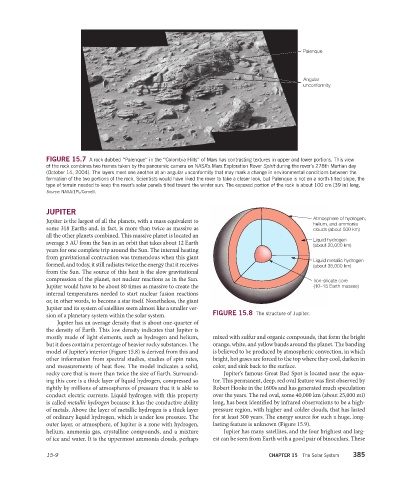
                                                                                                             Palenque


                                                                                                             Angular
                                                                                                             unconformity


                       FIGURE 15.7  A rock dubbed “Palenque” in the “Colombia Hills” of Mars has contrasting textures in upper and lower portions. This view
                       of the rock combines two frames taken by the panoramic camera on NASA’s Mars Exploration Rover Spirit during the rover’s 278th Martian day
                       (October 14, 2004). The layers meet one another at an angular unconformity that may mark a change in environmental conditions between the
                       formation of the two portions of the rock. Scientists would have liked the rover to take a closer look, but Palenque is not on a north-tilted slope, the
                       type of terrain needed to keep the rover’s solar panels tilted toward the winter sun. The exposed portion of the rock is about 100 cm (39 in) long.
                       Source: NASA/1PL/Cornell.


                       JUPITER
                                                                                                                Atmosphere of hydrogen,
                       Jupiter is the largest of all the planets, with a mass equivalent to                     helium, and ammonia
                       some 318 Earths and, in fact, is more than twice as massive as                           clouds (about 500 km)
                       all the other planets combined. This massive planet is located an                        Liquid hydrogen
                       average 5 AU from the Sun in an orbit that takes about 12 Earth                          (about 20,000 km)
                       years for one complete trip around the Sun. The internal heating
                       from gravitational contraction was tremendous when this giant                            Liquid metallic hydrogen
                       formed, and today, it still radiates twice the energy that it receives                   (about 35,000 km)
                       from the Sun. The source of this heat is the slow gravitational
                       compression of the planet, not nuclear reactions as in the Sun.                          Iron-silicate core
                       Jupiter would have to be about 80 times as massive to create the                         (10–15 Earth masses)
                       internal temperatures needed to start nuclear fusion reactions
                       or, in other words, to become a star itself. Nonetheless, the giant
                       Jupiter and its system of satellites seem almost like a smaller ver-
                       sion of a planetary system within the solar system.     FIGURE 15.8  The structure of Jupiter.
                           Jupiter has an average density that is about one-quarter of
                       the density of Earth. This low density indicates that Jupiter is
                       mostly made of light elements, such as hydrogen and helium,   mixed with sulfur and organic compounds, that form the bright
                       but it does contain a percentage of heavier rocky substances. The   orange, white, and yellow bands around the planet. The banding
                       model of Jupiter’s interior (Figure 15.8) is derived from this and   is believed to be produced by atmospheric convection, in which
                       other information from spectral studies, studies of spin rates,   bright, hot gases are forced to the top where they cool, darken in
                       and measurements of heat flow. The model indicates a solid,   color, and sink back to the surface.
                       rocky core that is more than twice the size of Earth. Surround-  Jupiter’s famous Great Red Spot is located near the equa-
                       ing this core is a thick layer of liquid hydrogen, compressed so   tor. This permanent, deep, red oval feature was first observed by
                       tightly by millions of atmospheres of pressure that it is able to   Robert Hooke in the 1600s and has generated much speculation
                       conduct electric currents. Liquid hydrogen with this property   over the years. The red oval, some 40,000 km (about 25,000 mi)
                       is called metallic hydrogen because it has the conductive ability   long, has been identified by infrared observations to be a high-
                       of metals. Above the layer of metallic hydrogen is a thick layer   pressure region, with higher and colder clouds, that has lasted
                       of ordinary liquid hydrogen, which is under less pressure. The   for at least 300 years. The energy source for such a huge, long-
                       outer layer, or atmosphere, of Jupiter is a zone with hydrogen,   lasting feature is unknown  (Figure 15.9).
                       helium, ammonia gas, crystalline compounds, and a mixture   Jupiter has many satellites, and the four brightest and larg-
                       of ice and water. It is the  uppermost ammonia clouds, perhaps   est can be seen from Earth with a good pair of binoculars. These

                       15-9                                                                      CHAPTER 15  The Solar System   385

