


Page 447 - 9780077418427.pdf
P. 447
/Users/user-f465/Desktop
          tiL12214_ch16_405-432.indd Page 424  9/3/10  6:19 PM user-f465
          tiL12214_ch16_405-432.indd Page 424  9/3/10  6:19 PM user-f465                                                /Users/user-f465/Desktop


                            Position for lunar eclipse                                                              Earth's
                            to occur when Earth is between                                                          surface
                            the Sun and the Moon           Plane of
                                                           the Moon's
                                                           orbit                                        Moon
                                               Shadow
                                                                                  Sun                        Umbra
                                                                                                                 Penumbra
                                      Earth        Moon    Plane of
                                                           Earth's
                                                           orbit

                                     Position for solar eclipse
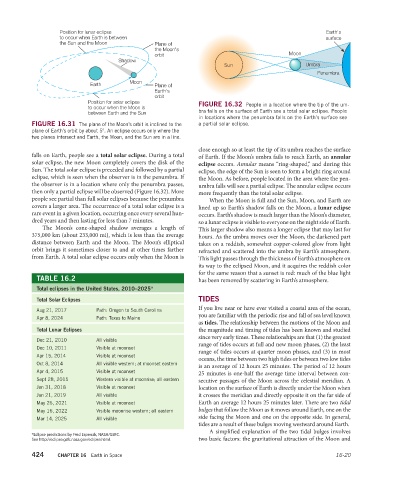
                                     to occur when the Moon is            FIGURE 16.32  People in a location where the tip of the um-
                                     between Earth and the Sun            bra falls on the surface of Earth see a total solar eclipse. People
                                                                          in locations where the penumbra falls on the Earth’s surface see
                   FIGURE 16.31  The plane of the Moon’s orbit is inclined to the   a partial solar eclipse.
                   plane of Earth’s orbit by about 5°. An eclipse occurs only where the
                   two planes intersect and Earth, the Moon, and the Sun are in a line.

                                                                          close enough so at least the tip of its umbra reaches the  surface
                   falls on Earth, people see a total solar eclipse. During a total   of Earth. If the Moon’s umbra fails to reach Earth, an annular
                   solar eclipse, the new Moon completely covers the disk of the   eclipse occurs. Annular means “ring-shaped,” and during this
                   Sun. The total solar eclipse is preceded and followed by a partial   eclipse, the edge of the Sun is seen to form a bright ring around
                   eclipse, which is seen when the observer is in the penumbra. If   the Moon. As before, people located in the area where the pen-
                   the observer is in a location where only the penumbra passes,   umbra falls will see a partial eclipse. The  annular eclipse occurs
                   then only a partial eclipse will be observed (Figure 16.32). More   more frequently than the total  solar eclipse.
                   people see partial than full solar eclipses because the penumbra   When the Moon is full and the Sun, Moon, and Earth are
                   covers a larger area. The occurrence of a total solar eclipse is a   lined up so Earth’s shadow falls on the Moon, a lunar eclipse
                   rare event in a given location, occurring once every several hun-  occurs. Earth’s shadow is much larger than the Moon’s diameter,
                   dred years and then lasting for less than 7 minutes.   so a lunar eclipse is visible to everyone on the night side of Earth.
                      The Moon’s cone-shaped shadow averages a length of   This larger shadow also means a longer eclipse that may last for
                   375,000 km (about 233,000 mi), which is less than the average   hours. As the umbra moves over the Moon, the darkened part
                   distance between Earth and the Moon. The Moon’s elliptical   takes on a reddish, somewhat copper-colored glow from light
                   orbit brings it sometimes closer to and at other times farther   refracted and scattered into the umbra by Earth’s atmosphere.
                   from Earth. A total solar eclipse occurs only when the Moon is   This light passes through the thickness of Earth’s  atmosphere on
                                                                          its way to the eclipsed Moon, and it acquires the reddish color
                                                                          for the same reason that a sunset is red: much of the blue light
                    TABLE 16.2                                            has been removed by scattering in Earth’s  atmosphere.
                    Total eclipses in the United States, 2010–2025*
                    Total Solar Eclipses                                  TIDES
                                                                          If you live near or have ever visited a coastal area of the ocean,
                    Aug 21, 2017        Path: Oregon to South Carolina
                                                                          you are familiar with the periodic rise and fall of sea level known
                    Apr 8, 2024         Path: Texas to Maine
                                                                          as tides. The relationship between the motions of the Moon and
                    Total Lunar Eclipses                                  the magnitude and timing of tides has been known and studied
                                                                          since very early times. These relationships are that (1) the greatest
                    Dec 21, 2010        All visible
                                                                          range of tides occurs at full and new moon phases, (2) the least
                    Dec 10, 2011        Visible at moonset
                                                                          range of tides occurs at quarter moon phases, and (3) in most
                    Apr 15, 2014        Visible at moonset
                                                                          oceans, the time between two high tides or between two low tides
                    Oct 8, 2014         All visible western; at moonset eastern
                                                                          is an average of 12 hours 25 minutes. The period of 12 hours
                    Apr 4, 2015         Visible at moonset
                                                                          25 minutes is one-half the average time interval between con-
                    Sept 28, 2015       Western visible at moonrise; all eastern  secutive passages of the Moon across the celestial meridian. A
                    Jan 31, 2018        Visible at moonset                location on the surface of Earth is directly under the Moon when
                    Jan 21, 2019        All visible                       it crosses the meridian and directly opposite it on the far side of
                    May 26, 2021        Visible at moonset                Earth an average 12 hours 25 minutes later. There are two tidal
                    May 16, 2022        Visible moonrise western; all eastern  bulges that follow the Moon as it moves around Earth, one on the
                                                                          side facing the Moon and one on the opposite side. In general,
                    Mar 14, 2025        All visible
                                                                          tides are a result of these bulges moving westward around Earth.
                                                                             A simplified explanation of the two tidal bulges involves
                   *Eclipse predictions by Fred Espenak, NASA/GSFC.
                   See http://eclipse.gsfc.nasa.gov/eclipse.html.         two basic factors: the gravitational attraction of the Moon and

                   424     CHAPTER 16  Earth in Space                                                                  16-20

