


Page 448 - 9780077418427.pdf
P. 448
/Users/user-f465/Desktop
          tiL12214_ch16_405-432.indd Page 425  9/3/10  6:19 PM user-f465
          tiL12214_ch16_405-432.indd Page 425  9/3/10  6:19 PM user-f465                                                /Users/user-f465/Desktop


                                                                     People Behind the Science


                                                                                    Carl Edward Sagan (1934–1996)

                             arl Edward Sagan was an American                                  (227°C/440°F) and 800 K (527°C/980°F)—
                          Castronomer and popularizer of astron-                               the range that would also be expected on
                          omy whose main research was on planetary                             the basis of emission rate.
                          atmospheres, including that of the primor-                               Sagan then turned his attention to the
                          dial Earth. His most remarkable achieve-                             early planetary atmosphere of Earth, with
                          ment was to provide valuable insights into                             regard to the origins of life. One way of
                          the origin of life on our planet.                                    understanding how life began is to try to
                             Sagan was born on November 19,                                    form the compounds essential to life in con-
                          1934, in New York City. Completing his                               ditions analogous to those of the primeval
                          education at the University of Chicago, he                           atmo sphere. Before Sagan, Stanley Miller
                          obtained his bachelor’s degree in 1955 and                           and Harold Urey had used a mixture of meth-
                          his doctorate in 1960. Then, for two years,                          ane, ammonia, water vapor, and hydrogen,
                          he was a  research fellow at the University   perhaps it was due to interactions between   sparked by a corona discharge that simulated
                          of California in Berkeley before he trans-  charged particles in Venus’s dense upper   the  effect of lightning, to produce amino and
                          ferred to the  Smithsonian Astrophysical   atmosphere; perhaps it was glow discharge     hydroxy acids of the sort found in life-forms.
                          Observatory in Cambridge, Massachusetts,   between positive and negative charges in   Later experiments used ultraviolet light or
                          lecturing also at Harvard University, where   the atmosphere; or perhaps emission was   heat as sources of energy, and even these had
                          he became assistant professor. Finally, in   due to a particular radiation from charged   less energy than would have been available
                          1968, Sagan moved to Cornell University   particles trapped in the Venusian equiva-  in Earth’s primordial state. Sagan followed a
                          in Ithaca, New York, and took a position   lent of a Van Allen Belt. Sagan showed that   similar method and, by irradiating a mixture
                          as director of the Laboratory for Planetary   each of these hypotheses was incompat-  of methane, ammonia, water, and hydrogen
                          Studies; in 1970, he became professor of   ible with other observed characteristics or   sulfide, was able to produce amino acids—as
                          astronomy and space science there. He died   with implications of these characteristics.   well as glucose, fructose, and  nucleic acids.
                          on December 20, 1996.              The positive part of Sagan’s proposal was   Sugars can be made from formaldehyde un-
                             In the early 1960s, Sagan’s first major   to show that all the observed characteris-  der alkaline conditions and in the presence
                          research was into the planetary surface and   tics were compatible with the straightfor-  of inorganic catalysts. These sugars include
                          atmosphere of Venus. At the time, although   ward hypothesis that the surface of Venus   five-carbon sugars, which are essential to
                          intense emission of radiation had shown   was very hot. On the  basis of radar and   the formation of nucleic acids, glucose, and
                          that the dark-side temperature of Venus   optical observations, the distance between     fructose—all common metabolites found as
                          was nearly 600 K, it was thought that the   surface and clouds was calculated to be be-  constituents of present-day life-forms. Sa-
                          surface itself remained relatively cool—  tween 44 km (27 mi) and 65 km (40 mi);   gan’s simulated primordial atmosphere not
                          leaving open the possibility that there was   given the cloud-top temperature and Sa-  only showed the presence of those metabo-
                          some form of life on the planet. Various   gan’s expectation of a “greenhouse effect”   lites, but also contained traces of adenosine
                          hypotheses were put  forward to account   in the atmosphere, surface temperature on   triphosphate (ATP)—the foremost agent
                          for the strong emission actually observed:   Venus was computed to be between 500 K   used by living cells to store energy.


                       Source: From the Hutchinson Dictionary of Scientific Biography. © Research Machines plc 2003. All Rights Reserved. Helicon Publishing is a division of Research Machines.


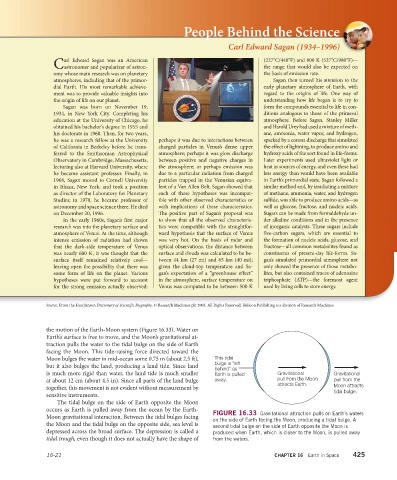
                       the motion of the Earth-Moon system (Figure 16.33). Water on
                       Earth’s surface is free to move, and the Moon’s gravitational at-
                       traction pulls the water to the tidal bulge on the side of Earth
                       facing the Moon. This tide-raising force directed toward the
                       Moon bulges the water in mid-ocean some 0.75 m (about 2.5 ft),   This tidal
                                                                               bulge is "left
                       but it also bulges the land, producing a land tide. Since land   behind" as
                       is much more rigid than water, the land tide is much smaller   Earth is pulled  Gravitational   Gravitational
                       at about 12 cm (about 4.5 in). Since all parts of the land bulge   away.     pull from the Moon  pull from the
                                                                                                    attracts Earth.
                       together, this movement is not evident without measurement by                                   Moon attracts
                                                                                                                       tidal bulge.
                       sensitive instruments.
                           The tidal bulge on the side of Earth opposite the Moon
                       occurs as Earth is pulled away from the ocean by the Earth-
                                                                               FIGURE 16.33  Gravitational attraction pulls on Earth’s waters
                       Moon gravitational interaction. Between the tidal bulges facing
                                                                               on the side of Earth facing the Moon, producing a tidal bulge. A
                       the Moon and the tidal bulge on the opposite side, sea level is   second tidal bulge on the side of Earth opposite the Moon is
                         depressed across the broad surface. The depression is called a   produced when Earth, which is closer to the Moon, is pulled away
                       tidal trough, even though it does not actually have the shape of   from the waters.

                       16-21                                                                       CHAPTER 16  Earth in Space   425

