


Page 444 - 9780077418427.pdf
P. 444
/Users/user-f465/Desktop
          tiL12214_ch16_405-432.indd Page 421  9/3/10  6:19 PM user-f465
          tiL12214_ch16_405-432.indd Page 421  9/3/10  6:19 PM user-f465                                                /Users/user-f465/Desktop


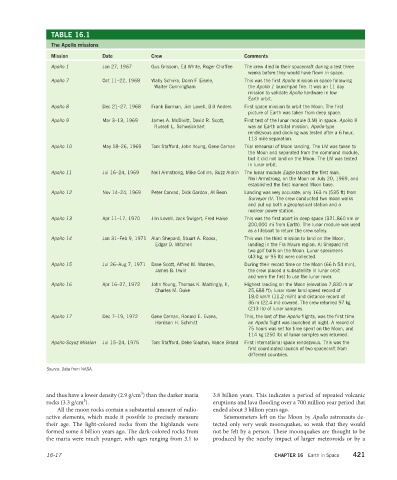
                         TABLE 16.1

                         The Apollo missions
                         Mission          Date            Crew                           Comments
                         Apollo 1         Jan 27, 1967    Gus Grissom, Ed White, Roger Chaffee   The crew died in their spacecraft during a test three
                                                                                            weeks before they would have flown in space.
                         Apollo 7         Oct 11–22, 1968   Wally Schirra, Donn F. Eisele,   This was the first Apollo mission in space following
                                                            Walter Cunningham               the Apollo 1 launchpad fire. It was an  11 day
                                                                                            mission to validate Apollo hardware in low
                                                                                            Earth orbit.
                         Apollo 8         Dec 21–27, 1968   Frank Borman, Jim Lovell, Bill Anders   First space mission to orbit the Moon. The first
                                                                                            picture of Earth was taken from deep space.
                         Apollo 9         Mar 3–13, 1969   James A. McDivitt, David R. Scott,   First test of the lunar module (LM) in space. Apollo 9
                                                            Russell L. Schweickhart         was an Earth orbital mission. Apollo-type
                                                                                            rendezvous and docking was tested after a 6 hour,
                                                                                            113 mile separation.
                         Apollo 10        May 18–26, 1969   Tom Stafford, John Young, Gene Cernan   Trial rehearsal of Moon landing. The LM was taken to
                                                                                            the Moon and separated from the command module,
                                                                                            but it did not land on the Moon. The LM was tested
                                                                                            in lunar orbit.
                         Apollo 11        Jul 16–24, 1969   Neil Armstrong, Mike Collins, Buzz Aldrin  The lunar module Eagle landed the first man,
                                                                                            Neil Armstrong, on the Moon on July 20, 1969, and
                                                                                            established the first manned Moon base.
                         Apollo 12        Nov 14–24, 1969   Peter Conrad, Dick Gordon, Al Bean   Landing was very accurate, only 163 m (535 ft) from
                                                                                          Surveyor III. The crew conducted two moon walks
                                                                                            and put up both a geophysical station and a
                                                                                            nuclear power station.
                         Apollo 13        Apr 11–17, 1970   Jim Lovell, Jack Swigert, Fred Haise   This was the first abort in deep space (321,860 km or
                                                                                            200,000 mi from Earth). The lunar module was used
                                                                                            as a lifeboat to return the crew safely.
                         Apollo 14        Jan 31–Feb 9, 1971  Alan Shepard, Stuart A. Roosa,   This was the third mission to land on the Moon,
                                                             Edgar D. Mitchell              landing in the Fra Mauro region. Al Shepard hit
                                                                                            two golf balls on the Moon. Lunar specimens
                                                                                            (43 kg, or 95 lb) were collected.
                         Apollo 15        Jul 26–Aug 7, 1971  Dave Scott, Alfred M. Worden,   During their record time on the Moon (66 h 54 min),
                                                             James B. Irwin                 the crew placed a subsatellite in lunar orbit
                                                                                            and were the first to use the lunar rover.
                         Apollo 16        Apr 16–27, 1972   John Young, Thomas K. Mattingly, II,   Highest landing on the Moon (elevation 7,830 m or
                                                             Charles M. Duke                25,688 ft); lunar rover land speed record of
                                                                                            18.0 km/h (11.2 mi/h) and distance record of
                                                                                            36 m (22.4 mi) covered. The crew returned 97 kg
                                                                                            (213 lb) of lunar samples.
                         Apollo 17        Dec 7–19, 1972   Gene Cernan, Ronald E. Evans,   This, the last of the Apollo flights, was the first time
                                                             Harrison H. Schmitt            an Apollo flight was launched at night. A record of
                                                                                            75 hours was set for time spent on the Moon, and
                                                                                            114 kg (250 lb) of lunar samples was returned.
                         Apollo-Soyuz Mission   Jul 15–24, 1975   Tom Stafford, Deke Slayton, Vance Brand  First international space rendezvous. This was the
                                                                                            first coordinated launch of two spacecraft from
                                                                                            different countries.
                       Source: Data from NASA.


                                                       3
                       and thus have a lower density (2.9 g/cm ) than the darker maria   3.8 billion years. This indicates a period of repeated volcanic
                                    3
                       rocks (3.3 g/cm ).                                      eruptions and lava flooding over a 700 million year period that
                           All the moon rocks contain a substantial amount of radio-  ended about 3 billion years ago.
                       active elements, which made it possible to precisely measure   Seismometers left on the Moon by Apollo astronauts de-
                       their age. The light-colored rocks from the highlands were   tected only very weak moonquakes, so weak that they would
                       formed some 4 billion years ago. The dark-colored rocks from   not be felt by a person. These moonquakes are thought to be
                       the maria were much younger, with ages ranging from 3.1 to   produced by the nearby impact of larger meteoroids or by a

                       16-17                                                                       CHAPTER 16  Earth in Space   421

