


Page 446 - 9780077418427.pdf
P. 446
/Users/user-f465/Desktop
          tiL12214_ch16_405-432.indd Page 423  9/3/10  6:19 PM user-f465
          tiL12214_ch16_405-432.indd Page 423  9/3/10  6:19 PM user-f465                                                /Users/user-f465/Desktop


                       away from Earth’s center toward the Moon. As a result, both
                       bodies act as a system, moving around a center of mass. The
                       center of mass  between Earth and the Moon follows a smooth
                       orbit around the Sun. Earth follows a slightly wavy path around
                       the Sun as it slowly  revolves around the common center of mass
                       (Figure 16.28B).


                       PHASES OF THE MOON
                                                                                               To the Sun
                       The phases of the Moon are a result of the changing relative
                       positions of Earth, the Moon, and the Sun as the Earth-Moon
                       system moves around the Sun. Sunlight always illuminates one-
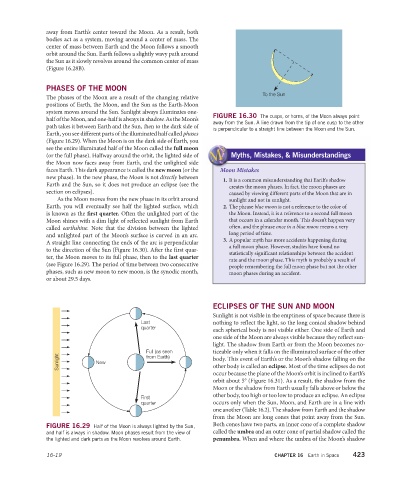
                                                                               FIGURE 16.30  The cusps, or horns, of the Moon always point
                       half of the Moon, and one-half is always in shadow. As the Moon’s
                                                                               away from the Sun. A line drawn from the tip of one cusp to the other
                       path takes it between Earth and the Sun, then to the dark side of
                                                                               is perpendicular to a straight line between the Moon and the Sun.
                       Earth, you see different parts of the illuminated half called phases
                       (Figure 16.29). When the Moon is on the dark side of Earth, you
                       see the entire illuminated half of the Moon called the full moon
                       (or the full phase). Halfway around the orbit, the lighted side of   Myths, Mistakes, & Misunderstandings
                       the Moon now faces away from Earth, and the unlighted side
                       faces Earth. This dark appearance is called the new moon (or the   Moon Mistakes
                       new phase). In the new phase, the Moon is not directly between
                                                                                   1. It is a common misunderstanding that Earth’s shadow
                       Earth and the Sun, so it does not produce an eclipse (see the   creates the moon phases. In fact, the moon phases are
                       section on eclipses).                                        caused by viewing different parts of the Moon that are in
                           As the Moon moves from the new phase in its orbit around   sunlight and not in sunlight.
                       Earth, you will eventually see half the lighted surface, which     2. The phrase blue moon is not a reference to the color of
                       is known as the fi rst quarter. Often the unlighted part of the   the Moon. Instead, it is a reference to a second full moon
                       Moon shines with a dim light of reflected sunlight from Earth   that occurs in a calendar month. This doesn’t happen very
                       called  earthshine. Note that the division between the lighted   often, and the phrase once in a blue moon means a very
                       and unlighted part of the Moon’s surface is curved in an arc.   long period of time.
                                                                                   3. A popular myth has more accidents happening during
                       A straight line connecting the ends of the arc is perpendicular
                                                                                    a full moon phase. However, studies have found no
                       to the direction of the Sun (Figure 16.30). After the first quar-
                                                                                    statistically significant relationships between the accident
                       ter, the Moon moves to its full phase, then to the last quarter
                                                                                    rate and the moon phase. This myth is probably a result of
                       (see Figure 16.29). The period of time between two consecutive   people remembering the full moon phase but not the other
                       phases, such as new moon to new moon, is the synodic month,   moon phases during an accident.
                       or about 29.5 days.


                                                                               ECLIPSES OF THE SUN AND MOON
                                                                               Sunlight is not visible in the emptiness of space because there is
                                                       Last                    nothing to reflect the light, so the long conical shadow behind
                                                       quarter
                                                                               each spherical body is not visible either. One side of Earth and
                                                                               one side of the Moon are always visible because they reflect sun-
                                                                               light. The shadow from Earth or from the Moon becomes no-
                                                         Full (as seen         ticeable only when it falls on the illuminated surface of the other
                           Sunlight     New              from Earth)           body. This event of Earth’s or the Moon’s shadow falling on the
                                                                               other body is called an  eclipse. Most of the time eclipses do not
                                                                               occur because the plane of the Moon’s orbit is inclined to Earth’s
                                                                               orbit about 5° (Figure 16.31). As a result, the shadow from the
                                                                               Moon or the shadow from Earth usually falls above or below the
                                                       First                   other body, too high or too low to produce an eclipse. An eclipse
                                                       quarter                 occurs only when the Sun, Moon, and Earth are in a line with
                                                                               one another (Table 16.2). The shadow from Earth and the  shadow
                                                                               from the Moon are long cones that point away from the Sun.
                                                                               Both cones have two parts, an inner cone of a complete shadow
                       FIGURE 16.29  Half of the Moon is always lighted by the Sun,
                        and half is always in shadow. Moon phases result from the view of   called the umbra and an outer cone of partial shadow called the
                        the lighted and dark parts as the Moon revolves around Earth.  penumbra. When and where the umbra of the Moon’s shadow

                       16-19                                                                       CHAPTER 16  Earth in Space   423

