


Page 445 - 9780077418427.pdf
P. 445
/Users/user-f465/Desktop
          tiL12214_ch16_405-432.indd Page 422  9/3/10  6:19 PM user-f465
          tiL12214_ch16_405-432.indd Page 422  9/3/10  6:19 PM user-f465                                                /Users/user-f465/Desktop


                   slight cracking of the crust from gravitational interactions   Stage 4.  The cold and quiet stage began 3.1 billion years ago
                   with Earth and the Sun. The movement of these seismic waves   as the last lava flow cooled and solidified. Since that
                   through the Moon’s interior suggests that the Moon has an in-  time, the  surface of the Moon has been continually
                   ternal structure. The outer layer of solid rock, or crust, is about   bombarded by  micrometeorites and a few larger
                   65 km (about 40 mi) thick on the side that always faces Earth   meteorites. With the exception of a few new craters,
                   and is about twice as thick on the far side. The data also sug-  the surface of the Moon has changed little in the last
                   gest a small, partly molten iron core at a depth of about 900 km   3 billion years.
                   (about 600 mi) beneath the surface. A small core would account
                                                 3
                   for the Moon’s low density (3.34 g/cm ) as compared to Earth’s   16.5  THE EARTH-MOON SYSTEM
                                 3
                   average (5.5 g/cm ) and for the observation that the Moon has
                                                                          Earth and its Moon are unique in the solar system because
                   no general magnetic field.
                                                                          of the size of the Moon. It is not the largest satellite, but the
                                                                          ratio of its mass to Earth’s mass is greater than the mass ratio
                   HISTORY OF THE MOON
                                                                          of any other moon to its planet. The Moon has a diameter of
                   The moon rocks brought back to Earth, the results of the  lunar   3,476 km (about 2,159 mi), which is about one-fourth the diam-
                   seismographs, and all the other data gathered through the Apollo   eter of Earth, and a mass of about 1/81 of Earth’s mass. This is a
                   missions have increased our knowledge about the Moon, leading   small fraction of Earth’s mass, but it is enough to affect Earth’s
                   to new understandings of how it formed. This model pictures the   motion as it revolves around the Sun.
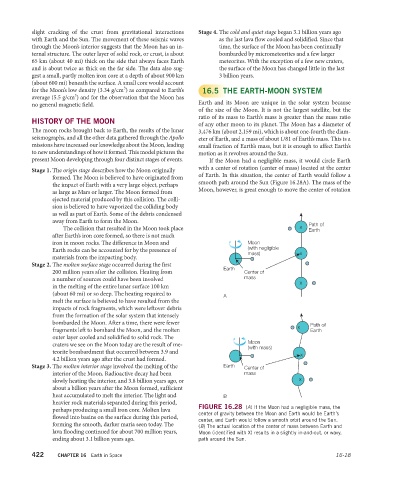
                   present Moon developing through four distinct stages of events.  If the Moon had a negligible mass, it would circle Earth
                                                                          with a center of rotation (center of mass) located at the center
                   Stage 1.  The origin stage describes how the Moon originally
                                                                          of Earth. In this situation, the center of Earth would follow a
                          formed. The Moon is believed to have originated from
                                                                          smooth path around the Sun (Figure 16.28A). The mass of the
                          the impact of Earth with a very large object, perhaps
                                                                          Moon, however, is great enough to move the center of rotation
                          as large as Mars or larger. The Moon formed from
                          ejected material  produced by this collision. The colli-
                          sion is believed to have  vaporized the colliding body
                          as well as part of Earth. Some of the debris condensed
                          away from Earth to form the Moon.                                                   Path of
                             The collision that resulted in the Moon took place                            x  Earth
                         after Earth’s iron core formed, so there is not much
                         iron in moon rocks. The difference in Moon and                   Moon
                         Earth rocks can be accounted for by the presence of              (with negligible  x
                                                                                          mass)
                         materials from the impacting body.
                   Stage 2.  The molten surface stage occurred during the first   Earth
                          200 million years after the collision. Heating from            Center of
                          a number of sources could have been involved                   mass              x
                          in the melting of the entire  lunar surface 100 km
                          (about 60 mi) or so deep. The heating  required to      A
                          melt the surface is believed to have resulted from the
                          impacts of rock fragments, which were leftover debris
                          from the formation of the solar system that intensely
                          bombarded the Moon. After a time, there were fewer                               x   Path of
                          fragments left to bombard the Moon, and the molten                                   Earth
                          outer layer cooled and solidified to solid rock. The
                          craters we see on the Moon today are the result of me-          Moon
                                                                                          (with mass)
                          teorite bombardment that occurred between 3.9 and                                 x
                          4.2 billion years ago after the crust had formed.
                   Stage 3.  The molten interior stage involved the melting of the   Earth  Center of
                          interior of the Moon. Radioactive decay had been               mass
                          slowly heating the interior, and 3.8 billion years ago, or                       x
                          about a billion years  after the Moon formed, sufficient
                          heat accumulated to melt the interior. The light and    B
                          heavier rock materials  separated during this period,
                          perhaps producing a small iron core. Molten lava   FIGURE 16.28  (A) If the Moon had a negligible mass, the
                                                                          center of gravity between the Moon and Earth would be Earth’s
                          flowed into basins on the surface during this period,
                                                                          center, and Earth would follow a smooth orbit around the Sun.
                          forming the smooth, darker maria seen today. The   (B) The actual location of the center of mass between Earth and
                          lava flooding continued for about 700 million years,   Moon (identified with X) results in a slightly in-and-out, or wavy,
                          ending about 3.1 billion years ago.             path around the Sun.

                   422     CHAPTER 16  Earth in Space                                                                  16-18

