


Page 442 - 9780077418427.pdf
P. 442
/Users/user-f465/Desktop
          tiL12214_ch16_405-432.indd Page 419  9/3/10  6:19 PM user-f465
          tiL12214_ch16_405-432.indd Page 419  9/3/10  6:19 PM user-f465                                                /Users/user-f465/Desktop


                                                              Additional turn  from Earth. A total of 12 Apollo astronauts walked on the Moon,
                                                              required to      taking thousands of photographs, conducting hundreds of
                                                              show same side
                                                              to Earth         experiments, and returning to Earth with over 380 kg (about
                                                                                 840 lb) of moon rocks (Table 16.1). In addition, instruments
                                                       Moon one                were left on the Moon that continued to radio data back to
                                                       synodic month later
                                                                               Earth after the Apollo program ended in 1972. As a result of
                                                                               the Apollo missions, many questions were answered about the
                                                                               Moon, but unanswered questions still remain.
                                                                                  Unmanned missions to the Moon have returned data about
                                                                               mineral composition, topography, the presence of water, and
                           Sun                   Earth    Moon
                                                                               other important information. In 1994, the spacecraft Clemen-
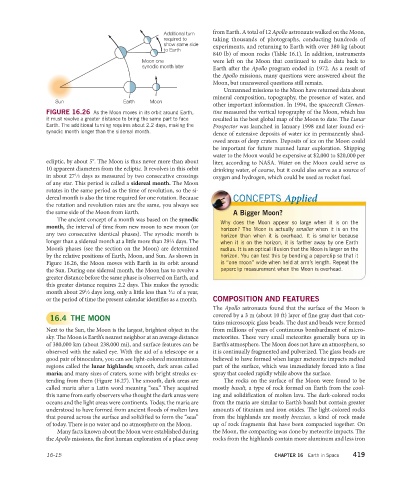
                       FIGURE 16.26  As the Moon moves in its orbit around Earth,   tine measured the vertical topography of the Moon, which has
                       it must revolve a greater distance to bring the same part to face   resulted in the best global map of the Moon to date. The Lunar
                       Earth. The additional turning requires about 2.2 days, making the   Prospector was launched in January 1998 and later found evi-
                       synodic month longer than the sidereal month.
                                                                               dence of extensive deposits of water ice in permanently shad-
                                                                               owed areas of deep craters. Deposits of ice on the Moon could
                                                                               be important for future manned lunar exploration. Shipping
                                                                               water to the Moon would be expensive at $2,000 to $20,000 per
                       ecliptic, by about 5°. The Moon is thus never more than about   liter, according to NASA. Water on the Moon could serve as
                       10 apparent diameters from the ecliptic. It revolves in this orbit   drinking water, of course, but it could also serve as a source of
                                 1
                       in about 27 ⁄3 days as measured by two consecutive crossings   oxygen and hydrogen, which could be used as rocket fuel.
                       of any star. This  period is called a sidereal month. The Moon
                         rotates in the same period as the time of revolution, so the si-
                       dereal month is also the time required for one rotation. Because   CONCEPTS Applied
                       the rotation and revolution rates are the same, you always see
                       the same side of the Moon from Earth.                         A Bigger Moon?
                           The ancient concept of a month was based on the synodic   Why does the Moon appear so large when it is on the
                       month, the interval of time from new moon to new moon (or   horizon? The Moon is actually  smaller when it is on the
                       any two consecutive identical phases). The synodic month is   horizon than when it is overhead. It is smaller because
                       longer than a sidereal month at a little more than 29 ⁄2 days. The   when it is on the horizon, it is farther away by one Earth
                                                                1
                       Moon’s phases (see the section on the Moon) are determined   radius. It is an  optical illusion that the Moon is larger on the
                       by the relative positions of Earth, Moon, and Sun. As shown in   horizon. You can test this by bending a paperclip so that it
                       Figure 16.26, the Moon moves with Earth in its orbit around   is “one moon” wide when held at arm’s length. Repeat the
                       the Sun. During one sidereal month, the Moon has to revolve a   paperclip measurement when the Moon is overhead.
                       greater distance before the same phase is observed on Earth, and
                       this greater distance requires 2.2 days. This makes the synodic
                                    1
                                                                1
                       month about 29 ⁄2 days long, only a little less than  ⁄12 of a year,
                       or the period of time the present calendar identifies as a month.  COMPOSITION AND FEATURES
                                                                               The Apollo astronauts found that the surface of the Moon is
                                                                               covered by a 3 m (about 10 ft) layer of fine gray dust that con-
                         16.4 THE MOON
                                                                               tains microscopic glass beads. The dust and beads were formed
                       Next to the Sun, the Moon is the largest, brightest object in the   from millions of years of continuous bombardment of micro-
                       sky. The Moon is Earth’s nearest neighbor at an average distance   meteorites. These very small meteorites generally burn up in
                       of 380,000 km (about 238,000 mi), and surface features can be   Earth’s atmosphere. The Moon does not have an atmosphere, so
                       observed with the naked eye. With the aid of a telescope or a   it is continually fragmented and pulverized. The glass beads are
                       good pair of binoculars, you can see light-colored mountainous   believed to have formed when larger meteorite impacts melted
                       regions called the lunar highlands; smooth, dark areas called   part of the surface, which was immediately forced into a fine
                       maria; and many sizes of craters, some with bright streaks ex-  spray that cooled rapidly while above the surface.
                       tending from them (Figure 16.27). The smooth, dark areas are   The rocks on the surface of the Moon were found to be
                       called maria after a Latin word meaning “sea.” They acquired   mostly basalt, a type of rock formed on Earth from the cool-
                       this name from early observers who thought the dark areas were   ing and solidification of molten lava. The dark-colored rocks
                       oceans and the light areas were continents. Today, the maria are   from the maria are similar to Earth’s basalt but contain greater
                       understood to have formed from ancient floods of molten lava   amounts of titanium and iron oxides. The light- colored rocks
                       that poured across the surface and solidified to form the “seas”   from the highlands are mostly breccias, a kind of rock made
                       of today. There is no water and no atmosphere on the Moon.  up of rock fragments that have been compacted together. On
                           Many facts known about the Moon were established during   the Moon, the compacting was done by meteorite impacts. The
                       the Apollo missions, the first human exploration of a place away   rocks from the highlands contain more aluminum and less iron

                       16-15                                                                       CHAPTER 16  Earth in Space   419

