


Page 456 - 9780077418427.pdf
P. 456
/Users/user-f465/Desktop
          tiL12214_ch17_433-454.indd Page 433  9/3/10  6:20 PM user-f465
          tiL12214_ch17_433-454.indd Page 433  9/3/10  6:20 PM user-f465                                                /Users/user-f465/Desktop


                                                                                                               EARTH SCIENCE


                                                                              17                  Rocks and


                                                                              17 Minerals


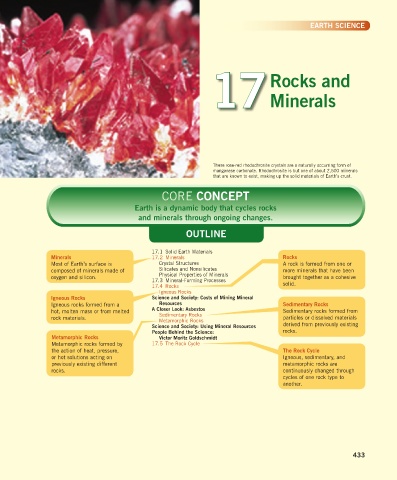
                                                                               These rose-red rhodochrosite crystals are a naturally occurring form of
                                                                                 manganese carbonate. Rhodochrosite is but one of about 2,500 minerals
                                                                               that are known to exist, making up the solid materials of Earth’s crust.


                                                              CORE CONCEPT

                                                     Earth is a dynamic body that cycles rocks
                                                      and minerals through ongoing changes.

                                                                      OUTLINE


                                                          17.1  Solid Earth Materials
                         Minerals                         17.2 Minerals                               Rocks
                         Most of Earth’s surface is          Crystal Structures                       A rock is formed from one or
                         composed of minerals made of        Silicates and Nonsilicates               more minerals that have been
                                                             Physical Properties of Minerals
                         oxygen and silicon.                                                          brought together as a cohesive
                                                          17.3 Mineral-Forming Processes
                                                          17.4 Rocks                                  solid.
                                                             Igneous Rocks
                         Igneous Rocks                    Science and Society: Costs of Mining  Mineral
                         Igneous rocks formed from a         Resources                                Sedimentary Rocks
                         hot, molten mass or from melted   A Closer Look: Asbestos                    Sedimentary rocks formed from
                                                             Sedimentary Rocks
                         rock materials.                                                              particles or dissolved materials
                                                               Metamorphic Rocks
                                                          Science and Society: Using Mineral Resources  derived from previously existing
                                                          People Behind the Science:                  rocks.
                         Metamorphic Rocks                   Victor Moritz Goldschmidt
                         Metamorphic rocks formed by        17.5  The Rock Cycle
                         the action of heat, pressure,                                                The Rock Cycle
                         or hot solutions acting on                                                   Igneous, sedimentary, and
                         previously existing different                                                metamorphic rocks are
                         rocks.                                                                       continuously changed through
                                                                                                      cycles of one rock type to
                                                                                                      another.


                                                                                                                             433

