


Page 461 - 9780077418427.pdf
P. 461
/Users/user-f465/Desktop
          tiL12214_ch17_433-454.indd Page 438  9/3/10  6:20 PM user-f465
          tiL12214_ch17_433-454.indd Page 438  9/3/10  6:20 PM user-f465                                                /Users/user-f465/Desktop


                                                       Oxygen
                                                     Silicon

                                    Tetrahedron
                                    structure
                       A


                       B                              C                             D
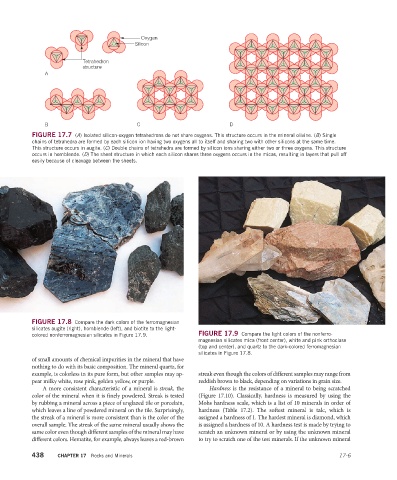
                   FIGURE 17.7  (A) Isolated silicon-oxygen tetrahedrons do not share oxygens. This structure occurs in the mineral olivine. (B) Single
                   chains of tetrahedra are formed by each silicon ion having two oxygens all to itself and sharing two with other silicons at the same time.
                   This structure occurs in augite. (C) Double chains of tetrahedra are formed by silicon ions sharing either two or three oxygens. This structure
                     occurs in hornblende. (D) The sheet structure in which each silicon shares three oxygens occurs in the micas, resulting in layers that pull off
                   easily because of cleavage between the sheets.


                   FIGURE 17.8  Compare the dark colors of the ferromagnesian
                   silicates augite (right), hornblende (left), and biotite to the light-
                   colored nonferromagnesian silicates in Figure 17.9.    FIGURE 17.9  Compare the light colors of the nonferro-
                                                                          magnesian silicates mica (front center), white and pink orthoclase
                                                                          (top and center), and quartz to the dark-colored ferromagnesian
                                                                          silicates in Figure 17.8.
                   of small amounts of chemical impurities in the mineral that have
                   nothing to do with its basic composition. The mineral quartz, for
                   example, is colorless in its pure form, but other  samples may ap-  streak even though the colors of different samples may range from
                   pear milky white, rose pink, golden  yellow, or purple.  reddish brown to black, depending on variations in grain size.
                      A more consistent characteristic of a mineral is streak, the   Hardness is the resistance of a mineral to being scratched
                   color of the mineral when it is finely powdered. Streak is tested    (Figure 17.10). Classically, hardness is measured by using the
                   by rubbing a mineral across a piece of unglazed tile or porcelain,   Mohs hardness scale, which is a list of 10 minerals in order of
                   which leaves a line of powdered mineral on the tile. Surprisingly,   hardness (Table 17.2). The softest mineral is talc, which is
                   the streak of a mineral is more consistent than is the color of the     assigned a hardness of 1. The hardest mineral is diamond, which
                   overall sample. The streak of the same mineral usually shows the   is assigned a hardness of 10. A hardness test is made by trying to
                   same color even though different samples of the  mineral may have   scratch an unknown mineral or by using the unknown mineral
                   different colors. Hematite, for example, always leaves a red-brown   to try to scratch one of the test minerals. If the unknown mineral

                   438     CHAPTER 17  Rocks and Minerals                                                               17-6

