


Page 460 - 9780077418427.pdf
P. 460
/Users/user-f465/Desktop
          tiL12214_ch17_433-454.indd Page 437  9/3/10  6:20 PM user-f465
          tiL12214_ch17_433-454.indd Page 437  9/3/10  6:20 PM user-f465                                                /Users/user-f465/Desktop


                         TABLE 17.1

                         Classification scheme of some common minerals
                                                                         MINERALS

                                             Silicates                                               Nonsilicates

                                                                                          Carbonates           Sulfates
                                  Ferromagnesian                     Clay Minerals       Calcite               Gypsum
                                                                                         Dolomite              Anhydrite
                                  Biotite                            Kaolinite
                                  Hornblende                         Illite
                                  Augite                             Chlorite             Oxides               Sulfides
                                  Olivine                                                Hematite              Pyrite
                                                  Nonferromagnesian                      Magnetite             Sphalerite
                                                  Quartz                                 Ilmenite              Galena
                                                  Muscovite (white mica)                 Aluminum oxides       Chalcopyrite
                                                  Feldspars (aluminum silicates)
                                                   Plagioclase                            Phosphates           Halides
                                                      (sodium feldspar)
                                                      (calcium feldspar)                 Apatite               Halite
                                                    Orthoclase (potassium feldspar)                            Fluorite


                                                                                                    Native Elements
                                                                                                      Gold
                                                                                                      Silver
                                                                                                      Copper
                                                                                                      Diamonds
                                                                                                      Sulfur


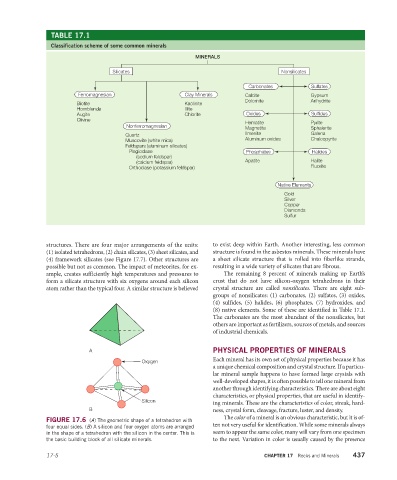
                       structures. There are four major arrangements of the units:   to exist deep within Earth. Another interesting, less common
                         (1) isolated tetrahedrons, (2) chain silicates, (3) sheet silicates, and   structure is found in the asbestos minerals. These minerals have
                       (4) framework silicates (see Figure 17.7). Other structures are   a sheet silicate structure that is  rolled into fiberlike strands,
                       possible but not as common. The impact of  meteorites, for ex-    resulting in a wide variety of  silicates that are fibrous.
                       ample, creates sufficiently high temperatures and pressures to   The remaining 8 percent of minerals making up Earth’s
                       form a silicate structure with six  oxygens around each silicon   crust that do not have silicon-oxygen tetrahedrons in their
                       atom rather than the typical four. A similar structure is believed     crystal structure are called  nonsilicates. There are eight sub-
                                                                               groups of nonsilicates: (1) carbonates, (2) sulfates, (3) oxides,
                                                                               (4) sulfides, (5) halides, (6) phosphates,  (7) hydroxides, and
                                                                               (8) native  elements. Some of these are  identified in Table 17.1.
                                                                               The carbonates are the most abundant of the  nonsilicates, but
                                                                               others are important as  fertilizers, sources of metals, and  sources
                                                                               of industrial chemicals.


                                      A                                        PHYSICAL PROPERTIES OF MINERALS
                                                       Oxygen                  Each mineral has its own set of physical properties because it has
                                                                               a unique chemical composition and crystal structure. If a particu-
                                                                               lar mineral sample happens to have formed large crystals with
                                                                               well-developed shapes, it is often possible to tell one mineral from
                                                                               another through identifying characteristics. There are about eight
                                                                               characteristics, or physical properties, that are useful in identify-
                                                       Silicon
                                                                               ing minerals. These are the characteristics of color, streak, hard-
                                      B                                        ness, crystal form, cleavage, fracture, luster, and density.
                                                                                  The color of a mineral is an obvious characteristic, but it is of-
                         FIGURE 17.6  (A) The geometric shape of a tetrahedron with
                       four equal sides. (B) A silicon and four oxygen atoms are arranged   ten not very useful for identification. While some minerals  always
                       in the shape of a tetrahedron with the silicon in the center. This is   seem to appear the same color, many will vary from one specimen
                       the basic building block of all silicate minerals.      to the next. Variation in color is usually caused by the presence

                       17-5                                                                     CHAPTER 17  Rocks and Minerals   437

